Affiliate disclosure: some links on this page go to Amazon. If you buy through one we may earn a small commission, at no extra cost to you. Full disclosure.
Autumn is preparation, not feeding. Use October to deep-clean every feeder, restock food, get nest boxes up, and resist tidying the borders. Seeds and peanuts go back out on 1 November, and a garden that’s ready on the day is far more use than one you’re still sorting out in December.
There’s a specific reason autumn matters more than it used to. Current RSPB guidance pauses seed and peanut feeding between 1 May and 31 October — which makes October a genuine changeover month rather than just a slow slide into winter.
Everything below can be done in an afternoon or two, and it means that when the weather turns, your garden is already working.
The autumn jobs
- Deep-clean every feeder — they’ve been stored or lightly used since May
- Buy food now, before the cold-snap rush
- Put nest boxes up — autumn is the best time, not spring
- Clean out old nest boxes — September to January only
- Don’t cut the borders back — seed heads feed finches all winter
- Sort out water before the first frost
1. Deep-clean everything (late October)
The single most important job, and the one most likely to be skipped.
If you’ve followed the seasonal guidance, your seed and peanut feeders have been down since May. Feeders that have sat in a shed for five months need more than a rinse — residue dries hard, and any that went away dirty have had a long time to get worse.
The method: dismantle completely, scrub in hot soapy water with a brush that reaches inside the tube, disinfect with a non-toxic product such as Ark-Klens or a mild 5% bleach solution, rinse thoroughly, and dry completely before storing or refilling.
Pay attention to the feeding ports and perches — that’s where beaks make contact and where disease transmission is most likely. Our cleaning guide covers it in full.
Check for damage while you’re at it
Autumn is when you find out that last winter’s frost cracked something. Look for:
- Crazed or brittle plastic, which will fail in the first hard frost
- Chewed ports where squirrels have been at it
- Perches that have worked loose
- Seed trays still attached — worth removing, since flat surfaces are no longer recommended
- Anything that won’t come apart properly for cleaning
Replace now rather than in December, when you’ll be doing it in the cold and the good ones are out of stock.
2. Buy food before you need it
Bird food sells hard from November, and prices and availability both move when a cold snap hits the news.
What to stock:
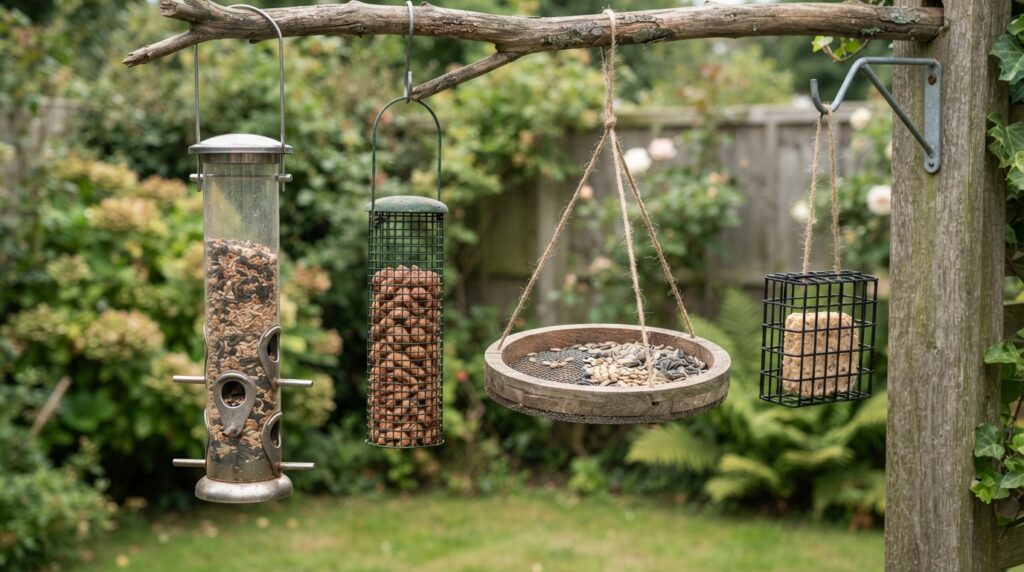
- Sunflower hearts — the one to buy in quantity. No husk, so no waste and far less rat interest
- Suet or fat balls — highest calorie option, and approved year-round. Buy loose, never in netting
- Peanuts — mesh feeder only, and only aflatoxin-free ones sold for wild birds
- Nyjer — only if you specifically want goldfinches
Buy what you’ll use in a season, not the biggest sack available. Seed degrades, and 20kg going stale in a damp shed is a false economy. Store it in a sealed metal bin — rats chew straight through paper sacks and thin plastic, and a food store is a far better prize than a handful of spillage under a feeder.
3. Put nest boxes up now
Counterintuitive, and worth doing.
Autumn is the best time to install a nest box, not spring. Two reasons: birds use boxes as winter roost sites on cold nights, and a box that’s been in place for months looks established rather than newly arrived when the breeding season comes round.
A blue tit that has spent January nights in your box is considerably more likely to nest in it in April.
The essentials: 25mm hole for blue tits, 28mm for great tits, 32mm for house sparrows, open-fronted and well hidden for robins. Face it between north and east, 2–4m up, tilted very slightly forward.
Full detail in our nest box guide.
Clean out last year’s boxes
Timing matters legally here. Nest boxes may only be cleaned between 1 September and 31 January. Outside that window it’s an offence to disturb nesting birds under the Wildlife and Countryside Act 1981.
Check the box is genuinely empty, remove old nesting material, and scald the inside with boiling water to kill parasites. Don’t use insecticides or chemical cleaners. Let it dry fully, then add a small handful of clean wood shavings — not straw or hay — to encourage winter roosting.
4. Leave the borders alone
The easiest job on this list, because it involves not doing something.
The instinct to cut everything back in October removes months of food. Standing seed heads feed goldfinches, greenfinches and siskins right through winter — and they matter more now, because they’re a natural food source with none of the disease transmission risk that shared feeders carry.
Leave standing until late February or March:
- Teasel — the classic goldfinch plant
- Sunflower heads, left on the plant rather than cut
- Knapweed, scabious, cornflower
- Lavender seed heads
- Michaelmas daisies and evening primrose
- Ornamental grasses
A border left standing also looks genuinely good in frost, which is a fair trade for a slightly untidy November.
Our plants guide covers what to add if you’re planting this autumn.
5. Sort out water before the frost
Water is scarce in freezing weather and birds need it for drinking and, just as importantly, for bathing — clean feathers are what keeps them insulated.
Before winter:
- Check your bird bath isn’t cracked from last year
- Consider moving it somewhere sunnier for winter, so it freezes later
- If it’s stone or ceramic and not frost-proof, plan to empty it before hard frosts or swap to a plastic one
- Line it with a plastic sheet or tray so ice can be lifted out in one piece
Never add antifreeze, salt, glycerine or oil to stop a bird bath freezing. All are harmful — antifreeze is lethal, salt damages kidneys and destroys feather waterproofing. Warm (not boiling) water and a floating ball are the safe methods.
Remember the standing rule: only offer water if you can change it daily, using fresh tap water. Our bird bath guide has the detail.
6. Plan where feeders will go
Worth thinking about before you hang anything, because placement affects everything.
- About 2m from cover — close enough for birds to escape into, far enough that a cat can’t ambush from it
- Around 1.5m off the ground
- 3m from any squirrel launch point — fence, shed roof, branch, bench
- Some shelter from prevailing wind and rain, which keeps seed dry
- Not directly beneath branches birds roost on
- Spread multiple feeders out rather than clustering them — this reduces crowding and is now actively recommended
- Either within 1m of a window, or beyond 10m — the middle distance is where birds build up enough speed to injure themselves on the glass
7. Clear the ground beneath
Rake or sweep up accumulated husks, dropped seed and droppings from where feeders hung over summer. That material is a disease reservoir, and clearing it is part of why current guidance asks you to move feeders to a fresh spot after each weekly clean.
It also removes what attracts rats before the winter feeding season starts.
The autumn timetable
| When | Job |
|---|---|
| September | Clean out old nest boxes. Put up new ones. Start leaving seed heads standing |
| Early October | Deep-clean all feeders. Check for damage, replace what’s failed |
| Mid October | Buy and store food. Sort out water and the bird bath |
| Late October | Clear the ground beneath feeder positions. Decide placements |
| 1 November | Seeds and peanuts go back out. Weekly cleaning starts again |
Common questions
Can I start feeding seeds before 1 November?
Current guidance sets the date, and it’s calendar-based rather than weather-based — it reflects when disease risk falls, not when it gets cold. A chilly October doesn’t move it. Suet, fat balls and mealworms are fine throughout in small amounts.
Why is my garden so quiet in September?
Natural food is at its most abundant, and birds are finishing their moult. It’s normal and not a sign anything’s wrong. See our guide on why birds stop coming to feeders.
Should I take feeders down completely over summer?
Seed and peanut feeders, yes — cleaned and stored. A suet cage can stay up year-round with smaller quantities, since suet remains approved.
Is it too late to plant for birds in autumn?
Autumn is actually the best planting season for shrubs and trees — the soil is still warm and roots establish before spring. Hawthorn, holly, rowan and pyracantha are all good choices.
What if I find a nest in a box I’m cleaning?
If it’s genuinely finished and empty, remove the material. If there’s any sign of current occupation, close it up and leave it — late broods do happen, and disturbing an active nest is an offence.
Related guides
- When to feed garden birds: the new UK guidance explained
- How to clean a bird feeder — and why it now matters more
- When to put up a nest box (and exactly where to site it)
- Best bird food for winter: what to put out and what to skip
Sources: RSPB feeding and hygiene guidance (April 2026); RSPB nest box guidance; British Trust for Ornithology; Wildlife and Countryside Act 1981.
Compare current prices on bird food and feeders at Amazon UK. Prices and stock change often, so it is worth checking before you commit.
Browse bird food →