Affiliate disclosure: some links on this page go to Amazon. If you buy through one we may earn a small commission, at no extra cost to you. Full disclosure.
Robins eat insects, worms, spiders and other invertebrates for most of the year, switching to berries, fruit and seeds when insects are scarce in winter. If you want to feed them, mealworms are the single most effective thing to offer — followed by suet, sunflower hearts and mild grated cheese.
There’s a useful practical point buried in that: mealworms and suet are among the few foods that stay recommended all year under the current UK feeding guidance, while seeds and peanuts pause between May and October. Robins are one of the easiest garden birds to keep feeding through the summer.
Robin quick facts
- Best foods: mealworms, suet, sunflower hearts, mild grated cheese
- Feeds: at or near ground level — poor at clinging to hanging feeders
- Males and females: look identical. Both have the red breast
- Present: all year round
- Sings: through the winter, unusually for a British bird
What robins eat naturally
A robin is primarily an insect eater, and its fine, pointed bill is built for the job rather than for cracking seeds.
Spring and summer: earthworms, beetles, caterpillars, spiders, ants, flies. Almost entirely invertebrates. During the breeding season, adults need a great deal of protein to feed their chicks.
Autumn and winter: as insects become scarce, robins shift to berries — hawthorn, holly, ivy, rowan, elder — plus windfall fruit and, reluctantly, seeds. This is when garden feeding genuinely matters to them.
The famous habit of following gardeners around comes directly from this diet. In woodland, robins follow wild boar and deer, taking invertebrates from disturbed ground. A person with a spade is doing the same job.
The best foods to put out
Mealworms — the top choice
Nothing else comes close for robins. High in protein, close to their natural diet, and taken readily.
Dried or live? Live mealworms are more nutritious and more enthusiastically taken, but most people find dried far more practical. Dried mealworms soaked in water for twenty minutes before putting out are a good compromise — the moisture content matters, especially in the breeding season and in dry weather.
How to offer them: in a small shallow dish at or near ground level. Put out a modest amount and make sure it’s all eaten or cleared away by dusk — leftovers attract rodents and, on a permanent flat surface, can contribute to disease spread.
Suet and fat
High-calorie and valuable in cold weather. Robins can’t cling to a fat ball cage well, but they’ll happily take fragments that fall beneath one — so hanging a suet feeder above a clear patch of ground feeds them indirectly.
Suet pellets scattered in small quantities work directly.
Sunflower hearts
Robins will take these, though they’re not a natural first choice. The hearts (husk removed) are much easier for them than whole sunflower seeds, which they struggle to open.
Mild grated cheese
A traditional and genuinely effective robin food. Mild cheddar, finely grated, in small amounts. Avoid anything strong or salty.
What not to give robins
- Bread — fills them up with almost no nutritional value
- Salted or roasted nuts — salt is harmful to small birds
- Desiccated coconut — swells inside the bird
- Milk — birds can’t digest lactose
- Anything mouldy
How robins prefer to feed
This is where robins differ from most feeder birds and where a lot of people go wrong.
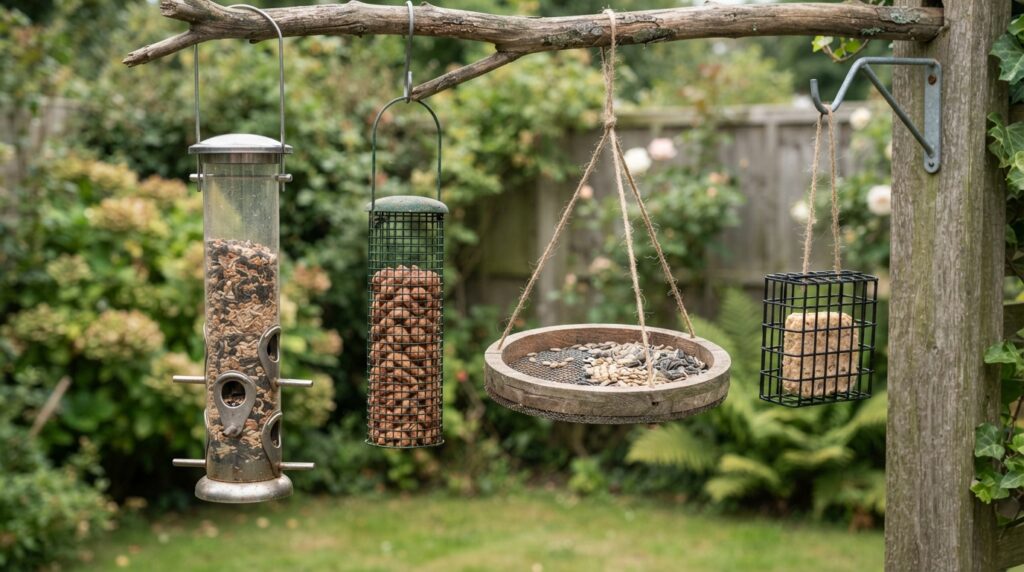
Robins are not good at hanging feeders. They lack the clinging ability of tits and finches. Watch a robin attempt a tube feeder and it will usually give up and wait underneath for spillage.
They feed at ground level or from low, open positions.
An honest tension worth flagging. Robins prefer open, flat feeding surfaces — which is exactly what current guidance now advises against, because flat surfaces where food accumulates spread disease.
The workable middle ground: use a small dish with a modest quantity, cleared and cleaned daily, rather than a permanent bird table or tray. Scatter small amounts on the ground in a different spot each time. The principle is avoiding a fixed surface where damp food and droppings build up — not preventing ground-feeding birds from eating at ground level, which is simply what they do.
Why robins are so tame
British robins are noticeably bolder around people than robins elsewhere in Europe, where they tend to be shy woodland birds.
The usual explanation is historical: in Britain, robins have long associated humans with disturbed ground and easy food, and haven’t been hunted. On the continent, small birds were more widely trapped, and robins there remain wary.
Individual robins can become genuinely tame, taking mealworms from a hand with patience. It takes weeks of consistency, always in the same spot at the same time.
Robin behaviour
Territorial year-round
Most British birds hold territory only in the breeding season. Robins hold it all year, and defend it aggressively — including against other robins. The red breast is a warning signal, and disputes between males can be serious.
This is also why you generally see one robin in a garden, not a group. Two robins together outside the breeding season usually means you’re looking at a territory boundary.
Winter song
Robins sing through the winter, which almost no other British bird does. Both males and females sing in winter, each holding separate territory. The winter song is often described as thinner and more melancholy than the spring song.
Robins also sing at night, particularly in towns — street lighting is the usual cause. A bird singing at 2am is far more likely to be a robin than a nightingale.
Nesting
Robins nest low and in odd places — ivy, dense shrubs, banks, and famously in sheds, watering cans, plant pots and coat pockets left in outbuildings.
Legal note: in the UK it is an offence under the Wildlife and Countryside Act 1981 to intentionally damage or destroy an active nest, or disturb nesting birds. If you find a robin nesting somewhere inconvenient, you need to leave it until the young have fledged.
Robins typically raise two or three broods a season, from around April onward.
How to attract robins to your garden
- Offer mealworms in a small ground-level dish, consistently, at the same time each day
- Provide low cover — dense shrubs and hedges near the feeding spot
- Provide low perches — robins like to watch from a metre or so up before dropping down
- Water — a shallow dish, changed daily with fresh tap water
- Turn some soil over — robins genuinely will come to freshly dug ground
- Avoid insecticides — you’re removing their main food source
- Leave some leaf litter — it holds the invertebrates robins forage for
- Consider an open-fronted nest box — robins won’t use a standard hole-fronted box. They need the open-fronted type, placed low and well hidden in vegetation
Identifying a robin
Adults: orange-red breast and face, brown-olive upperparts, pale belly. About 14cm.
Males and females: identical. There’s no reliable way to tell them apart visually — a very widespread misconception is that only males have the red breast.
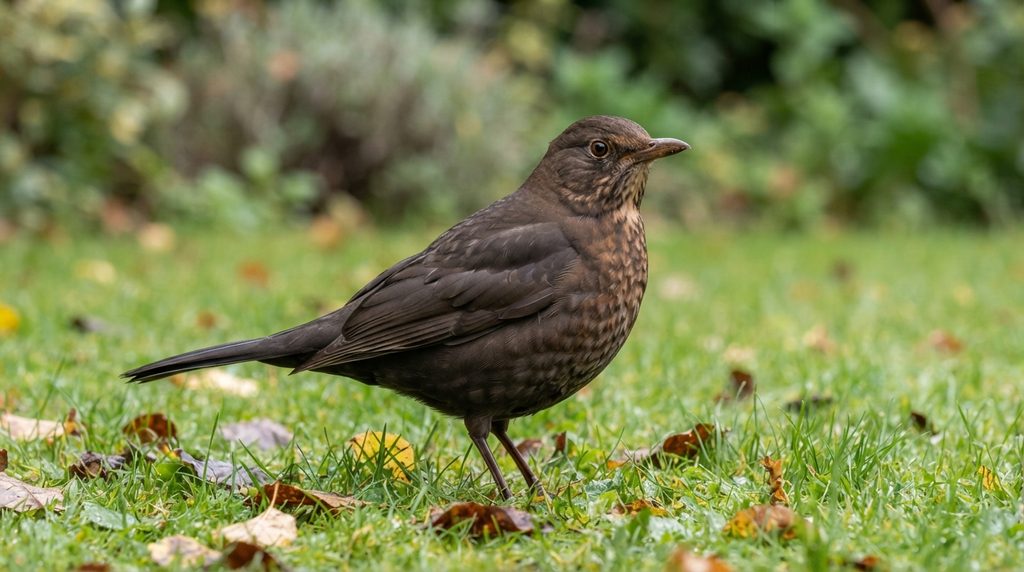
Juveniles: completely different. Warm brown, heavily mottled and spotted, with no red at all. They develop the red breast at their first moult, in late summer. Young robins are frequently mistaken for a different species entirely, or confused with dunnocks — the giveaway is the upright, alert robin posture and the stumpy tail on newly fledged birds.
Common questions
Do robins mate for life?
Not reliably. Pairs form for a breeding season and may re-form the following year if both survive and hold adjacent territories, but robins have a high annual mortality rate and lifelong pairing is not the norm.
How long do robins live?
Typically only a year or two, with high first-year mortality. Individuals that survive their first winter can live considerably longer — ringed birds have reached eight years and beyond, but that’s exceptional.
Why is a robin attacking my window?
It’s seeing its reflection and interpreting it as a rival in its territory. Common in spring. Breaking up the reflection from the outside — netting, decals, or something to reduce the mirroring — usually stops it. It generally passes once the breeding season settles.
Are robins really that aggressive?
Between themselves, yes. Territorial disputes between male robins can be genuinely violent and are a significant cause of adult mortality. Towards people and other species, they’re bold rather than aggressive.
Is the same robin visiting every day?
Very likely. Robins hold small year-round territories and a garden usually falls within one bird’s patch. If you’re seeing a robin daily in the same spot, it’s almost certainly the same individual.
Can I feed robins in summer?
Yes. Mealworms and suet remain recommended year-round under current guidance — it’s seeds and peanuts that pause between 1 May and 31 October. See our seasonal feeding guide.
Related guides
- Common garden birds in the UK: how to identify your visitors
- When to feed garden birds: the new UK guidance explained
- Best bird food for winter: what to put out and what to skip
- Small brown birds in your garden: how to tell them apart
Sources: RSPB species information and feeding guidance; British Trust for Ornithology; Woodland Trust; Wildlife and Countryside Act 1981.
Compare dried mealworms at Amazon UK. Prices and stock change often, so it is worth checking before you commit.
Browse mealworms →