Affiliate disclosure: some links on this page go to Amazon. If you buy through one we may earn a small commission, at no extra cost to you. We haven’t personally tested every product mentioned — where that’s the case our assessment is based on ingredients, specifications and how the product compares to alternatives, and we say so. Full disclosure.
If you want one answer: sunflower hearts. They’re taken by almost every UK garden bird, they’re high in oil and energy, and because the husk is already removed there’s no waste on the ground. If you buy nothing else, buy those.
But different birds want different things, and some widely sold products are worth avoiding entirely. Here’s what actually helps.
The short version
- Best all-rounder: sunflower hearts
- Highest energy: suet and fat balls — and the only option that stays approved year-round
- For goldfinches: nyjer seed (needs a specialist feeder)
- For robins and blackbirds: mealworms
- Avoid: bread, salted nuts, desiccated coconut, milk, cheap filler-heavy mixes
- Season: seeds and peanuts run 1 Nov – 30 Apr under current guidance
Why winter feeding matters
A small bird has very little margin. A blue tit weighs around 11 grams and can lose a significant proportion of its body weight over a single long winter night simply keeping warm.
In December and January, daylight for feeding is short, natural insect food is essentially gone, and the nights are long and cold. That combination is why high-fat, high-calorie foods matter far more in winter than at any other time.
Timing note. Current RSPB guidance is to offer seeds and peanuts between 1 November and 30 April, and to pause them from 1 May to 31 October. Suet, fat balls and mealworms stay fine all year in small amounts. Full detail in our seasonal feeding guide.
The foods, ranked
| Food | Attracts | Feeder needed | Season |
|---|---|---|---|
| Sunflower hearts | Almost everything — tits, finches, sparrows, robins | Tube feeder | Nov–Apr |
| Suet / fat balls | Tits, starlings, woodpeckers, long-tailed tits | Suet cage | Year-round |
| Black sunflower seeds | Finches, tits, sparrows | Tube feeder | Nov–Apr |
| Peanuts | Tits, greenfinches, nuthatches, woodpeckers | Mesh feeder only | Nov–Apr |
| Nyjer seed | Goldfinches, siskins, redpolls | Nyjer feeder | Nov–Apr |
| Mealworms | Robins, blackbirds, wrens | Small dish | Year-round |
| Quality seed mix | Varies with quality | Tube feeder | Nov–Apr |
Sunflower hearts
Sunflower seeds with the husk removed. The best single food you can buy for UK garden birds.
Why they win:
- High in oil and energy
- Taken by an unusually wide range of species — tits, finches, sparrows, and even robins and blackbirds from the ground
- No husk, so no mess beneath the feeder and nothing rotting on the ground
- Easier for smaller birds, which struggle to open whole sunflower seeds
The trade-off: more expensive per kilo than seeds in the husk. But since you’re not paying for husk weight and there’s virtually no waste, the real cost difference is smaller than it appears.
Sunflower hearts from an established UK bird food supplier
If you buy one thing, buy these. The husk is already removed, so birds eat the whole seed and almost nothing reaches the ground — which cuts waste, mess and the spilled food that attracts rats. Quality varies more than price suggests: cheaper hearts often carry a high proportion of broken fragments and fine dust, which clogs feeder ports and goes off faster. Buying from a supplier that specialises in bird food, rather than a generic marketplace seller, is usually the difference. Buy a quantity you’ll get through in a season rather than the biggest sack available, and decant it into a sealed metal bin.
- Taken by almost every UK garden bird, from blue tits to robins
- No husk means no mess beneath the feeder and far less rat interest
- High in oil and energy — the most useful winter food you can offer
- More expensive per kilo than seed in the husk, though there’s virtually no waste
- Cheaper bags can be dusty and full of broken fragments that clog feeder ports
Suet and fat balls
The highest-calorie option available, and the most useful feeder food to own right now — because suet stays recommended year-round while seeds and peanuts pause for six months.
Formats: fat balls, suet blocks, suet pellets. Pellets can go in a standard seed feeder; balls and blocks need a cage.
Taken by: Blue tits, great tits, coal tits, long-tailed tits, starlings, great spotted woodpeckers. Fragments falling below feed robins and blackbirds.
Never leave fat balls in plastic netting. Birds regularly get their beaks and feet trapped in it, causing serious injury. Remove the netting and use a proper cage feeder — or buy loose fat balls sold without it. The RSPB is explicit on this point.
Quality varies a lot. Cheap fat balls are often bulked out with low-value cereal and set in poor-quality fat. Better products use a higher proportion of actual suet and useful ingredients like sunflower hearts, mealworms or insects.
Loose fat balls, sold without netting
The highest-calorie food you can put out, and one of the few that stays recommended through the summer pause. What separates a good fat ball from a poor one is the ratio of actual suet to cereal filler — cheaper products are bulked out with low-value grain set in poor-quality fat, which crumbles in warm weather and offers far less energy. Better ones use a higher suet content with useful additions like sunflower hearts, mealworms or insects mixed through. Buy them loose in a tub or bag rather than individually wrapped in plastic netting, and use a proper cage feeder.
- Highest calorie density of any common bird food
- Approved all year, unlike seeds and peanuts
- Attracts a wide range including long-tailed tits and woodpeckers
- Goes rancid quickly in warm weather — put out smaller amounts in summer
- Cheap versions are mostly cereal filler and worth avoiding
- Never use any sold in netting: birds get beaks and feet trapped in it
Peanuts
High in fat and protein, and a long-standing garden bird staple — with two important conditions.
Buy aflatoxin-free peanuts from a reputable bird food supplier. Poor-quality peanuts can carry aflatoxin, a fungal toxin that kills birds. This is not a theoretical risk. Never use peanuts from the supermarket snack aisle, and never anything salted, roasted or flavoured.
Always use a mesh feeder. Whole peanuts taken away intact can choke chicks if a parent carries one back to the nest. Mesh forces birds to peck fragments instead. Loose peanuts in an open dish are genuinely dangerous.
Peanuts fall under the seasonal pause — 1 November to 30 April only.
Nyjer seed
Tiny black oil-rich seeds, and close to irresistible for goldfinches.
Requires a specialist nyjer feeder with very fine ports — the seed pours straight out of a normal feeder.
Honest assessment: it’s expensive, it appeals to a narrow range of species, and it clogs if it gets damp. Buy it if you specifically want goldfinches, siskins or redpolls. Don’t buy it as a general-purpose food.
Mealworms
High protein, close to the natural diet of insect-eating birds, and — like suet — approved all year round.
Taken by: Robins especially, plus blackbirds, wrens, starlings and dunnocks.
Dried vs live: live are more nutritious and more enthusiastically taken; dried are far more practical. Soaking dried mealworms in water for twenty minutes before putting them out improves their value considerably, particularly in dry weather.
How to offer: a small dish at ground level, in modest amounts, all eaten or cleared by dusk.
Mixed seed — read the ingredients
This is where most money gets wasted.
Cheap mixes are frequently padded with wheat, barley, split peas, lentils and dried rice — bulk ingredients that are cheap by weight and that most garden birds simply will not eat. Birds pick out the few sunflower seeds and flick the rest onto the ground, where it rots and attracts rats and mice.
You end up buying a lot of grain to feed a small number of sunflower seeds.
What a good mix looks like:
- Sunflower hearts or black sunflower seeds as a leading ingredient
- Kibbled or flaked maize
- Millet (genuinely eaten by sparrows and dunnocks)
- Peanut granules
- Possibly suet pellets or dried mealworms
- No whole wheat, split peas, lentils or dried rice near the top of the list
If a mix doesn’t list its ingredients clearly, that’s usually a signal in itself.
What never to put out
| Don’t | Why |
|---|---|
| Bread | Fills birds up with almost no nutritional value. Particularly harmful for chicks. Mouldy bread is worse again |
| Salted or roasted nuts | Birds can’t process salt; small quantities are harmful |
| Desiccated coconut | Swells inside the bird after being eaten |
| Milk | Birds can’t digest lactose |
| Cooked porridge oats | Congeals around the beak and hardens. Raw oats are fine |
| Anything mouldy | Some moulds cause fatal respiratory infections |
| Highly processed leftovers | Too salty and too fatty in the wrong way |
Matching food to birds
| Want to attract | Put out | In |
|---|---|---|
| Blue tits and great tits | Sunflower hearts, peanuts, suet | Tube or mesh feeder, suet cage |
| Goldfinches | Nyjer, sunflower hearts | Nyjer feeder, tube feeder |
| Robins | Mealworms, suet pellets | Small ground-level dish |
| Blackbirds | Mealworms, windfall apples, suet pellets | Ground, scattered in small amounts |
| House sparrows | Sunflower hearts, quality mixed seed | Tube feeder |
| Long-tailed tits | Suet, fat balls | Suet cage |
| Woodpeckers | Peanuts, suet blocks | Mesh feeder, suet cage |
| Starlings | Suet, fat balls | Suet cage |
Buying and storing
Buy quantities you’ll use within a season. Bulk sacks look economical but seed degrades, and a 20kg bag going stale in a damp shed is a false saving.
Store cool, dry and sealed. A lidded plastic or metal bin. Rodents chew straight through paper and thin plastic sacks — and a bird food store is exactly what a rat is looking for.
Check before filling. Any clumping, musty smell or visible mould means bin it.
Feed in moderation. Current guidance is to adjust quantities to demand. Seeds and peanuts should be eaten within one to two days; suet can stay out up to seven. Overfilling means food sitting and spoiling, which is both wasteful and a disease risk.
Don’t forget water
Often more important than food and routinely overlooked. In freezing weather, birds struggle to find drinking water at all — and they need it for bathing too, since clean feathers are what keeps them insulated.
Current guidance: only offer water if you can change it daily, using fresh tap water, and clean the bath weekly. Standing water spreads disease.
Never add antifreeze, salt, glycerine or any other chemical to a bird bath to stop it freezing. All of these are harmful. Float a small ball on the surface, or pour on warm — not boiling — water to melt ice.
Common questions
What’s the single best food if I only buy one thing?
Sunflower hearts. Widest appeal, high energy, no waste.
Is expensive bird food actually better?
Often yes, but read the ingredients rather than the price. A mid-priced mix leading with sunflower hearts beats an expensive one padded with wheat.
How much should I put out?
Enough to be eaten within a day or two. Refill little and often rather than filling to the brim weekly.
Can I feed birds kitchen scraps?
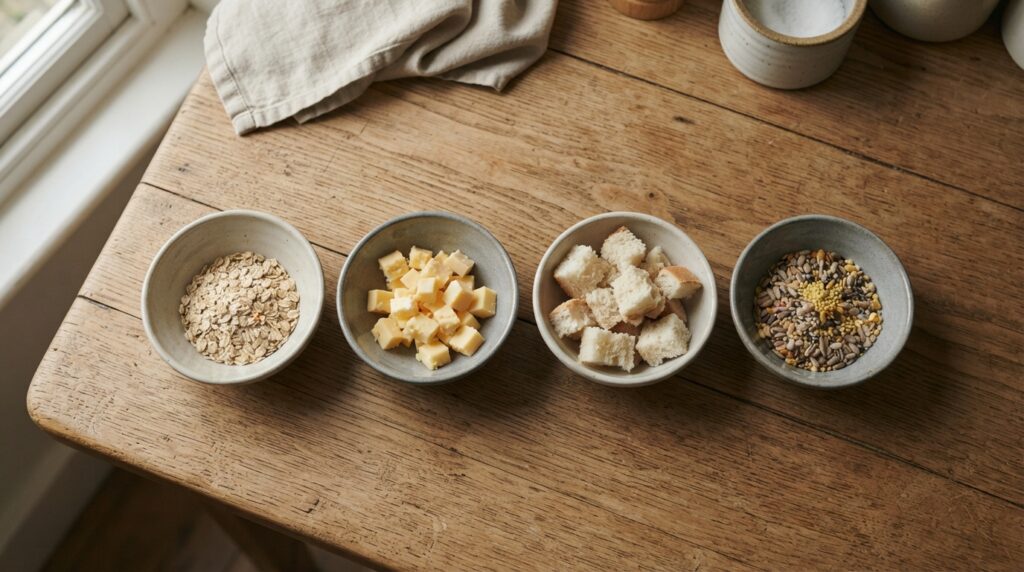
Some things are fine in moderation — mild grated cheese, unsalted cooked potato, windfall fruit, raw porridge oats. Avoid anything salted, processed or mouldy, and don’t scatter more than will be eaten the same day.
Why is bread so bad when birds obviously eat it?
They eat it because it’s easy, not because it’s good for them. It provides bulk with almost no nutritional value, and a bird full of bread has less room for food that would actually help it.
When exactly should I start feeding for winter?
Current guidance puts the seed and peanut window at 1 November to 30 April. Suet and mealworms can continue through October in small amounts.
Related guides
- When to feed garden birds: the new UK guidance explained
- Types of bird feeder: which one should you actually buy?
- How to clean a bird feeder — and why it now matters more
- Common garden birds in the UK: how to identify your visitors
Sources: RSPB feeding guidance (April 2026); British Trust for Ornithology seasonal feeding FAQs; RSPB advice on food types and hygiene. Product assessments are based on ingredients and specifications; we state clearly where we have not tested a product ourselves.
Compare sunflower hearts and suet at Amazon UK. Prices and stock change often, so it is worth checking before you commit.
Browse bird food →