Affiliate disclosure: some links on this page go to Amazon. If you buy through one we may earn a small commission, at no extra cost to you. Full disclosure.
Everything that works comes down to two numbers: a grey squirrel can jump roughly 1.2 metres vertically and up to 3 metres horizontally.
Get your feeder outside that envelope and squirrels physically cannot reach it. Everything else — baffles, caged feeders, weight-activated ports — is a way of achieving the same thing when perfect placement isn’t possible.
What actually works
- Placement — 3m from any launch point, 1.5m off the ground
- Baffles — a cone below a pole, a dome above a hanging feeder
- Caged feeders — mesh that admits small birds, excludes squirrels
- Weight-activated feeders — ports close under a squirrel’s weight
- Smooth metal poles — squirrels can’t grip them
Why it’s worth solving
Beyond the irritation, there are three real costs.
Money. A determined squirrel empties a feeder in a session. If you’re refilling far more often than seems reasonable, that’s where your seed is going.
Damage. Squirrels chew straight through plastic feeders — ports first, then the tube. A cheap plastic feeder in a squirrel garden is a consumable.
The birds. This is the one people underestimate. A squirrel on a feeder physically prevents small birds from using it, and repeated raids deter them from the area. It’s a common answer to why birds have stopped coming to a feeder.
Understanding the opponent
Grey squirrels are exceptional climbers and problem-solvers, and treating this as an engineering problem rather than a battle of wills is what works.
The key figures:
- Vertical jump from the ground: around 1.2m
- Horizontal leap: up to roughly 3m from a raised launch point
- Grip: excellent on wood, bark, rope, brick and textured plastic — poor on smooth metal
- Persistence: effectively unlimited
A “launch point” is anything a squirrel can climb and jump from: a fence, tree branch, shed roof, wall, washing line, water butt, or garden furniture.
1. Placement — free and most effective
Before buying anything, look at where your feeder actually is.
The rule: at least 3 metres horizontally from any launch point, and at least 1.5 metres off the ground.
Walk around the feeder and look for what you’ve missed. Common oversights:
- A fence panel just within range
- An overhanging branch you’d stopped noticing
- A shed or garage roof
- A wheelie bin, water butt or garden bench moved into range
- A washing line running past
- A neighbour’s tree overhanging the boundary
Squirrels find the one route you didn’t think of. If they’re getting there, there’s a path.
The tension: birds want the feeder near cover, ideally about 2m from a shrub. Squirrels want it near anything climbable. The compromise is low cover — shrubs and dense planting a squirrel can’t launch from usefully — rather than trees and fences.
2. Baffles
A physical barrier a squirrel can’t get past. Cheap, and very effective when correctly positioned.
Pole baffles
A cone or cylinder fitted around a pole beneath the feeder. The squirrel climbs, meets a widening surface it can’t grip, and drops off.
Positioning matters: the baffle needs to sit high enough that a squirrel can’t jump over it from the ground — so at least 1.2m up the pole, and ideally higher.
Hanging baffles
A dome fitted above a hanging feeder, blocking the route down from the branch or bracket.
Positioning: the dome must be wide enough that a squirrel can’t reach around it, and the feeder must hang low enough beneath it that it can’t be reached from above.
A squirrel baffle — matched to how your feeder hangs
The most cost-effective thing you can buy, provided you buy the right shape. A dome baffle fits above a hanging feeder and blocks the route down from a branch or bracket; a cone or cylinder baffle fits around a pole and blocks the route up from the ground. They are not interchangeable, and buying the wrong one is the single most common mistake here. Check the diameter — a narrow dome lets a squirrel reach around it — and check what pole widths a cone model fits before ordering. Metal outlasts plastic, which squirrels chew.
- Cheap relative to a squirrel-proof feeder, and genuinely effective when sited correctly
- Also deters cats and rats climbing the same pole
- Works with feeders you already own
- Useless if placement is wrong — a squirrel that can jump across from a fence simply bypasses it
- A pole baffle must sit above 1.2m or a squirrel jumps straight over it
- Dome and cone types are not interchangeable
3. Caged feeders
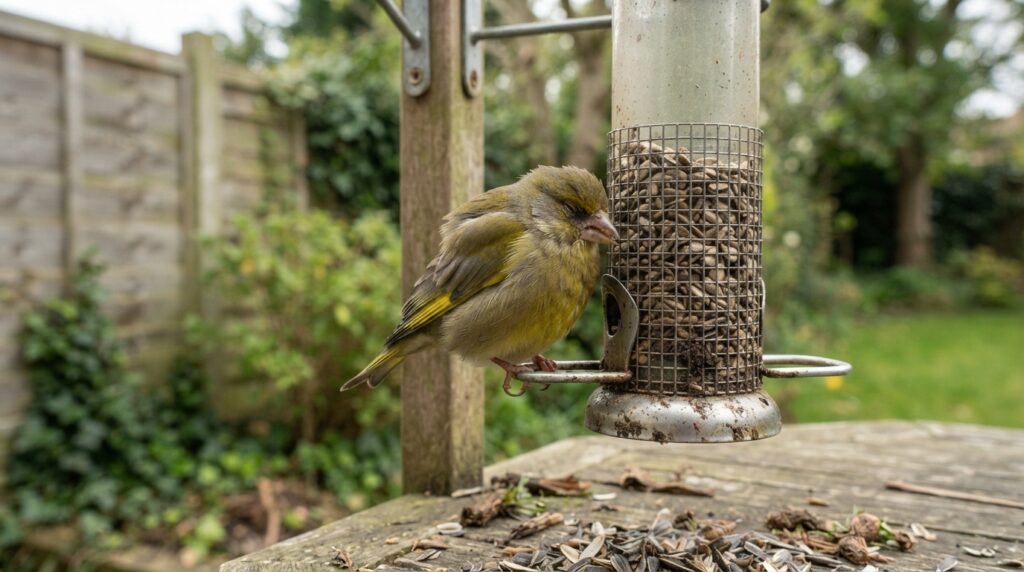
A feeder inside a wire cage. Small birds pass through the mesh; squirrels can’t.
Works well, and has the side benefit of excluding pigeons and starlings if they’re monopolising your feeder.
Trade-offs to be aware of:
- Also excludes birds you may want — great spotted woodpeckers, and sometimes larger birds like blackbirds
- Mesh sizing is critical. Too tight and even blue tits hesitate; too loose and a determined squirrel gets a paw through
- Squirrels can still reach seed near the mesh edge on poorly designed cages — look for a decent gap between cage and feeder
- More parts to clean, and weekly cleaning is now the standard
4. Weight-activated feeders
The most effective option, and the most expensive. A spring-loaded mechanism closes the feeding ports when something heavier than a bird lands on the perch.
Advantages: genuinely works, needs no particular placement, and doesn’t exclude any bird species.
Trade-offs: significantly more expensive, has a mechanism that can seize or wear, and is more fiddly to dismantle for the weekly clean. Some models can be adjusted to exclude larger birds too, which may or may not be what you want.
A weight-activated squirrel-proof feeder
The most reliable answer, and the most expensive. A spring-loaded shroud drops to close the feeding ports when something heavier than a small bird lands on the perch ring, so squirrels get nothing while blue tits and finches feed normally. Unlike a cage, it excludes by weight rather than by size, so it doesn’t shut out woodpeckers. Models with an adjustable weight threshold let you also exclude larger birds like starlings and pigeons if they’re a problem. The trade-offs are real: it costs several times what a baffle does, it has a mechanism that can stiffen or seize if not kept clean, and the extra parts make the weekly clean more fiddly.
- Works regardless of placement — useful where you can’t achieve the 3m clearance
- Excludes by weight, so it doesn’t shut out woodpeckers the way a cage does
- Adjustable models can also exclude pigeons and starlings
- Considerably more expensive than a baffle
- Moving parts can stiffen or seize, particularly if suet residue builds up
- More components to dismantle for the weekly clean
5. Smooth metal poles
Squirrels grip wood and textured surfaces easily. Smooth, narrow metal is much harder — especially combined with a baffle.
Avoid wooden posts, rope, and anything with a rough texture in a squirrel garden.
What doesn’t work
Plenty of widely repeated advice is ineffective, and some of it is harmful.
Greasing the pole — don’t
Petroleum jelly, cooking oil or grease on a pole is frequently suggested and genuinely harmful. It mats the fur of any animal that touches it, damaging its insulation and waterproofing. It also transfers to birds’ feathers, which is worse. Don’t do this.
Chilli-treated seed — questionable
Sold on the basis that mammals detect capsaicin and birds don’t. Widely marketed, but the evidence for reliable effectiveness in real garden conditions is thin, and there are practical problems: chilli dust irritates human eyes and skin when you’re filling the feeder, and there are reasonable concerns about contact with birds’ eyes. We’d exclude squirrels physically rather than rely on this.
Sonic and ultrasonic deterrents
Evidence of effectiveness against squirrels is weak. Animals habituate quickly to sounds that carry no actual consequence.
Waiting them out
They won’t lose interest. Squirrels have exceptional spatial memory for food sources.
Feeding squirrels separately — mixed
Some people set up a dedicated squirrel feeding station well away from the bird feeders, on the basis that a well-fed squirrel bothers the feeder less. Results vary, and it can attract more squirrels to the garden overall. Worth trying only alongside proper exclusion, not instead of it.
The legal position
Important. Grey squirrels are a non-native invasive species in the UK. It is illegal to release a trapped grey squirrel back into the wild, or to allow one to escape. That means live-trapping and relocating a squirrel to a nearby wood — which many people assume is the humane option — is not lawful.
This site recommends exclusion, not trapping. Baffles, distance and caged feeders solve the problem without any of this arising.
If you have a squirrel problem in your loft or building rather than at the feeder, that’s a different matter and worth taking professional advice on.
A combined approach
The reliable setup, in order of what to do first:
- Fix the placement — 3m from every launch point, 1.5m up. Free, and often sufficient
- Add a baffle — matched to your setup, positioned above jumping height
- Use a smooth metal pole rather than wood or a branch
- Switch to metal-ported feeders so they can’t be chewed open
- Add a cage or upgrade to weight-activated if squirrel pressure is heavy
Change one thing at a time. Otherwise you’ll never know which change did the work.
Common questions
How far can a squirrel actually jump?
Roughly 1.2m vertically from a standing start, and up to about 3m horizontally from a raised launch point. Plan around those figures.
Do squirrel-proof feeders really work?
Weight-activated designs work well. Caged feeders work but exclude some birds too. Neither compensates for a feeder hung from a branch a squirrel can simply climb down — placement still matters.
Is it cruel to exclude squirrels?
No. You’re not harming them, just denying them one food source. Grey squirrels are abundant and highly adaptable.
Will squirrels take eggs or chicks?
Grey squirrels do sometimes take eggs and nestlings. It’s a genuine reason to discourage them from concentrating in a garden with nest boxes.
What about red squirrels?
Red squirrels are a protected native species with a limited UK range, and the situation is entirely different. If you’re in red squirrel territory, seek local advice rather than applying grey squirrel deterrence.
Do rats have the same problem?
Rats are attracted by spilled food on the ground rather than by climbing to the feeder. The fix is different: use no-waste food like sunflower hearts, clear debris beneath feeders, and don’t overfill.
Related guides
- Types of bird feeder: which one should you actually buy?
- Why have the birds stopped coming to my feeder?
- Best bird food for winter: what to put out and what to skip
- How to clean a bird feeder — and why it now matters more
Sources: RSPB advice on feeders and squirrels; Wildlife and Countryside Act 1981 (Schedule 9) and Invasive Alien Species (Enforcement and Permitting) Order 2019 regarding grey squirrel release; RSPB feeder buying guidance.
Compare squirrel-resistant feeders and baffles at Amazon UK. Prices and stock change often, so it is worth checking before you commit.
Browse squirrel-proof feeders →