Affiliate disclosure: some links on this page go to Amazon. If you buy through one we may earn a small commission, at no extra cost to you. Full disclosure.
The cheapest way to feed birds well is sunflower hearts only, in modest amounts, in a feeder you can clean. Cheap mixed seed looks like a saving and isn’t — birds discard most of it, so you’re paying to feed the ground. Feeding less but better costs less than feeding more but badly.
Bird food isn’t cheap, and if you’re feeding through a whole winter it adds up to a real amount of money. There’s no need to feel awkward about wanting to spend less on it.
The good news is that the biggest savings come from stopping waste rather than from buying cheaper — and cutting waste tends to improve the feeding rather than compromise it.
Where the savings actually are
- Switch to sunflower hearts only — no husk, almost no waste
- Stop buying cheap mixes — most of it ends up on the ground uneaten
- Feed smaller amounts — matches current guidance anyway
- Exclude squirrels and pigeons — they’re a bigger cost than most people realise
- Store it properly — damp or rodent-raided food is money thrown away
- Grow some of it — free, and increasingly recommended
Why cheap seed mix is the most expensive option
This is the one that surprises people.
Budget mixed seed is padded with wheat, barley, split peas, lentils and dried rice — cheap bulk ingredients that most garden birds simply will not eat. Birds pick out the few sunflower seeds and flick the rest onto the ground.
So a £6 bag where perhaps a third gets eaten costs you more per useful kilo than a £10 bag where almost all of it does. And the discarded remainder rots underneath, attracting rats — which then costs you again.
How to spot a padded mix: look at the ingredients list. If wheat, barley, split peas or dried rice appear near the top, most of that bag is filler. A good mix leads with sunflower hearts or black sunflower seeds, with kibbled maize, millet and peanut granules making up the rest.
If a product doesn’t list its ingredients clearly at all, that’s usually a signal in itself.
Sunflower hearts: the honest value pick
More expensive per kilo than almost anything else, and still the cheapest way to feed birds properly.
Why the maths works:
- The husk is already removed, so you’re not paying for weight birds throw away
- Taken by almost every garden bird — tits, finches, sparrows, and robins and blackbirds from the ground
- Virtually nothing reaches the ground, so no rot, no rats, no waste
- One food covers most species, so you don’t need three different products
Buying a larger sack brings the price per kilo down considerably — but only buy what you’ll use in a season. Seed degrades, and a damp half-used sack in a shed is a false saving.
Feed less — it’s the recommendation anyway
Current RSPB guidance asks people to feed in moderation, with seed and peanuts eaten within one to two days rather than sitting in a full feeder for a week.
That happens to be the single biggest cost saving available.
What overfilling costs you: food that sits gets damp, clumps, grows mould and has to be binned. A brimming feeder topped up weekly wastes considerably more than a half-filled one topped up every couple of days — and the half-filled one is better for the birds.
Two feeding seasons also cut the annual cost substantially on their own: seeds and peanuts run 1 November to 30 April only, with just small amounts of suet and mealworms through the summer. That’s roughly half the year at a fraction of the cost.
Squirrels and pigeons are a budget problem
Easy to think of as an annoyance rather than an expense. A determined grey squirrel can empty a feeder in a session, and a flock of woodpigeons or starlings will clear a suet feeder in an afternoon.
If you’re refilling far more often than seems reasonable, that’s where the money is going — not into small birds.
The cheapest effective fix is placement, which is free. Three metres from any launch point — fence, shed roof, branch, bench — and 1.5m off the ground puts a feeder outside a squirrel’s jumping range.
Beyond that, a baffle is the cheapest piece of kit that reliably works. A caged feeder solves squirrels and pigeons together.
Our guides on stopping squirrels and pigeons and starlings go into detail.
Store it properly
Food ruined in storage is money already spent and thrown away.
- Use a metal bin with a tight lid. Rats and mice chew straight through paper sacks and thin plastic tubs
- Keep it cool and dry — a damp shed floor ruins seed
- Don’t leave part-used sacks open
- Check before filling — clumping, a musty smell or visible mould means it goes in the bin, not the feeder
Free food you already have
Genuinely useful, and safe — provided you stick to the list.
| Free food | Who takes it |
|---|---|
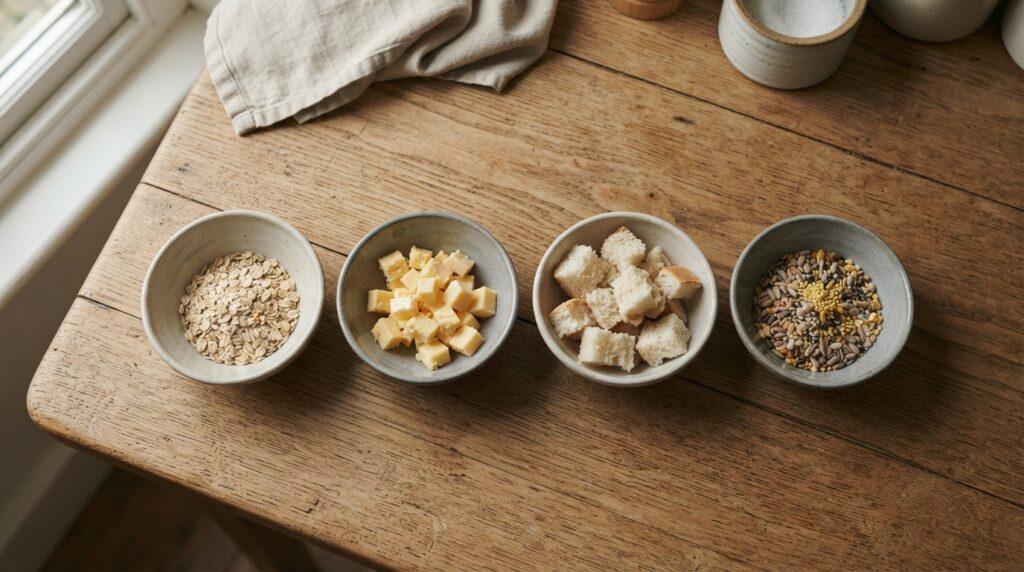
| Windfall apples and pears | Blackbirds, thrushes, redwings, fieldfares. Bruised fruit is ideal |
| Raw porridge oats | Blackbirds, sparrows, thrushes. Uncooked only |
| Mild grated cheese | Robins and wrens especially |
| Unsalted cooked potato | Plain, cooled, no butter or salt |
| Plain cooked rice | Unsalted, no sauce |
| Soaked raisins and sultanas | Blackbirds and thrushes. Keep away from dogs — toxic to them |
Never: bread in quantity, salted or roasted nuts, milk, desiccated coconut, cooked porridge, or anything mouldy. Our kitchen food guide has the full safe and unsafe lists.
Put out only what will be gone by dusk, scattered on the ground in a different spot each time rather than on a fixed tray.
Grow food instead
The genuine long-term saving, and increasingly what’s recommended anyway — plants carry none of the disease transmission risk that shared feeders do, and they cover the May-to-October window when seed feeding pauses.
The free version: stop cutting your borders back in October. Standing seed heads feed finches all winter. Teasel, sunflower heads, knapweed, lavender and ornamental grasses all work, and teasel self-seeds readily once you have one.
The cheap version: a packet of sunflower or teasel seed costs very little and produces food year after year.
The longer-term version: a berry shrub — hawthorn, holly, rowan, pyracantha, cotoneaster — takes a few years to crop but then feeds birds every autumn for decades at no ongoing cost.
Our plants guide covers what’s worth planting.
Where not to economise
Three things where saving money costs more, or causes harm.
Peanuts. Never buy cheap or non-bird-grade peanuts. Poor-quality peanuts can carry aflatoxin, a fungal toxin that kills birds. Only buy peanuts sold specifically for wild birds from a reputable supplier, and never anything salted or roasted.
Feeders. A very cheap plastic feeder becomes brittle in frost, cracks, and gets chewed open by squirrels — often within one winter. A metal-ported feeder that dismantles properly costs more once and lasts years. It’s also the only kind you can realistically clean weekly, which matters.
Cleaning. Not a cost worth cutting. Weekly cleaning is the current standard, and the reason is trichomonosis — a parasitic disease that has driven greenfinch numbers down around 67% since 1979. Washing-up liquid and a brush cost almost nothing.
A workable budget setup
- One good feeder that comes apart for cleaning, metal ports, no base tray
- Sunflower hearts only — one food, widest appeal, least waste
- Placement done properly — 2m from cover, 1.5m up, 3m from squirrel launch points. Free
- Small amounts, topped up every couple of days
- Windfall fruit and raw oats for ground feeders, from the kitchen
- Borders left standing over winter
- Weekly clean, moving the feeder each time
That’s a properly-fed garden for the cost of one food and one feeder.
Common questions
Is it wrong to stop feeding if money’s tight?
No. Feeding is supplementary — birds forage naturally and garden feeders make up a portion of their intake rather than all of it. Water, cover and unsprayed planting all help and cost nothing. Don’t feel obliged to spend money you don’t have.
Are supermarket own-brand bird foods any good?
Varies. Judge by the ingredients rather than the brand — a mix leading with sunflower hearts is fine wherever it’s from; one leading with wheat isn’t, at any price.
Can I make my own fat balls?
Yes, and it’s cheap — hard fat such as suet or lard mixed with sunflower hearts or oats. Never use soft spreads, margarine or cooking oils, which smear feathers and go rancid. And never leave any fat product in netting.
Does buying in bulk actually save money?
Per kilo, yes. In practice only if you use it within a season and store it in a sealed metal bin. Otherwise you’re buying more to waste more.
What’s the single cheapest thing that makes a difference?
Water, changed daily in a shallow dish. Free, and in a hard frost it’s often more valuable than food.
Related guides
- Best bird food for winter: what to put out and what to skip
- Can birds eat bread, porridge oats or cheese?
- Best plants to attract birds to a UK garden
- How to stop squirrels raiding your bird feeder
Sources: RSPB feeding guidance (April 2026), including advice on feeding in moderation; RSPB food type guidance and aflatoxin warnings; RSPB Big Garden Birdwatch population trends.
Compare sunflower hearts and suet at Amazon UK. Prices and stock change often, so it is worth checking before you commit.
Browse bird food →