Affiliate disclosure: some links on this page go to Amazon. If you buy through one we may earn a small commission, at no extra cost to you. Full disclosure.
A feeding station is convenient and easy to squirrel-proof, but it concentrates birds in one spot — which current hygiene guidance advises against. Two or three feeders spread around the garden is better for the birds. If you want a station, buy one and hang fewer feeders on it, or use a station plus one or two separate positions.
A feeding station is a pole with several arms, so you can hang a seed feeder, a suet cage, a peanut feeder and a water dish from one point. They’re popular, widely sold, and genuinely convenient.
There’s a tension with current guidance, though, and it’s worth understanding before you buy.
The trade-off
- Station: one thing to squirrel-proof, easy to site, tidy, easy to fill
- Separate feeders: less crowding, less disease risk, easier to move weekly
- Guidance says: spread feeders out and move them regularly
- Sensible compromise: a station with two or three feeders, plus one or two positions elsewhere
The hygiene issue
The RSPB’s revised 2026 guidance specifically recommends spacing feeders out rather than clustering them, and moving them to a fresh spot after each weekly clean.
Both recommendations exist because of trichomonosis — a parasitic disease spread through saliva and regurgitated food, which has driven greenfinch numbers down around 67% since 1979. Anywhere birds gather in numbers around a shared food source is where it moves between individuals.
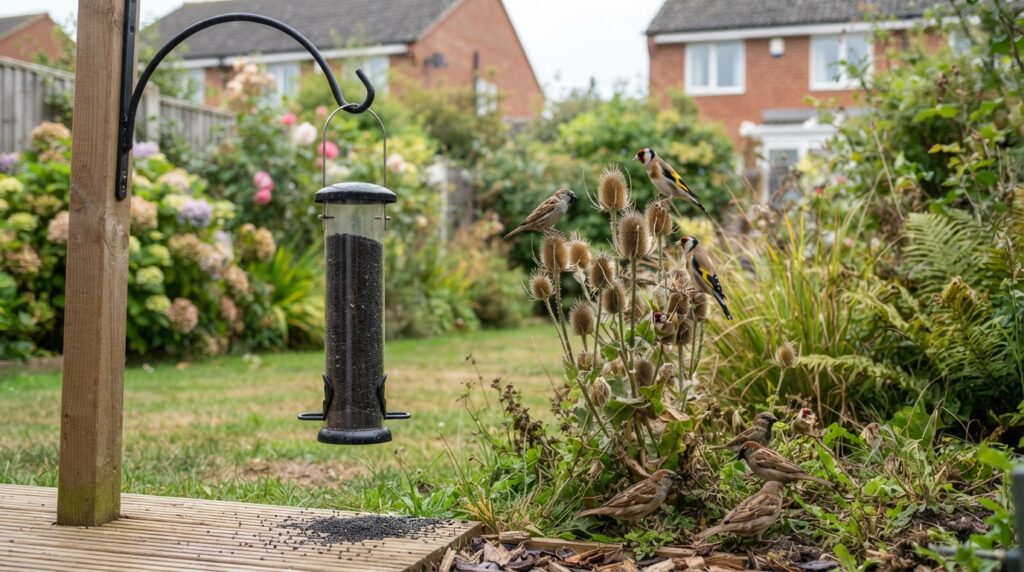
A feeding station does exactly what the guidance advises against: concentrates several food sources into one small area, bringing more birds into closer contact than they’d otherwise be, and accumulating dropped food and droppings in one patch of ground.
That doesn’t make stations unusable. It means using one thoughtfully rather than loading it up.
What a station does well
Squirrel-proofing
Genuinely the strongest argument for one. A single smooth metal pole with a baffle is far easier to defend than four hanging feeders in different trees, each with its own set of jump routes.
If squirrels are your main problem, a station in open ground — three metres from any fence, shed or branch — with a baffle fitted above jumping height solves it in one go.
Siting where there’s nothing to hang from
New-build gardens, small lawns and paved yards often have no mature trees. A freestanding pole gives you a feeding position where none exists.
Ease of filling
Not trivial if you’re refilling every couple of days through winter. Everything at one height, in one place, reachable without a ladder.
Tidiness
Feeders hung off fences and branches around a garden look scattered. A station looks deliberate.
What separate feeders do well
Less crowding
Birds spread across several positions come into contact with each other less. That’s the whole point of the guidance.
It also reduces competition — a dominant bird can monopolise one feeder but not four in different parts of the garden.
Easier to move
Current guidance asks you to reposition after each weekly clean. Moving a lightweight hanging feeder to a different hook takes seconds. Relocating a whole station means pulling up a pole, and most people won’t do it weekly.
This is the practical reason separate feeders suit the guidance better — not that stations are inherently bad, but that they discourage the behaviour the guidance asks for.
More species
Different birds prefer different situations. Some want cover close by; others prefer open ground. Multiple positions at different heights and exposures suit a wider range.
Cheaper to start
A hook and a feeder costs a fraction of a station, and you can add positions gradually.
Which suits your garden
| Your situation | Better option |
|---|---|
| Heavy squirrel pressure | Station with a baffle, correctly sited |
| New-build, no mature trees | Station — nothing else to hang from |
| Paved yard or small garden | Station in a weighted base |
| Mature garden with trees and shrubs | Separate feeders — you’ve already got the positions |
| Want maximum species variety | Separate feeders at varied heights |
| Following hygiene guidance closely | Separate feeders, or a lightly-loaded station |
| Larger garden, want both | Both — station in one area, hanging feeders elsewhere |
If you buy a station, use it well
The compromise that satisfies both convenience and guidance:
- Hang two or three feeders, not five. A fully loaded station is the crowding problem in miniature
- Add one or two separate positions elsewhere in the garden, so birds have alternatives
- Move the pole periodically — even a few metres, even monthly rather than weekly, helps prevent build-up underneath
- Clear the ground beneath regularly. This is where debris accumulates fastest
- Don’t use the water dish attachment unless you’ll change it daily. Standing water in a busy feeding area is exactly what spreads disease
What to look for when buying a station
- Smooth metal pole — squirrels grip textured surfaces and wood easily
- Solid ground spike or a weighted base — a wobbling station deters birds and blows over in wind
- Height around 1.8–2m, giving roughly 1.5m of feeder height once it’s in the ground
- Baffle compatibility — check what pole diameter baffles fit before ordering
- Arms that unhook easily, so feeders come off for the weekly clean without dismantling everything
- Avoid ones sold with a flat tray or bird table top — flat surfaces are no longer recommended. Remove it if yours has one
Add a baffle
A station without one is a ladder. A cone baffle fitted at least 1.2m up the pole is what makes it work.
Placement — the part that decides everything
A station in the wrong place is worse than a hanging feeder in the right one.
- 3m from any launch point — fence, shed roof, branch, bench, water butt, wheelie bin
- About 2m from cover — close enough for birds to escape into, far enough that cats can’t ambush
- Not under branches birds roost on — droppings contaminate the food below
- Within 1m of a window, or beyond 10m — the middle distance is where window strikes happen
- Somewhere you can actually reach in January, in the dark, in the rain
Common questions
Are feeding stations bad for birds?
Not inherently. The concern is concentration — several food sources in one spot brings birds into closer contact and accumulates debris. Used with two or three feeders, kept clean and moved occasionally, a station is fine.
How many feeders should one station hold?
Two or three. Most stations have arms for four or more, but a fully loaded one concentrates birds more than is ideal.
Should I use the water dish that came with it?
Only if you’ll change it daily with fresh tap water. Standing water in a busy feeding area is a genuine disease risk. A separate bird bath away from the feeders is better.
My station blows over in wind. What now?
Either a deeper ground spike, or a weighted base plate. Removing one feeder from the top arm also helps — top-heavy stations catch the wind badly.
Can I put a station on a patio?
Yes, with a weighted base rather than a spike. Bear in mind you’ll need to sweep beneath it regularly — spillage on paving is more visible but also easier to clear.
Related guides
- Types of bird feeder: which one should you actually buy?
- How to stop squirrels raiding your bird feeder
- How to clean a bird feeder — and why it now matters more
- How to attract birds to a new-build garden with no trees
Sources: RSPB feeding and hygiene guidance (April 2026), including recommendations on spacing and moving feeders; RSPB feeder buying advice; RSPB Big Garden Birdwatch population trends.
Compare rodent-proof seed storage at Amazon UK. Prices and stock change often, so it is worth checking before you commit.
Browse seed storage →