Affiliate disclosure: some links on this page go to Amazon. If you buy through one we may earn a small commission, at no extra cost to you. Full disclosure.
A bare garden’s problem isn’t a lack of food — it’s a lack of cover. Birds won’t use an exposed feeder with nowhere to escape to. Put in something to perch and hide in first, even temporarily, then feed. A feeding station plus a couple of large pots of shrubs will get you birds in the first season while permanent planting establishes.
New-build gardens are hard work for birds. Fence panels instead of hedges, a lawn of fresh turf, no mature trees, and often subsoil rather than topsoil under the grass.
The good news is that it’s fixable faster than you’d think, and the first-season fixes are cheap.
The order to do things in
- 1. Cover first — birds won’t use an exposed feeder
- 2. A freestanding feeder position — nothing to hang from means a pole
- 3. Water — cheap, and often what tips it
- 4. Plant for the long term — hedging beats fence panels
- 5. Be patient — six weeks is normal, not a failure
Why cover matters more than food
This is the thing people get wrong. They put out an excellent feeder with excellent food in the middle of a bare lawn, and nothing comes.
Small birds are prey animals. They need somewhere to bolt to within a second or two of a sparrowhawk appearing, and somewhere to perch and check the area is safe before dropping down. A feeder in open ground with nothing within reach simply feels too dangerous to use.
The workable distance is about two metres from cover — close enough to escape into, far enough that a cat can’t ambush from it.
Instant cover, first season
You don’t have to wait years. Options that work immediately:
- Large pots of evergreen shrubs near the feeder. Even two or three good-sized pots change a bare lawn into somewhere birds will use
- A trellis with a climber against a fence — ivy or honeysuckle establishes fast
- The Christmas tree trick — a used real Christmas tree, staked upright near the feeder, gives genuinely useful winter cover for a couple of months and costs nothing
- Prunings staked into a loose pile — untidy but effective, particularly in a corner
- Don’t mow one strip — even long grass provides some structure and shelters insects
Somewhere to put a feeder
No trees means no branches, and fence panels are usually too exposed and too accessible to cats.
A freestanding feeding station is the obvious answer, and this is the situation they’re genuinely best suited to. A pole gives you a feeding position where none exists, at the right height, sited exactly where you want it.
Siting it: about 2m from whatever cover you’ve created, 1.5m off the ground, and 3m from the fence — fence panels are a launch point for squirrels and a perch for cats.
A shepherd’s hook in a large pot is the cheaper version and works fine for one or two feeders. Our station vs separate feeders guide covers the trade-offs.
Water is the underrated fix
New estates often have very little standing water — no ponds, no mature gardens, sometimes not even a water butt yet. A reliable shallow dish gets noticed.
Keep it shallow (no more than about 10cm at the deepest point, sloping sides), put a couple of pebbles in for grip, and site it near your cover rather than in the open.
Only offer water if you can change it daily, using fresh tap water, and clean the dish weekly. Standing water spreads disease. It’s thirty seconds a day, but it does have to be every day.
Food to start with
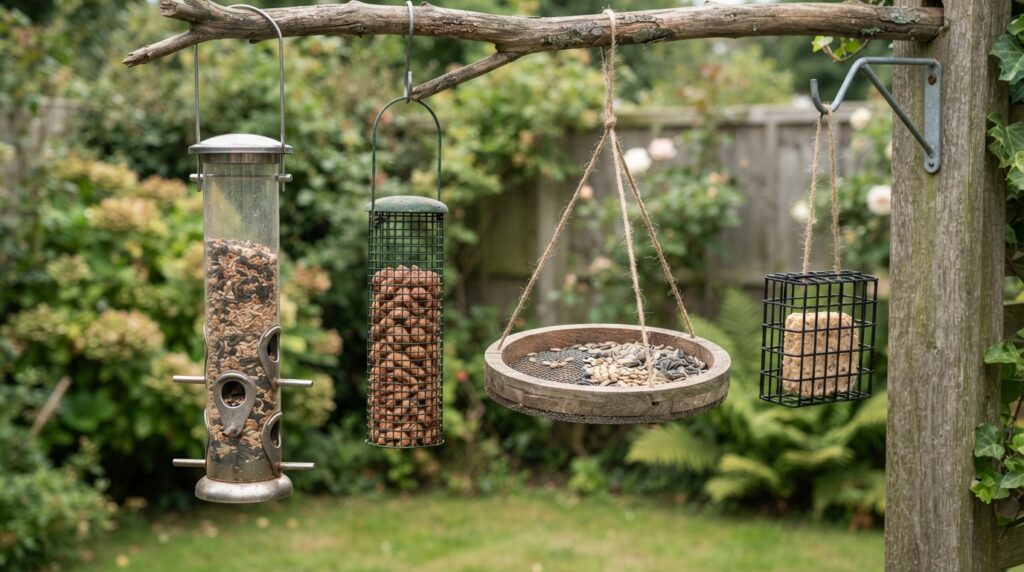
Keep it simple. Sunflower hearts in a hanging tube feeder is the highest-percentage opening move — taken by almost every garden bird, no husk waste, and no specialist feeder needed.
Add a suet cage as the second feeder. Suet is high energy and stays approved year-round, while seeds and peanuts pause from 1 May to 31 October.
Planting for the long term
This is what actually solves it permanently.
Replace or supplement the fence
A hedge beats a fence panel for wildlife every time — nesting sites, shelter, insects and berries in one structure. A mixed native hedge of hawthorn, blackthorn, hazel and holly does far more than anything else you can plant.
If you can’t remove the fence (and in a new-build you often can’t, since it may be a boundary you don’t solely own), plant a hedge line just inside it, or grow climbers up it.
Get a tree in early
Trees take time, so the sooner one goes in the better. For a typical new-build plot:
- Rowan — modest size, berries from August, good for thrushes
- Crab apple — fruit hangs on into winter when little else is left
- Hawthorn — can be a tree or a hedge, excellent for insects and nesting
- Silver birch — supports a very large number of insect species, though it gets big
Berry shrubs
Faster than trees, usually cropping within a few years: pyracantha, cotoneaster, holly, elder, guelder rose. Pyracantha and cotoneaster both train flat against a fence, which suits a narrow plot.
Seed heads and insects
The quickest wins. Sunflowers and teasel grow from seed in a season, and leaving the heads standing over winter feeds finches directly. Lavender, knapweed and ornamental grasses all do the same.
Our plants guide has the full list.
The soil problem
Worth knowing, because it explains why blackbirds and thrushes may be scarce even once you’ve got other birds.
New-build gardens are frequently turfed over compacted subsoil, with construction debris underneath. That means few earthworms — and earthworms are what blackbirds, thrushes and robins are after.
What helps: mulching borders with compost or well-rotted manure, avoiding lawn feed and weedkiller, leaving grass clippings occasionally, and letting leaf litter accumulate under shrubs. Worm populations recover over a few years as organic matter builds up.
A robin will follow you around while you dig a border — genuinely, this is how they forage — so any soil work you do is likely to bring one in.
Nest boxes: put them up now
New estates have very few natural nest sites. Modern buildings are sealed, and there are no mature trees with holes in them.
A nest box is therefore worth more in a new-build garden than almost anywhere else. Put boxes up in autumn or early winter — birds roost in them over winter and are more likely to nest in a box that’s been in place a few months.
25mm hole for blue tits, 28mm for great tits, 32mm for house sparrows, open-fronted and hidden for robins. Face them between north and east, 2–4m up, and away from the feeders.
Full detail in our nest box guide.
What to expect, and when
| Timescale | What happens |
|---|---|
| Weeks 1–6 | Often nothing. This is normal, not failure — a new feeder in a new garden takes time to be found |
| Months 2–3 | First regulars — usually house sparrows, blue tits, starlings, woodpigeons |
| Year 1 | A handful of species. Robins arrive once you’re digging borders |
| Years 2–3 | Planting starts providing cover. Blackbirds as worms return. Possible first nesting |
| Years 4+ | Shrubs cropping, hedge thickening, noticeably more species |
Common questions
I’ve had a feeder up for weeks and seen nothing. What’s wrong?
Most likely no cover nearby, or simply not long enough. Six weeks is normal in a bare garden. Add something to perch in within about two metres and give it time — don’t keep moving the feeder while you wait.
Can I hang a feeder on the fence?
You can, but it’s not ideal — fences are a highway for cats and a launch point for squirrels. A pole placed away from the boundary works considerably better.
My garden is tiny. Is it worth bothering?
Yes. Even a small plot with one feeder, a water dish and a couple of pots gets birds. Our balcony guide covers doing it in very little space.
Are the neighbours’ gardens affecting it?
Very much so. On a new estate everyone’s garden is bare at once, which means there’s little cover anywhere. As the estate matures, bird numbers rise across the whole area — you’re not working against your plot alone.
Should I plant native or ornamental?
Native supports far more insect species, and insects are what chicks are fed on. But some non-natives — pyracantha, cotoneaster — are excellent for berries. A mix works well.
Related guides
- Best plants to attract birds to a UK garden
- Bird feeding station vs separate feeders
- Why have the birds stopped coming to my feeder?
- When to put up a nest box (and exactly where to site it)
Sources: RSPB guidance on gardening for wildlife and feeder placement; RSPB feeding guidance (April 2026); Royal Horticultural Society plants for wildlife; Woodland Trust native species guides.
Compare current prices on bird food and feeders at Amazon UK. Prices and stock change often, so it is worth checking before you commit.
Browse bird food →