Affiliate disclosure: some links on this page go to Amazon. If you buy through one we may earn a small commission, at no extra cost to you. Full disclosure.
Water is often more valuable to garden birds than food, and it’s the thing most people get wrong. Birds need it for drinking and — just as importantly — for bathing, because clean feathers are what keeps them insulated and able to fly properly.
The two numbers that matter: no more than about 10cm deep at the centre, and around 2.5cm at the edge. Most decorative bird baths sold in garden centres are too deep and too slippery.
What makes a good bird bath
- Shallow — 2.5cm at the edge, no more than 10cm at the deepest point
- Gently sloping sides so birds can wade in
- A rough surface for grip — glazed ceramic is slippery when wet
- Easy to lift and scrub, because it needs cleaning weekly
- Stable — a wobbling bath deters birds
Before anything else: current RSPB guidance is to only offer water if you can change it every day, using fresh tap water, and clean the bath itself weekly. Standing water spreads disease — the parasite behind trichomonosis survives in it. If daily changes aren’t realistic for you, it’s genuinely better not to offer water at all.
Why water matters so much
Drinking. Most small birds need to drink at least twice a day. Seed-eaters need more than insect-eaters, because their food contains almost no moisture.
Bathing. This is the part people underestimate. Feathers only insulate properly when clean and correctly aligned. A bird bathes to remove dust, parasites and old preen oil, then preens to redistribute fresh oil. In cold weather, a bird with dirty feathers loses heat faster — so bathing in winter isn’t odd behaviour, it’s essential.
When it’s most critical: hard frost, when natural water is frozen solid, and prolonged dry spells in summer.
Choosing a bird bath
Depth and shape
Shallow with gently sloping sides. Birds wade in from the edge rather than jumping into the middle, so a bath with vertical sides and a flat bottom is far less useful.
If yours is too deep, put a few flat stones in the bottom to create shallower standing areas. This also gives grip and gives smaller birds somewhere to perch.
Material
| Material | Pros | Cons |
|---|---|---|
| Stone / concrete | Stable, good grip, weathers well | Heavy to lift and clean, can crack in hard frost |
| Ceramic / glazed | Attractive, easy to wipe | Slippery when wet, cracks in frost |
| Metal | Durable, easy to clean | Heats up in sun; can be slippery |
| Plastic / resin | Light, cheap, frost-tolerant, easy to lift | Can blow over; less attractive |
Given that weekly scrubbing is now the standard, how easy it is to lift and clean is a more useful buying criterion than how it looks. A heavy stone bath you can’t move is one you’ll clean badly.
Ground level or raised?
Both work. Ground-level baths suit blackbirds, dunnocks and robins; raised ones feel safer to smaller birds and are easier for you to maintain.
If cats visit your garden, raised is the safer choice — a bathing bird is wet, heavy and slow to take off.
Where to put it
- Near cover, but not right against it — around 2m from a shrub. Birds want an escape route without giving a cat somewhere to hide
- With a perch nearby — birds like to sit and preen after bathing
- Partial shade — full sun makes water warm and speeds up algae; deep shade means it stays frozen longer in winter
- Not directly under a feeder — spilled seed and droppings fouling the water is exactly what you’re trying to avoid
- Visible from a window — bathing birds are among the best things to watch
Cleaning
Water needs more attention than feeders, because the parasite survives in it.
Daily: tip out the old water, give it a quick rinse and scrub, refill with fresh tap water.
Weekly: a proper clean — empty, scrub with hot soapy water, then a non-toxic disinfectant such as Ark-Klens or a mild 5% bleach solution, rinse thoroughly, refill.
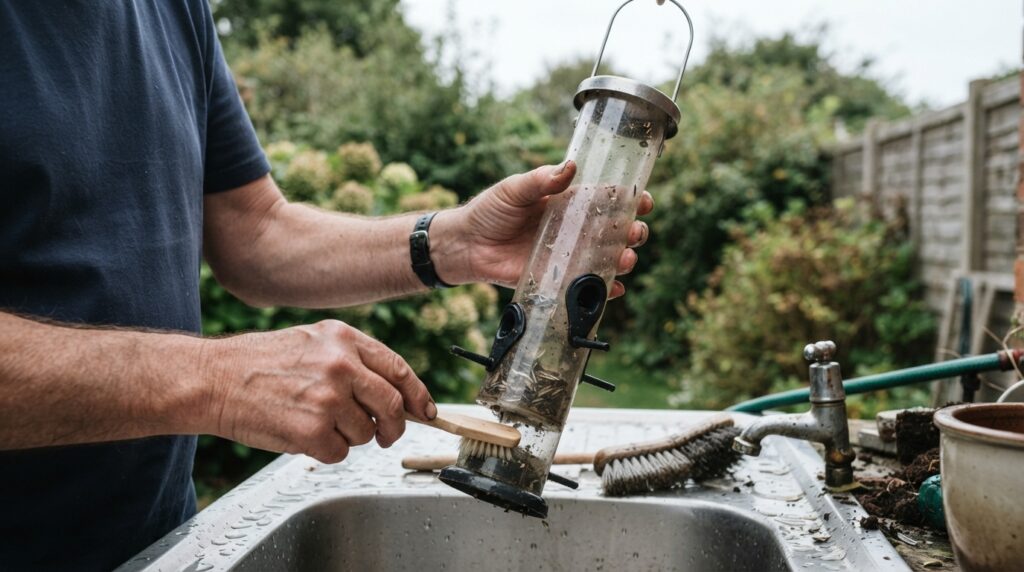
Keep a dedicated brush for the job and wear gloves. Full method in our cleaning guide.
Stopping it freezing — safely
In a hard frost, open water can be genuinely hard for birds to find, so keeping a bath usable matters.
Never add antifreeze, salt, glycerine, oil or any other chemical to a bird bath. All of these are harmful. Antifreeze is lethal. Salt damages birds’ kidneys and, if it gets onto feathers, destroys their waterproofing. Glycerine and oils coat feathers and ruin insulation. There is no chemical shortcut here.
What actually works:
- Pour on warm water — not boiling, which can crack stone or ceramic. Warm water melts existing ice and buys you a few hours
- Float a light ball — a ping pong ball or similar. Slight movement in wind slows ice forming
- Line with a plastic sheet or tray so ice can be lifted out in one piece rather than chipped away
- Refresh twice on very cold days — morning and early afternoon
- Site it in a sunnier spot for winter if you can move it
- A small heated bird bath or de-icer is an option, though far less common in the UK than in North America
Never break ice by hammering it while birds are nearby, and never use a bath with cracked ice edges that could injure feet.
Encouraging birds to find it
Moving water is considerably more attractive than still water — birds notice the sound and the movement.
- A small solar fountain pump creates ripple and sound
- A dripper — even a container with a pinhole slowly dripping in — works well
- Position it where birds already gather, near existing feeders but not directly beneath them
Bear in mind that any recirculating pump needs the same daily water change and weekly clean as a still bath.
Common questions
How deep should a bird bath be?
No more than about 10cm at the deepest point, and around 2.5cm at the edges, with sloping sides. Add flat stones if yours is deeper.
Can I use rainwater from a water butt?
Current guidance specifies fresh tap water. Water butt water can harbour bacteria and algae, which is exactly what you’re trying to avoid.
Why is my bird bath going green?
Algae, usually from sun and infrequent changing. If it’s turning green you’re not changing the water often enough — daily is the standard.
Do birds bathe in winter?
Yes, and it matters more then. Clean, well-aligned feathers insulate far better, so bathing is part of how a bird survives cold weather.
Should I take the bird bath in during summer?
No — summer is when water is most valuable, particularly since seed feeding pauses between 1 May and 31 October. Just keep up the daily changes.
My bath cracked in the frost. What now?
Common with stone and ceramic. Empty it before hard frosts if it’s not frost-proof, or switch to a plastic or resin bath for winter.
Related guides
- How to clean a bird feeder — and why it now matters more
- When to feed garden birds: the new UK guidance explained
- Best bird food for winter: what to put out and what to skip
- Best plants to attract birds to a UK garden
Sources: RSPB water and hygiene guidance (April 2026); British Trust for Ornithology; RSPB advice on providing water in winter.
Compare bird baths at Amazon UK. Prices and stock change often, so it is worth checking before you commit.
Browse bird baths →