Affiliate disclosure: some links on this page go to Amazon. If you buy through one we may earn a small commission, at no extra cost to you. Full disclosure.
Two foods reliably bring goldfinches into a garden: nyjer seed and sunflower hearts. The catch is that nyjer needs a specialist feeder — the seed is so fine it pours straight out of a standard one.
Get both right and goldfinches are one of the more rewarding birds to attract, partly because they arrive in small groups rather than singly.
Goldfinch quick facts
- Best foods: nyjer seed, sunflower hearts
- Feeder: nyjer feeder (fine ports) or standard tube for sunflower hearts
- Identifying: red face, black-and-white head, broad gold wing bar
- Behaviour: in small groups, with a tinkling liquid call
- Trend: one of the few garden birds to have increased in recent decades
Identifying a goldfinch
Once you’ve seen one properly, there’s nothing else like it in a British garden.
Look for: a bright red face, a black-and-white patterned head, buff-brown body, and — the standout feature — a broad gold bar across black wings, obvious in flight.
Males and females are very similar. The red on a male’s face extends slightly further back, past the eye; on a female it stops at the eye. It’s a real difference but hard to judge without a good view.
Juveniles have no red face at all — plain grey-brown heads with the adult gold wing bar already present. That wing bar is the giveaway.
Listen for: a light, tinkling, liquid twittering, often the first sign a group has arrived. The collective noun — a “charm” of goldfinches — comes from the sound.
Nyjer seed
Tiny, black, oil-rich seeds. Not a native food, but goldfinches take to them readily.
You need the right feeder
Nyjer is roughly the size of a grain of sand. In a standard seed feeder it simply runs out of the ports onto the ground.
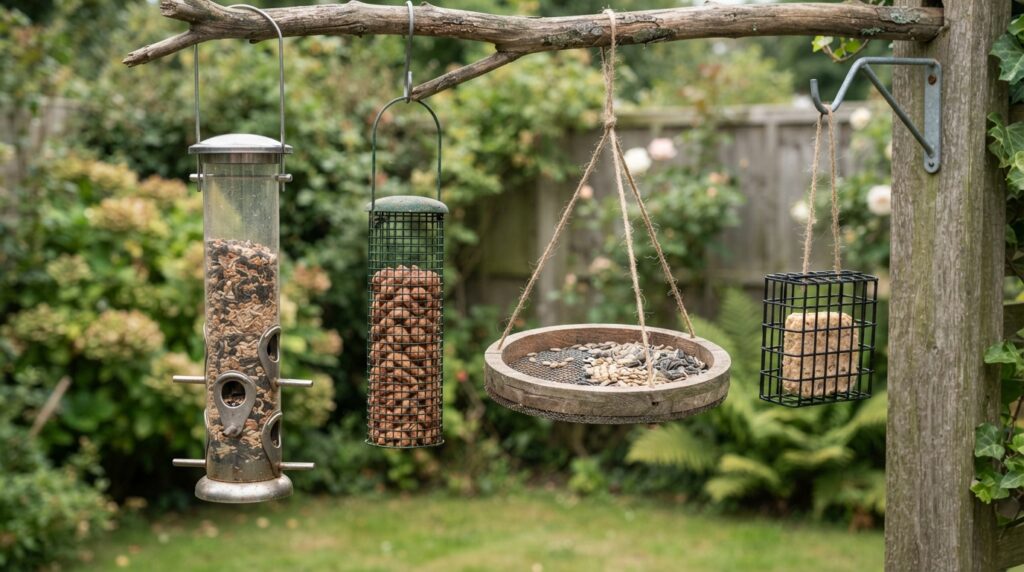
A nyjer feeder has very fine slits or small ports designed for it. They’re inexpensive and widely available.
An honest assessment of nyjer
It’s worth being straight about the downsides, because nyjer is heavily marketed:
- Expensive per kilo compared to sunflower hearts
- Narrow appeal — goldfinches, siskins and redpolls, and not much else. Most garden birds ignore it
- Clogs when damp, and then goes off. Check it regularly and don’t overfill
- Loses freshness relatively quickly. Buy small quantities
Buy it if goldfinches specifically are the goal. Don’t buy it as a general-purpose food.
Sunflower hearts — the cheaper alternative
Goldfinch numbers at garden feeders have risen substantially over recent decades, and the increasing availability of sunflower hearts is widely thought to be part of the reason.
Sunflower hearts are cheaper than nyjer, work in an ordinary tube feeder, and are taken by almost every other garden bird as well. If you’re only buying one thing, buy these.
Many people run both — a nyjer feeder to draw goldfinches in, and sunflower hearts to keep the wider garden busy.
Plants that bring goldfinches
Goldfinches evolved eating seed heads, and their fine, tweezer-like bills are built for extracting seeds other finches can’t reach. Planting for them works, costs nothing to maintain, and carries none of the disease risk that shared feeders do.
- Teasel — the classic goldfinch plant. Their bills are among the few that can reach into the seed heads. Leave the stems standing over winter
- Sunflowers — leave the heads on the plant rather than cutting them down
- Thistles — including ornamental varieties like globe thistle
- Knapweed, scabious, cornflower
- Lavender — leave the seed heads after flowering
- Michaelmas daisies and evening primrose
The single most useful habit: stop deadheading and tidying in autumn. A border left standing over winter feeds goldfinches for months. The instinct to cut everything back in October removes exactly the food they need.
This matters more under current guidance, since seeds and peanuts pause between 1 May and 31 October — plants fill that gap without any of the hygiene concerns.
Feeder placement
Goldfinches are relatively bold once established but wary on arrival.
- About 2m from cover — close enough to escape, far enough to see danger coming
- Height around 1.5m
- Somewhere sheltered from rain, since nyjer spoils when damp
- Give it time — a new nyjer feeder can take several weeks to be discovered. This is normal and not a sign it isn’t working
Hygiene — particularly important for finches
Finches are the group worst affected by trichomonosis, the disease behind the 2026 change in UK feeding guidance. Greenfinch numbers have fallen by around 67% since 1979 and chaffinches have been badly hit.
If you’re deliberately attracting finches, weekly cleaning is not optional. Clean feeders at least once a week, move them to a fresh spot each time, and clear debris from underneath. See our cleaning guide.
Nyjer feeders need particular attention — the narrow ports trap damp seed and are easy to clean badly.
Common questions
I’ve had a nyjer feeder up for weeks and nothing. Why?
Usually patience. Nyjer feeders are often slow to be found. Check the seed hasn’t clogged or gone damp, make sure the feeder is near cover, and give it a month. Running sunflower hearts alongside helps draw birds to the area in the first place.
Is nyjer the same as thistle seed?
No, though it’s often sold as “thistle seed” in some markets. Nyjer comes from an African daisy relative, not a thistle. It’s also heat-treated before sale so it can’t germinate.
Why do goldfinches come in groups?
They’re sociable outside the breeding season and forage in flocks. A single goldfinch finding your feeder usually means several more will follow.
Do goldfinches stay all year?
Many do, though a proportion of UK goldfinches migrate south to France and Spain for the winter. Garden numbers can fluctuate noticeably through the year as a result.
Will goldfinches use a nest box?
No. They build open cup nests in trees and shrubs, often quite high up. Providing dense shrubs and trees is more useful than a box.
Related guides
- Best bird food for winter: what to put out and what to skip
- Best plants to attract birds to a UK garden
- How to clean a bird feeder — and why it now matters more
- Common garden birds in the UK: how to identify your visitors
Sources: RSPB species information and feeding guidance; British Trust for Ornithology Garden BirdWatch trends; RSPB Big Garden Birdwatch results.
Compare nyjer seed and feeders at Amazon UK. Prices and stock change often, so it is worth checking before you commit.
Browse nyjer feeders →