Affiliate disclosure: some links on this page go to Amazon. If you buy through one we may earn a small commission, at no extra cost to you. Full disclosure.
Two things matter most in a hard frost: high-fat food and unfrozen water. Put food out at first light and again mid-afternoon, offer suet and sunflower hearts, and keep a shallow dish of water liquid using warm water — never salt, antifreeze or glycerine, all of which are harmful.
A cold night is genuinely dangerous for a small bird. A blue tit weighs around 11 grams and can lose a significant proportion of its body weight overnight simply staying warm. Add frozen ground, iced-over water and short daylight hours, and a few days of hard frost becomes a survival problem.
Here’s what actually helps, and what to avoid doing with the best of intentions.
Priorities in freezing weather
- Water first — often harder to find than food when everything’s frozen
- High-fat food — suet, fat balls, sunflower hearts
- Feed twice — first light and mid-afternoon
- Clear snow from a patch of ground for ground feeders
- Keep cleaning weekly — busy feeders in cold weather spread disease fastest
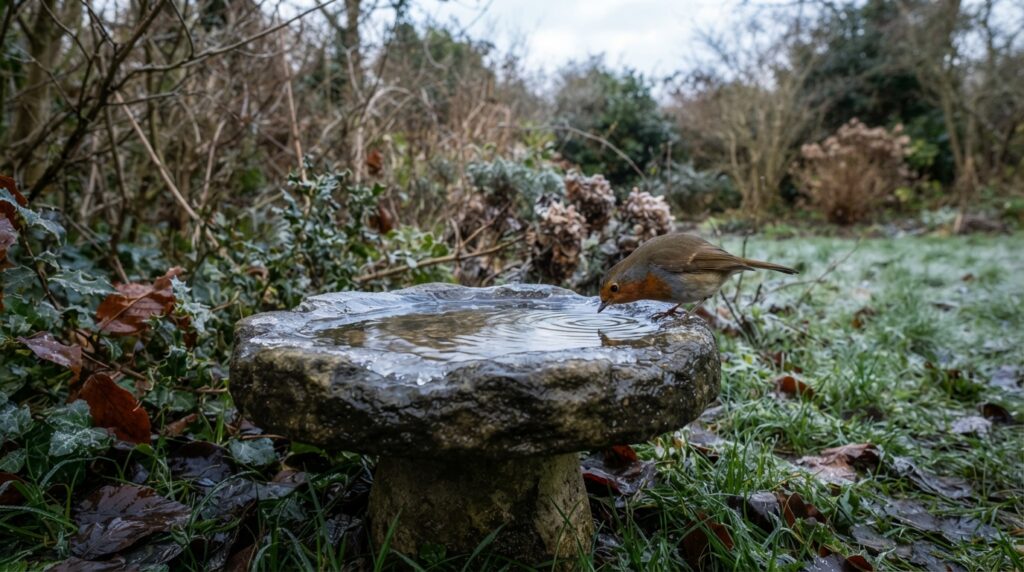
Water is the priority
People instinctively think about food first, but in a freeze, water is often the scarcer resource. Ponds, puddles and gutters ice over, and birds need water both for drinking and for bathing — clean, well-aligned feathers are what traps the layer of air keeping them alive overnight.
A bird with dirty or damaged plumage loses heat faster, which is why you’ll see birds bathing on genuinely cold days. It isn’t odd behaviour; it’s maintenance.
How to keep it liquid
- Pour on warm water — not boiling, which can crack stone or ceramic. This melts existing ice and buys several hours
- Float a light ball — a ping pong ball. Slight movement in the wind slows ice forming
- Line the bath with a plastic sheet or an old tray, so ice lifts out in one piece rather than needing chipping
- Refresh twice daily on very cold days — morning and early afternoon
- Move it into the sun if you can, and out of the wind
- Use a shallow dish — a plant saucer works. Deep water freezes solid; shallow water thaws faster
Never add antifreeze, salt, glycerine, oil or any other chemical to a bird bath.
Antifreeze is lethal. Salt damages birds’ kidneys and, worse, destroys the waterproofing on feathers if it gets onto plumage — a bird with salt-contaminated feathers can’t insulate itself and may die of cold. Glycerine and oils coat feathers with the same result. There is no safe chemical shortcut.
The standing hygiene rule still applies: change the water daily using fresh tap water, and clean the bath weekly. Our bird bath guide covers the detail.
High-fat food
In freezing weather, calories per beakful is what matters.
| Food | Why it helps |
|---|---|
| Suet and fat balls | Highest calorie density available. Taken by tits, starlings, long-tailed tits and woodpeckers |
| Sunflower hearts | High in oil, no husk to waste energy opening, taken by almost everything |
| Peanuts (mesh feeder) | High fat and protein. Aflatoxin-free, bird-grade only |
| Mealworms | Protein for robins, blackbirds and wrens. Soak dried ones first |
| Windfall apples | Blackbirds, thrushes, and winter visitors like redwings and fieldfares |
| Raw porridge oats | Useful carbohydrate. Uncooked only — cooked oats set hard around beaks |
December through February falls inside the 1 November to 30 April window when the full range of foods including seeds and peanuts is recommended, so nothing is off the menu.
Timing matters more than quantity
Two feeds a day, at the right times, do more than one big fill.
First light. Birds have burned through the night’s reserves and need to refuel urgently. Food available at dawn is the single most valuable thing you can provide.
Mid-afternoon. Birds need to go to roost with as much stored energy as possible. A top-up two hours before dusk in December — when it’s dark by four — helps them through the long night.
Put out amounts that get eaten rather than filling to the brim. Food sitting in a feeder gets damp, freezes, and goes off.
Don’t forget ground feeders
Blackbirds, robins, dunnocks, thrushes and winter visitors feed at ground level, and snow cover removes their food supply entirely.
- Clear a patch of ground — sweep or shovel snow off a small area, ideally near cover
- Scatter small amounts directly on the cleared ground, in a different spot each time
- Put out windfall apples, halved. Redwings and fieldfares arrive in gardens during hard weather specifically looking for fruit
- Only what will be eaten by dusk — leftovers attract rats
The reason to scatter rather than use a fixed tray is that flat feeding surfaces where food accumulates are no longer recommended, for disease reasons. Scattering small amounts in changing spots gets the food to ground feeders without creating that problem.
Shelter matters too
Easy to overlook, and it makes a real difference on the coldest nights.
- Leave nest boxes up — birds roost in them through winter. Wrens roost communally in cold weather, sometimes in remarkable numbers in a single box
- Don’t cut hedges or ivy — dense evergreen cover is prime roosting habitat
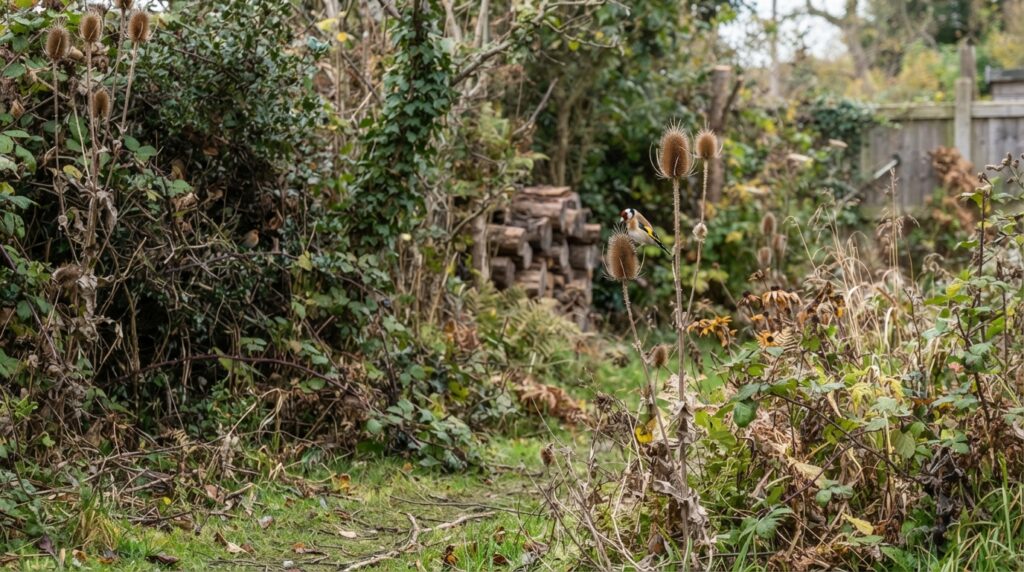
- Leave a rough corner — log piles, long grass and leaf litter all shelter something
Our guide on where garden birds sleep covers how they survive freezing nights.
Hygiene still applies — arguably more
Cold weather concentrates birds at feeders in larger numbers than any other time of year. That’s exactly the condition disease needs.
Keep to the weekly clean — hot soapy water, non-toxic disinfectant, rinse, dry fully — and move the feeder to a fresh spot each time. It’s less appealing in January than in June, but it matters more.
If you see birds looking fluffed up and lethargic, struggling to swallow or reluctant to fly, that may be trichomonosis rather than cold. See our guide on sick birds at the feeder — the response is different, and involves stopping feeding temporarily.
Well-meant mistakes
| Don’t | Why |
|---|---|
| Add anything to water to stop it freezing | Salt, antifreeze, glycerine and oil are all harmful. No exceptions |
| Put out bread | Fills birds up with almost no usable energy — the opposite of what’s needed in a freeze |
| Cook the porridge oats | Sets hard around the beak. Raw is fine |
| Put out warm or hot food | Unnecessary, and can scald. Room temperature is fine |
| Use salted or roasted nuts | Salt is harmful in quantities we’d consider trivial |
| Bring a cold bird indoors | Stress can kill. Unless it’s injured or cat-caught, leave it alone |
| Break ice violently while birds watch | Startles them into flying off when they most need to conserve energy |
If you find a bird that seems in trouble
Birds fluff up in cold weather to trap air — a round, puffed-up bird is insulating itself, not necessarily ill.
Signs that something is genuinely wrong: sitting still for long periods without reacting to disturbance, visible injury, being unable to fly, or having been caught by a cat.
Any bird caught by a cat needs urgent veterinary attention, even with no visible injury. Bacteria in a cat’s mouth cause rapidly fatal infection without antibiotics.
Contact the RSPCA (England and Wales), Scottish SPCA (Scotland), USPCA (Northern Ireland), or a local wildlife rescue. Many vets accept injured wildlife without charge.
Common questions
Should I feed more in cold weather?
Feed more often rather than more at once. Twice daily in modest amounts beats one big fill that sits and freezes.
Why are birds bathing when it’s freezing?
Feather maintenance. Clean, correctly aligned feathers insulate far better, so bathing is part of how a bird survives the cold rather than a lapse of judgement.
Do birds’ feet freeze on metal feeders?
No. Birds’ legs and feet have a counter-current heat exchange system that limits heat loss, and there’s minimal soft tissue to freeze. It’s the same reason ducks can stand on ice.
Should I use a heated bird bath?
They exist and work, though they’re far less common in the UK than in North America. Warm water twice a day achieves much the same for nothing.
What are the brown thrush-like birds that turned up in the snow?
Very likely redwings or fieldfares — Scandinavian winter thrushes that move into gardens during hard weather looking for fruit. Windfall apples will keep them coming back.
Will feeding stop birds foraging naturally?
No. Supplementary feeding is exactly that — supplementary. Birds continue to forage, and garden feeders typically make up a portion of their intake rather than all of it.
Related guides
- Best bird food for winter: what to put out and what to skip
- Bird baths: choosing one, siting it, and stopping it freezing
- Where do garden birds sleep at night?
- Winter visitors: birds that only appear in UK gardens in winter
Sources: RSPB guidance on helping birds in cold weather and on providing water; RSPB feeding guidance (April 2026); British Trust for Ornithology; RSPCA guidance on injured wild birds.
Compare sunflower hearts and suet at Amazon UK. Prices and stock change often, so it is worth checking before you commit.
Browse bird food →