Affiliate disclosure: some links on this page go to Amazon. If you buy through one we may earn a small commission, at no extra cost to you. Full disclosure.
If food disappears overnight rather than during the day, the usual suspects are brown rats, wood mice, hedgehogs (eating spillage on the ground), badgers or foxes. Squirrels are daytime-only, so they’re ruled out. The fix for nearly all of them is the same: stop the spillage.
A feeder that’s full at dusk and empty at dawn is a different problem from one being emptied during the day. Knowing which animal it is decides what to do about it — and in one case, changes what you should be putting out.
Quick identification
- Feeder itself emptied, chewed → rats (they climb well)
- Small amounts gone, tiny droppings → wood mice
- Only ground spillage gone, no damage → hedgehog
- Feeder knocked over, ground dug up → badger
- Whole feeder missing or dragged → fox
- Daytime only → squirrels, not night visitors
Brown rats
The most likely and the least welcome.
Signs: dark tapered droppings around 1–2cm, worn runs through grass or under hedges, burrows 6–9cm across near sheds or compost heaps, gnaw marks on feeders and bins, and disturbed soil beneath the feeder.
Worth knowing: rats climb considerably better than people expect. A pole, a fence, a wall or an overhanging branch is a route, and a smooth metal pole with a baffle is one of the few things that genuinely stops them.
The important point is that rats are after the spillage, not the feeder itself. They turn up because seed accumulates on the ground.
Our full guide to rats and bird feeders covers the fix in detail, but the summary: switch to sunflower hearts (no husk, minimal waste), stop ground feeding, clear the ground thoroughly, feed smaller amounts, store food in a sealed metal bin, and if it persists, pause feeding entirely for two to three weeks.
Please don’t reach for poison. Poisoned rats become slow and easy to catch, and are then eaten by owls, kestrels, foxes, cats and dogs. This secondary poisoning is a documented and serious problem — UK monitoring has repeatedly found rodenticide residues in the majority of barn owls tested. You’d be poisoning the predators that would otherwise control rats for you.
Removing the food source works, and doesn’t have that consequence.
Wood mice
Far more common than people realise, and much less of a problem.
Signs: small amounts of seed gone rather than a whole feeder emptied. Tiny dark droppings, a few millimetres long. Occasionally small neat holes in the ground.
Wood mice are native, attractive, and excellent climbers — they’ll go up a pole or along a fence to reach a feeder. They’re also an important prey species for owls and kestrels.
What to do: honestly, usually nothing. A few wood mice taking spilled seed isn’t a problem in the way rats are. If you’d rather they didn’t, the same measures work — reduce spillage, clear the ground, store food securely.
Hedgehogs
The one that changes what you should put out.
Signs: ground spillage cleared but no damage to the feeder itself, and no gnawing. Hedgehogs can’t climb a pole. You may hear them — they’re surprisingly noisy, snuffling and rustling through leaf litter.
Hedgehogs are declining in the UK and a garden visitor most people are pleased to have. They’re eating the fallen seed and, more usefully, the invertebrates attracted to it.
An important warning about mealworms. Dried mealworms are widely put out for birds and hedgehogs alike, but they are harmful to hedgehogs in anything more than tiny quantities. They’re very high in phosphorus and low in calcium, and a hedgehog eating them regularly can develop serious metabolic bone disease — effectively drawing calcium out of its own skeleton.
If you have hedgehogs, don’t scatter dried mealworms on the ground. Offer them in a raised dish birds can reach and hedgehogs can’t, and clear any leftovers before dusk. Wildlife charities have campaigned on this specifically, because well-meaning people cause real harm with it.
If you want to feed hedgehogs, meat-based wet cat or dog food, or a proper hedgehog food, is appropriate — never bread or milk.
Badgers
Signs: considerably more disruption than anything else on this list. Feeders knocked over or pulled down, poles bent, ground dug up in shallow snuffle holes, and gaps pushed under fences.
Badgers are strong and will happily flatten a feeding station to get at spilled seed.
What to do: clear ground spillage religiously, bring feeders in overnight if it’s persistent, and make sure any pole is properly anchored. There’s not much else — a badger determined to get into a garden generally will.
Badgers and their setts are protected under the Protection of Badgers Act 1992. It’s an offence to interfere with a sett, and deterrence must stop well short of harming them. If badgers are causing real damage, take advice rather than acting on your own.
Foxes
Signs: the feeder dragged some distance or missing entirely, scattered debris, sometimes a strong musky smell.
Foxes aren’t especially interested in seed, but will take suet and fat balls, and will investigate anything that smells of food — particularly kitchen scraps put out for ground feeders.
What to do: don’t put out kitchen scraps overnight, clear anything not eaten by dusk, and secure feeders properly.
Deer
Less common but not rare, particularly on rural edges and increasingly in suburbs with muntjac or roe deer.
Signs: feeders emptied at height rather than from the ground, bent or damaged brackets, and hoof marks in soft soil. Deer can reach considerably higher than most people plan for.
What to do: raise feeders further, or move them somewhere enclosed.
How to find out for certain
Guessing from indirect signs only gets you so far. If you want to know:
- A trail camera is the definitive answer, and inexpensive ones work perfectly well for this. Set it facing the ground beneath the feeder rather than the feeder itself, since that’s where most of the activity is
- Smooth a patch of soil or sand beneath the feeder before dark and check for tracks in the morning
- Note the pattern — a whole feeder emptied suggests rats or badgers; small amounts suggests mice; only ground spillage suggests hedgehogs
- Look at the timing — anything happening in daylight is squirrels or birds, not night visitors
The fix that covers nearly all of them
Almost every night visitor is there for the same reason: food on the ground. Remove that and most of the problem goes.
- Switch to sunflower hearts. No husk means birds eat the whole thing and almost nothing reaches the ground
- Stop using cheap mixed seed. The wheat and split peas birds won’t eat are precisely what feeds rats overnight
- Feed smaller amounts, eaten within a day or two — which is the current guidance anyway
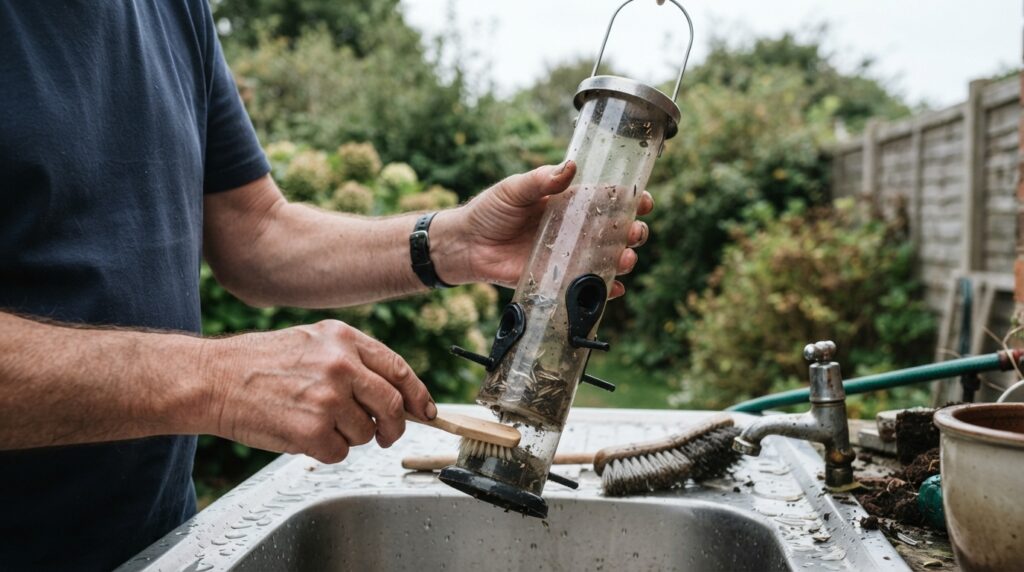
- Clear the ground weekly, alongside the feeder clean
- Stop ground feeding and kitchen scraps while you have a problem
- Store food in a sealed metal bin
- Bring feeders in overnight if it persists — put them back at first light, which is when birds most need them
Common questions
Could it be squirrels?
Not overnight. Grey squirrels are active in daylight. If your feeder empties during the day, see our squirrel guide.
Are mice as bad as rats?
No. Wood mice are native, take far less, cause no structural damage, and are important prey for owls. Most people can reasonably leave them alone.
Can I keep feeding birds if I have rats?
Yes, with changes — sunflower hearts only, small amounts, no ground feeding, ground cleared. If it persists, a two to three week pause usually breaks the pattern.
Is it bad that hedgehogs eat the spillage?
Not in itself. The one genuine concern is dried mealworms, which cause serious bone problems in hedgehogs. Keep those in a raised dish, not on the ground.
Should I bring feeders in every night?
Only if you have a real problem. Birds need food available at first light, so if you do bring them in, put them straight back out at dawn.
Related guides
- Rats under the bird feeder: how to stop attracting them
- How to stop squirrels raiding your bird feeder
- Best bird food for winter: what to put out and what to skip
- Can birds eat bread, porridge oats or cheese?
Sources: RSPB guidance on rodents and bird feeding; British Hedgehog Preservation Society and wildlife rescue guidance on mealworms and metabolic bone disease; RSPB and Barn Owl Trust information on secondary rodenticide poisoning; Protection of Badgers Act 1992.
Compare sunflower hearts and suet at Amazon UK. Prices and stock change often, so it is worth checking before you commit.
Browse bird food →