Yes, some do. Corvids — crows, magpies, jackdaws — have been shown in research to recognise and remember individual human faces, and to hold grudges. Robins and tits learn routines and individual gardeners well enough to appear at the sound of a back door. As for lifespan: most small garden birds average only two to three years, though individuals can live far longer.
Two questions people ask constantly about their garden birds, and both have more interesting answers than you’d expect.
The short version
- Crows and magpies genuinely recognise individual human faces
- Robins learn individual people, routines and sounds
- Most small birds average 2–3 years, with very high first-year mortality
- Individuals can live much longer — ringing has recorded blackbirds past 20 years
- Yes, it probably is the same robin — they hold small year-round territories
Do they actually recognise you?
Corvids: yes, demonstrably
The strongest evidence concerns the crow family. Research — most famously a long-running study in which researchers wore particular masks while handling crows — found that the birds subsequently recognised and scolded people wearing those masks, avoided them, and that this recognition spread through the local population to birds that had never been handled themselves.
The birds remembered for years.
Magpies and jackdaws show comparable abilities. Jackdaws in particular are sensitive to human eye direction, and respond differently to a person looking at them than one looking away.
So if you’ve ever felt a magpie was watching you specifically, that’s not necessarily imagination.
Robins: routines, and probably you
Robins are the garden bird most people feel a relationship with, and there’s a reason.
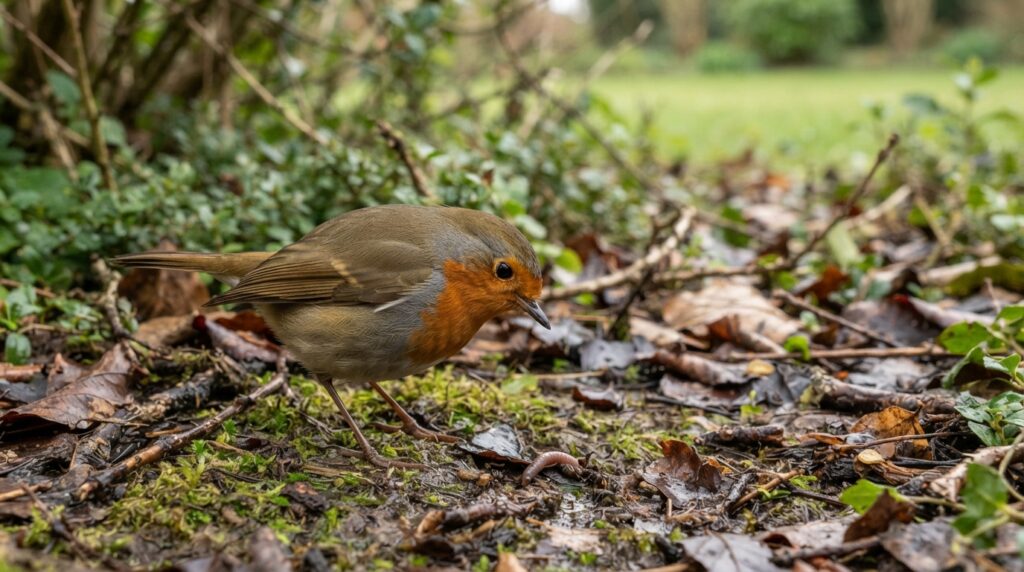
In woodland, robins follow wild boar and deer to take invertebrates from disturbed ground. A person with a spade occupies exactly the same niche — which is why a robin will appear within moments of you starting to dig, often within a metre or two.
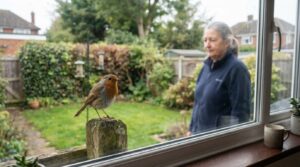
They learn routines reliably: the time you come out, the sound of the back door, the rattle of a seed tub. Individual robins can be trained over weeks to take mealworms from a hand, always in the same spot at the same time.
Whether that’s facial recognition in the corvid sense is less well established. What’s clear is that they learn to associate a specific person’s presence and behaviour with food, and behave differently towards that person than a stranger.
Tits and other feeder birds
Blue tits and great tits are quick learners generally — the classic example being tits learning to open foil milk bottle tops in the mid-20th century, a behaviour that spread across the country through social transmission.
They’ll certainly learn that a particular window, door or time of day means food. Most people who feed regularly notice birds gathering before the food actually appears.
Is it the same bird every day?
Usually, yes — and for robins, almost certainly.
Robins hold small territories year-round, which is unusual among British birds. A typical garden falls within one bird’s patch. If you see a robin daily in the same spot, it’s very likely the same individual, and it will be there for as long as it holds that territory.
Blackbirds and dunnocks are similar, though territories shift more.
Tits are different. A garden might be visited by considerably more blue tits than you’d guess — ringing studies consistently show that far more individuals pass through a feeder than are ever present at once. The two blue tits on your feeder now may not be the two that were there an hour ago.
How to tell: look for distinguishing marks. Slight plumage differences, a missing feather, a leg ring, an odd pale patch. Partial leucism — patches of white feathering — is fairly common in blackbirds and makes individuals recognisable for years.
How long do garden birds live?
Shorter than most people expect, and the averages are dragged down heavily by first-year mortality.
| Bird | Typical lifespan |
|---|---|
| Blue tit | Around 2–3 years |
| Great tit | Around 2–3 years |
| Robin | Around 2 years |
| Blackbird | Around 3 years |
| House sparrow | Around 3 years |
| Wren | Around 2 years |
| Goldfinch | Around 2–3 years |
The crucial caveat: these averages include the very high proportion of young birds that don’t survive their first winter. A great many fledglings die within months of leaving the nest — from predation, starvation, weather and inexperience.
A bird that makes it through its first year has a considerably better outlook, and individuals recorded through ringing have lived far longer than the averages suggest. Ringing recoveries include blackbirds past twenty years and blue tits into double figures — exceptional, but real.
Why so short?
Small birds live fast. High metabolic rates, constant predation risk, and no reserves to fall back on — a blue tit can lose a significant share of its body weight over a single cold night.
The evolutionary answer is to breed prolifically rather than live long. A pair of blue tits laying eight to twelve eggs in a single brood is making that trade explicitly.
Larger birds do better: corvids commonly live well over a decade, and some considerably longer.
What this means for feeding
Two things worth taking from it.
Consistency matters more than quantity. Birds learn routines and return to reliable food sources. A modest amount put out at the same time each day does more than an occasional large fill.
The hard times are what count. Given how narrow the margin is, food and unfrozen water during a freeze genuinely affect survival in a way that summer feeding doesn’t. That’s part of the reasoning behind the current guidance to concentrate seed and peanut feeding between 1 November and 30 April — see our seasonal feeding guide.
Common questions
Does my robin know me?
It knows your routine, your sounds, and very likely you as an individual associated with food. Whether that’s facial recognition in the way corvids manage is less certain — but the behaviour is real and not imagined.
Do magpies really hold grudges?
Corvids demonstrably remember individuals who have threatened them, sometimes for years, and can pass that wariness to other birds. So yes, broadly.
Why did my robin disappear?
Given a typical lifespan of around two years, robins are replaced fairly often. A new bird usually takes over a vacant territory quickly, which is why people sometimes think “their” robin has come back after a gap.
How many blue tits actually visit my feeder?
Far more than are ever there at once. Ringing studies consistently find that the number of individuals passing through a garden over a season is many times the number visible at any moment.
Can I tell how old a garden bird is?
Rarely with any precision by sight. Juveniles are distinguishable in their first months — young robins have no red breast, young starlings are plain brown — but after the first moult, age is generally not visible.
What’s the leg ring for?
Scientific ringing, run under licence by the BTO. Each ring has a unique number, and recoveries build the data behind everything known about lifespan and movement. If you find a ringed bird, dead or alive, the number is worth reporting.
Related guides
- What do robins eat? Feeding Britain’s favourite garden bird
- Black birds in your garden: crow, rook, jackdaw or something else?
- Where do garden birds sleep at night?
- When to feed garden birds: the new UK guidance explained
Sources: British Trust for Ornithology ringing scheme data on lifespan and survival; published research on facial recognition in corvids; RSPB species information; BTO Garden BirdWatch.
Compare current prices on bird food and feeders at Amazon UK. Prices and stock change often, so it is worth checking before you commit.
Browse bird food →