Six black or mostly-black birds turn up in British gardens, and they separate out quickly once you know what to look at: size, bill shape, and whether the bird is alone or in a group.
The crow-versus-rook question is the one people ask most, and there’s a genuinely reliable answer below.
The quick test
- Blackbird-sized, orange bill → Blackbird
- Blackbird-sized, iridescent, spotted, walks, in flocks → Starling
- Black and white with a long tail → Magpie
- Smaller, grey nape, pale eye → Jackdaw
- Large, all black, alone or in a pair → Carrion Crow
- Large, bare grey face, in a noisy group → Rook
Crow or rook? The reliable answer
There’s an old birding saying: a rook on its own is a crow, and crows in a flock are rooks. It’s a decent rule of thumb, but here’s what actually separates them.
| Carrion Crow | Rook | |
|---|---|---|
| Bill base | Feathered right to the bill | Bare greyish-white skin at the base — the single best feature |
| Bill shape | Thick, blunt, curved | Longer, straighter, more pointed |
| Head | Flat crown | Peaked, domed crown |
| Legs | Neat | Shaggy “trousers” of loose feathering on the thighs |
| Plumage | Glossy black, greenish sheen | Black with a purplish sheen |
| Company | Alone or in pairs | Sociable — usually in groups |
| Nesting | Solitary nest in a tree | Colonial — rookeries of many nests in treetops |
| Call | A harsh, deliberate “kaaw”, often repeated three times | A flatter, more nasal “kaah” |
If you can only check one thing: look at the base of the bill. A rook has an obvious patch of bare, pale, greyish skin where the feathers stop. A carrion crow is feathered right up to the bill. It’s visible at surprising distance and it’s definitive.
One caveat: juvenile rooks haven’t developed the bare face yet and look very crow-like. In late spring and summer, use the peaked crown and the fact that they’re in a group.
Where you’ll see each
Carrion crows are widespread across England, Wales and southern Scotland, in gardens, parks and towns. In north-west Scotland and Ireland they’re replaced by the hooded crow — same shape but with a grey body and black head and wings, which is unmistakable.
Rooks favour farmland and open country with tall trees. They’re less common in dense urban gardens but very obvious near rookeries.
Jackdaw
The easiest of the crow family to identify once you’ve noticed the two key features.
Size: noticeably smaller than a crow or rook — roughly pigeon-sized.
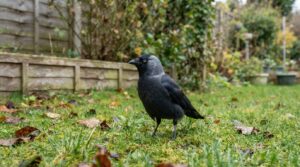
Look for: a grey nape and cheeks contrasting with a black cap, and a pale, silvery-white eye. Nothing else in the group has a pale eye, and it’s striking at close range.
Behaviour: sociable, often in pairs within a larger flock — jackdaws pair for life and you can usually pick out the pairs. Bold, inquisitive and comfortable around people. The call is a short, sharp “chack”, which is where the name comes from.
In gardens: will readily take food from feeders and the ground. Frequently nests in chimneys, which can be a genuine fire risk if the flue is in use — see our guide to birds nesting in roofs.
Magpie
Unmistakable: black and white, with a long tail that shows a green-blue iridescence in good light.
Behaviour: bold, intelligent, noisy — a harsh rattling chatter. Often in small groups outside the breeding season.
The reputation: magpies do take eggs and nestlings in spring, and it’s genuinely unpleasant to watch. But it’s worth knowing that research — including long-term BTO analysis — has not found magpie predation to be a driver of songbird population declines nationally. Songbird numbers in areas with many magpies are broadly comparable to areas with few.
If you want to protect nests, dense thorny hedging and well-sited nest boxes do far more than resenting the magpies. Magpies are also protected under the Wildlife and Countryside Act 1981.
Blackbird
Size: about 25cm — much smaller than the crow family.
Male: glossy jet black with a bright orange-yellow bill and matching eye-ring. The bill colour is the giveaway at any distance.
Female: brown, not black — which catches people out constantly. Dark brown with a slightly paler, faintly mottled throat.
Behaviour: hops, feeds on the ground, runs a few paces then stops to listen for worms. Turns over leaf litter noisily.
Full detail in our blackbird guide.
Starling
Looks black at a distance and is anything but up close.
Look for: in good light, an iridescent green and purple sheen over black, heavily spangled with white spots in winter. The bill is yellow in summer, dark in winter.
Shape: shorter-tailed and more upright than a blackbird, with a triangular look in flight from the pointed wings.
The behavioural giveaway: starlings walk; blackbirds hop. Once you’ve noticed this you’ll never confuse them again.
Also: arrives in noisy flocks, and is an exceptional mimic — a starling copying a car alarm, a phone or another bird is entirely normal.
Despite seeming abundant, starlings are on the UK Red List following substantial population decline.
Full comparison
| Bird | Size | Key feature | Alone or group? |
|---|---|---|---|
| Blackbird | 25cm | Orange bill (male); female is brown | Alone or in pairs |
| Starling | 21cm | Iridescent, spotted, walks | Flocks |
| Jackdaw | 34cm | Grey nape, pale eye | Pairs within flocks |
| Magpie | 45cm | Black and white, long tail | Pairs or small groups |
| Carrion Crow | 47cm | Feathered bill base, flat crown | Alone or in pairs |
| Rook | 46cm | Bare grey face, peaked crown | Groups, colonial nests |
Less likely, but possible
- Raven — much larger than a crow, with a huge bill, shaggy throat feathers and a diamond-shaped tail in flight. A deep “cronk” call. Increasingly widespread but rarely a garden bird
- Hooded crow — grey body, black head and wings. North-west Scotland, the Isle of Man and Ireland
- Chough — glossy black with a bright red curved bill and red legs. Coastal west Wales, Cornwall, Isle of Man, western Scotland and Ireland. Unmistakable if you see one
- Blackcap — nothing like the others. A small grey warbler with a neat black cap (male) or reddish-brown cap (female). Increasingly overwinters in UK gardens and will visit feeders
Should you feed them?
Crows, rooks, jackdaws and magpies will happily take food from a garden, and some people would rather they didn’t — mostly because they dominate feeders and deter smaller birds.
If you want to limit them without excluding everything:
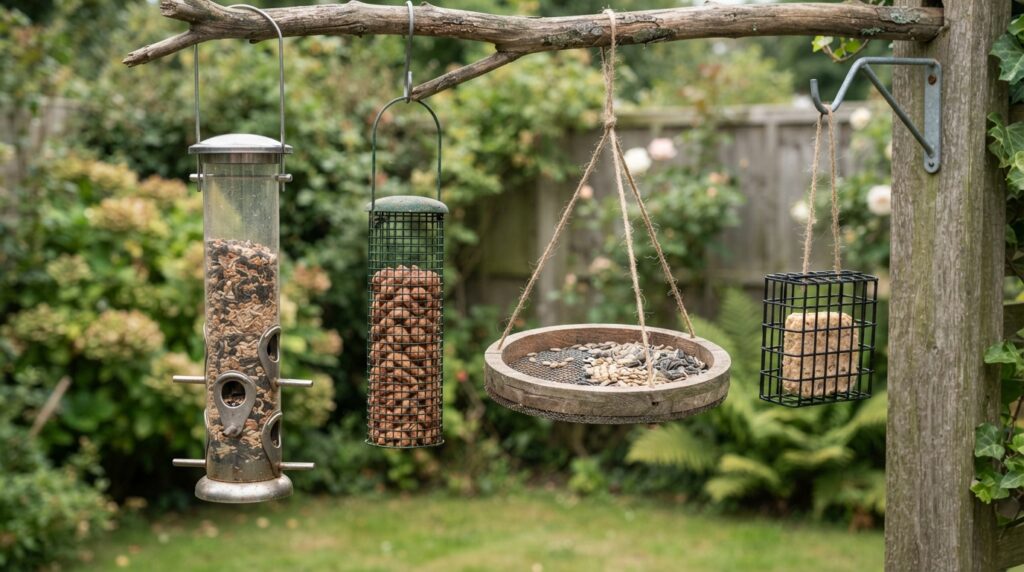
- Caged feeders admit small birds and exclude all the corvids
- Remove flat surfaces — they need somewhere to stand
- Avoid ground feeding and kitchen scraps
- Feed smaller amounts more often
More in our guide to stopping larger birds hogging the feeder.
All of these birds are protected under the Wildlife and Countryside Act 1981. Exclusion is the only appropriate approach.
Common questions
What’s the difference between a crow and a rook, in one line?
The rook has bare greyish skin at the base of its bill; the crow is feathered right up to it. Rooks are also sociable, crows usually solitary.
Is a jackdaw a type of crow?
Yes — jackdaws, rooks, crows, magpies, jays and ravens are all corvids. Jackdaws are the smallest of the black ones, with the grey nape and pale eye.
Do magpies really kill songbirds?
They take eggs and chicks in spring. But long-term research hasn’t found this to be a cause of songbird population declines nationally.
Why does my “blackbird” have spots?
Probably a starling in winter plumage, or a juvenile blackbird. Check the bill and whether it walks or hops.
Are crows a sign of anything bad?
No. They’re intelligent, adaptable birds attracted by food and open ground. The folklore is just folklore.
Can I stop jackdaws nesting in my chimney?
Not while a nest is active — that’s an offence. Cap the chimney between September and February. See our roof nesting guide.
Related guides
- Common garden birds in the UK: how to identify your visitors
- Small brown birds in your garden: how to tell them apart
- What do blackbirds eat? How to feed and attract them
- How to stop pigeons and starlings taking all the bird food
Sources: RSPB bird identifier and species information; British Trust for Ornithology research on corvid predation and songbird populations; Woodland Trust identification guides; Wildlife and Countryside Act 1981.
Compare current prices on bird food and feeders at Amazon UK. Prices and stock change often, so it is worth checking before you commit.
Browse bird food →