Affiliate disclosure: some links on this page go to Amazon. If you buy through one we may earn a small commission, at no extra cost to you. Full disclosure.
Rats aren’t after your feeder. They’re after what falls out of it.
That distinction matters, because it points straight at the fix: eliminate the spillage and you eliminate the food source. Switching to sunflower hearts and clearing the ground beneath solves most cases within a couple of weeks.
What to change, in order
- Switch to sunflower hearts — no husk, dramatically less waste
- Stop all ground feeding immediately
- Clear the ground beneath feeders thoroughly
- Feed smaller amounts that get eaten the same day
- Store food in metal — rats chew through plastic bins and sacks
- Pause feeding entirely for a fortnight if the problem persists
Why they’ve turned up
A bird feeder creates a small, reliable, daily supply of high-calorie food on the ground. To a brown rat, that’s an unusually good deal.
Three things typically drive it:
Spilled seed. The main cause. Birds are messy eaters, and mixed seed is the worst — birds flick out the wheat, barley and split peas they don’t want, and it accumulates.
Ground feeding. Food deliberately placed on the ground, or on a low table, is effectively a rat feeding station.
Overfilling. A brimming feeder topped up weekly spills far more than a small amount topped up daily.
Rats are mostly nocturnal, so by the time you see one in daylight the population is usually established. Seeing one at midday often means several are around.
1. Change the food
The highest-impact single change.
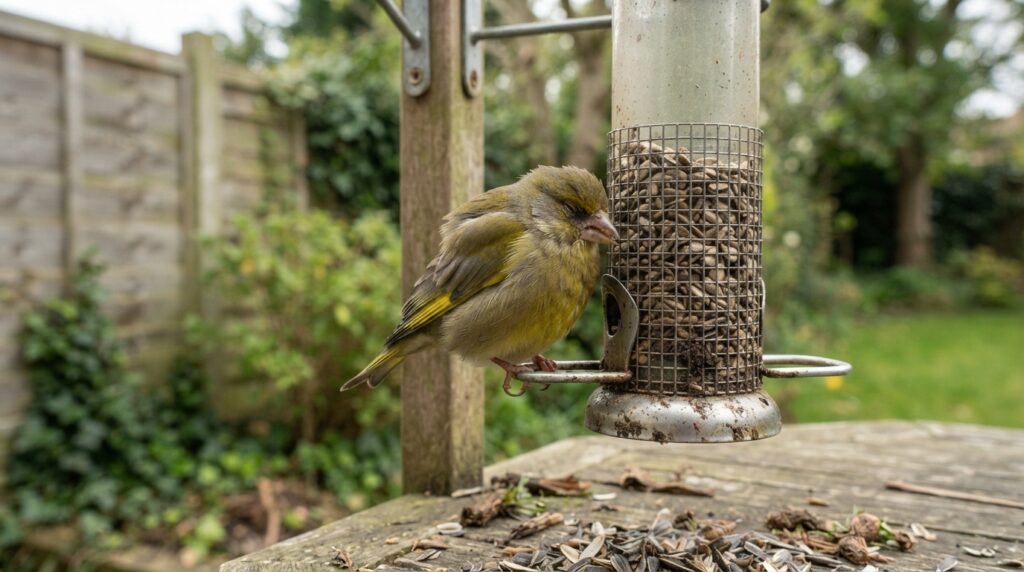
Sunflower hearts have the husk already removed. Birds eat the whole thing, so almost nothing reaches the ground. Compare that to black sunflower seeds, where every seed produces a discarded husk.
Stop using cheap mixed seed. Budget mixes padded with wheat, barley, split peas and dried rice are the single worst thing for rats — most garden birds won’t eat the filler, so it all ends up underneath.
Suet in a cage generates very little waste and is a good option year-round.
Avoid loose peanuts and kitchen scraps while you have a problem.
2. Stop ground feeding
Completely, while the problem lasts. That includes scattered seed, ground trays, and low bird tables.
This aligns with current RSPB guidance anyway — flat-surfaced feeders and ground feeding stations are no longer recommended, for disease reasons unrelated to rats.
Ground-feeding birds like blackbirds and robins will still find suet fragments dropped from a hanging feeder. See our blackbird guide for the practical middle ground.
3. Clear the ground properly
Not a quick sweep — properly.
- Rake up accumulated husks, dropped seed and droppings beneath every feeder
- If it’s on a lawn, this may mean lifting a layer of matted debris
- On paving, brush and wash down
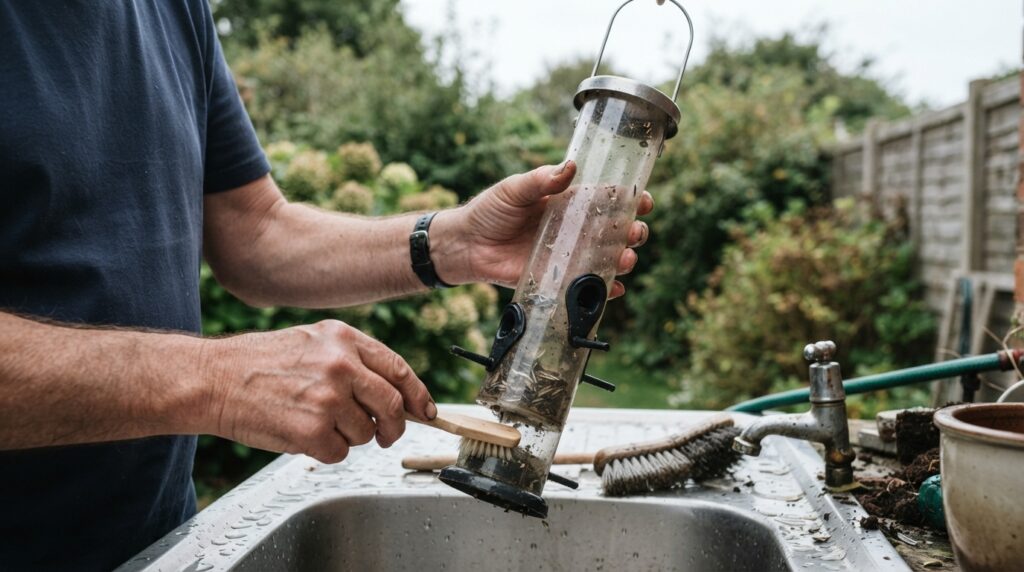
- Do this weekly from now on, alongside the feeder clean
You’re also removing a disease reservoir, which is why current guidance asks you to move feeders to a new spot after each weekly clean.
4. Rethink placement
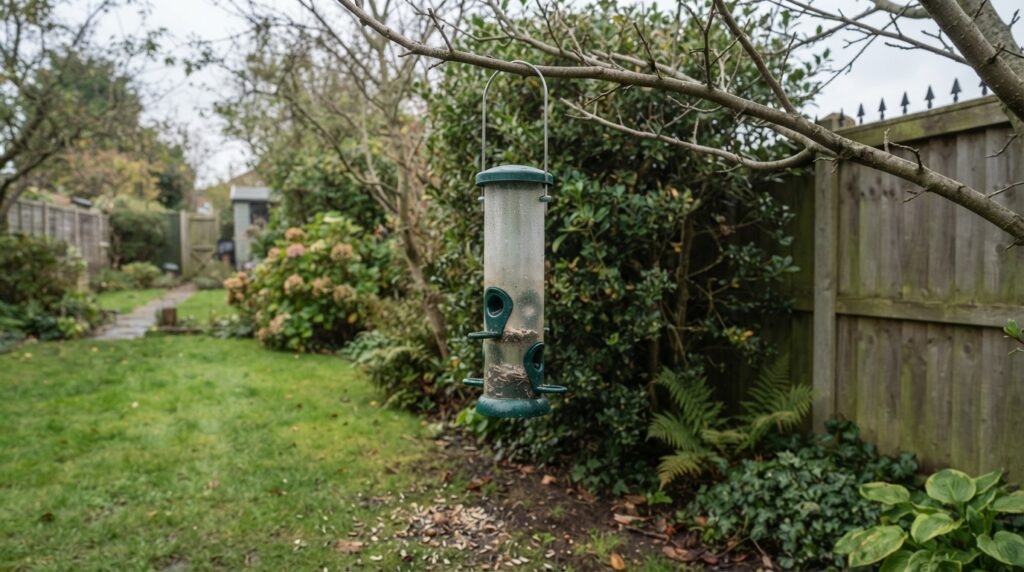
- Move feeders away from cover — rats avoid crossing open ground. A feeder near a fence line, shed base, compost heap or dense hedge is a rat’s ideal location
- Away from sheds and decking, which are common harbourage
- Onto paving rather than grass if possible, so spillage is visible and easy to sweep
- Raise the feeder — rats climb well, but height plus a smooth pole and a baffle makes access harder
A squirrel baffle on a smooth metal pole is also a reasonable rat deterrent, since both are climbing the same pole.
5. Store food properly
Frequently overlooked, and sometimes the actual source of the problem.
Rats chew through paper sacks and plastic bins without difficulty. A 20kg bag of seed in a shed is a far better prize than the handful under your feeder.
Use a metal bin with a tight lid. Keep it off the floor if you can, check regularly for gnaw marks, and don’t leave part-used sacks open.
6. Pause feeding if needed
If you’ve done all of the above and rats are still around, stop feeding entirely for two to three weeks.
Rats move on when a food source dries up. Bird populations don’t collapse in a fortnight — they’ll find food elsewhere and return when you resume.
When you do restart: sunflower hearts only, small amounts, no ground feeding, cleared daily.
Timing note: if it’s between 1 May and 31 October, you should be pausing seeds and peanuts anyway under current RSPB guidance. That six-month window is a natural opportunity to break a rat cycle — offer only small amounts of suet in a cage during it.
On poison — please don’t
Rodenticide is a genuinely bad idea in a garden where you feed birds.
Poisoned rats don’t die immediately. They become slow and easy to catch — and are then eaten by owls, kestrels, buzzards, foxes, cats and dogs. This is secondary poisoning, and it’s a documented, significant problem: monitoring in the UK has repeatedly found rodenticide residues in the majority of barn owls tested.
You’d be poisoning exactly the predators that would otherwise control rats for you.
UK rodenticide use is also increasingly restricted, with professional certification required for many products and specific rules on outdoor use.
If you need intervention beyond exclusion, contact your local council’s pest control service or a qualified professional who can advise on approaches that don’t put wildlife at risk. Removing the food source remains the first and most effective step regardless.
What about traps?
Snap traps are legal but need care — they can injure hedgehogs, birds and pets. If used at all, they must be in a proper covered tunnel or bait station that excludes non-target animals.
Live-catch traps raise a practical problem: releasing a rat elsewhere simply moves it to someone else’s garden, and released animals often don’t survive.
Honestly, exclusion works better and is less unpleasant.
Signs to look for
- Droppings — dark, tapered, around 1-2cm, usually along walls or fence lines
- Runs — worn tracks through grass or under hedges
- Burrows — holes 6-9cm across, often near sheds, compost heaps or decking
- Gnaw marks on feeders, sheds, bins or sacks
- Disturbed soil beneath feeders
- Seed disappearing overnight rather than during the day
Common questions
Do bird feeders always attract rats?
No. A well-managed feeder with no-waste food, no ground feeding and a clean base rarely does. It’s the spillage, not the feeder.
Should I stop feeding birds completely?
Not permanently. A two to three week pause usually breaks the pattern, after which you can resume with the changes above.
Are rats dangerous to my birds?
Rats will take eggs and nestlings if they can reach them, so keeping them away from nest boxes matters. The bigger issue for most people is having rats in the garden at all.
Will a cat sort it out?
Unreliably. Cats catch some rats, but adult brown rats are large and cats often prefer easier prey — including your garden birds.
Is it my neighbour’s feeder, not mine?
Possibly, and rats range widely. Worth a friendly conversation — the measures here only work if everyone nearby does them.
Rats are climbing the pole. Now what?
A baffle on a smooth metal pole helps, as does moving the feeder away from anything they can jump from. Ultimately, removing the spilled food underneath is what makes the trip not worth their while.
Related guides
- Best bird food for winter: what to put out and what to skip
- How to clean a bird feeder — and why it now matters more
- How to stop squirrels raiding your bird feeder
- When to feed garden birds: the new UK guidance explained
Sources: RSPB guidance on rodents and bird feeding; RSPB and Barn Owl Trust information on secondary rodenticide poisoning in birds of prey; UK rodenticide stewardship guidance; RSPB feeding guidance (April 2026).
Compare rodent-proof seed storage at Amazon UK. Prices and stock change often, so it is worth checking before you commit.
Browse seed storage →