For blue tits and great tits: roughly two weeks of incubation, then about three weeks in the nest before fledging — so around five weeks from the last egg to an empty box. Most UK boxes are empty by mid-June. Blackbirds and robins are much quicker, leaving the nest after about two weeks.
If you’ve got a nest box with birds in it, the natural question is how long this goes on for and when something will happen.
Here’s the timeline, plus the answer to the question everyone asks about touching nests.
Blue tit timeline at a glance
- Nest building: 1–2 weeks, late March to April
- Laying: one egg a day, typically 8–12 eggs
- Incubation: about 14 days, starting after the last egg
- In the nest: about 18–21 days
- Fledging: usually late May to mid-June
- One brood a year — they don’t do it twice
The stages, in order
1. Prospecting — February to March
Birds inspect boxes, sometimes several, going in and out repeatedly. This can go on for weeks before anything is decided, and a box being visited isn’t a box being used.
This is also why putting boxes up in autumn works better than spring — birds roost in them over winter and a familiar box is more likely to be chosen.
2. Nest building — late March to April
The female does the building, carrying in moss, then grass and hair, finally lining the cup with feathers. It takes one to two weeks.
3. Laying — April to early May
One egg per day, usually early in the morning. A blue tit clutch is typically 8 to 12 eggs — one of the largest of any British bird — and can be more.
The eggs are covered with nest material between visits, and the female doesn’t start incubating until the clutch is complete. That’s deliberate: it means all the eggs develop together and hatch within a day of each other.
4. Incubation — about 14 days
The female sits; the male brings food. From the outside the box goes quiet, which sometimes convinces people it’s been abandoned. It usually hasn’t.
5. Chicks in the nest — about 18 to 21 days
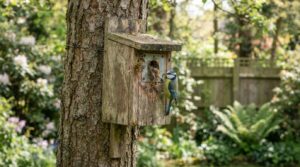
The busy phase, and remarkable to watch from a distance. Both parents feed the brood almost continuously through daylight hours, and a pair of blue tits may deliver several hundred caterpillars a day.
This is why the whole thing is timed to the caterpillar peak, and why avoiding insecticides matters far more than what’s in your feeder. Chicks are fed on invertebrates, not seed.
You’ll hear the noise from inside the box increase over the three weeks.
6. Fledging — late May to mid-June
The young leave, usually over a few hours on a single morning, and usually all together.
They can fly, but not well. For the first week or so they’re clumsy, hide in cover, and are still fed by their parents.
A fledgling on the ground is usually fine. Most young birds found in gardens in late spring don’t need rescuing — the parents are nearby and still feeding them. See our guide on finding a baby bird before intervening.
Other garden birds
| Species | Incubation | In nest | Broods per year |
|---|---|---|---|
| Blue tit | ~14 days | 18–21 days | 1 |
| Great tit | ~14 days | 18–21 days | 1 |
| Robin | ~13 days | 13–14 days | 2–3 |
| Blackbird | ~14 days | 13–14 days | 2–3 |
| House sparrow | ~12 days | ~17 days | 2–3 |
| Starling | ~12 days | ~21 days | 1–2 |
| Wren | ~16 days | ~17 days | 1–2 |
The pattern worth noticing: open-nesting birds like robins and blackbirds get their young out fast — around two weeks — because an open cup nest is vulnerable. Hole-nesting birds like tits can afford three weeks in relative safety.
It also explains the brood counts. Tits raise one large brood timed to the caterpillar peak; blackbirds and robins raise two or three smaller ones across a longer season.
Does touching a nest make birds abandon it?
The question everyone asks, and the answer has two halves.
The myth part: the idea that birds smell human scent and reject eggs or chicks is not correct. Most birds have a limited sense of smell and don’t abandon a nest because it’s been touched.
The part that’s true anyway: you still shouldn’t.
- Disturbance genuinely can cause abandonment, particularly during incubation and particularly if repeated. It’s the disruption, not the scent
- You can cause premature fledging. Opening a box with well-grown chicks can make them explode out before they’re ready, which usually kills them
- You may leave a scent trail for mammals. Foxes and cats do have a good sense of smell, and a path worn to a nest is an invitation
- It’s an offence. Under the Wildlife and Countryside Act 1981 it’s illegal to intentionally disturb, damage or destroy an active nest. Some species have additional protection making even reckless disturbance an offence
The practical rule: don’t open a nest box once there’s a nest in it. Watch from a distance, from indoors, and let them get on with it. Clean the box out between 1 September and 31 January, which is the only lawful window.
If you want to see inside, a nest box camera fitted before the breeding season, in autumn or winter, is the way to do it — no disturbance during the season at all.
When something has gone wrong
Nest failure is common and mostly not preventable.
Signs a nest has genuinely failed: no adult activity for several days during what should be an active period, or a nest visibly damaged and empty.
Common causes:
- Timing mismatch — a warm spring shifts the caterpillar peak earlier than the birds anticipated, and the brood starves
- Predation — great spotted woodpeckers hammer into boxes, and cats and squirrels take young. A metal hole plate prevents the first
- Cold or wet weather reducing insect availability
- Inexperience — first-year birds often fail
Blue tits raise one brood a year and generally won’t try again if it fails. Robins and blackbirds usually will.
If a box fails, leave it until September, then clean it out and leave it up for winter roosting.
What actually helps
- Stop using insecticides — caterpillars are what the chicks eat
- Plant native trees and shrubs — oak, birch and hawthorn support the most caterpillars
- Put boxes up in autumn, not spring
- Fit a metal hole plate against woodpeckers and squirrels
- Offer suet and mealworms — approved year-round, and useful to hard-working adults
- Don’t cut hedges March to August
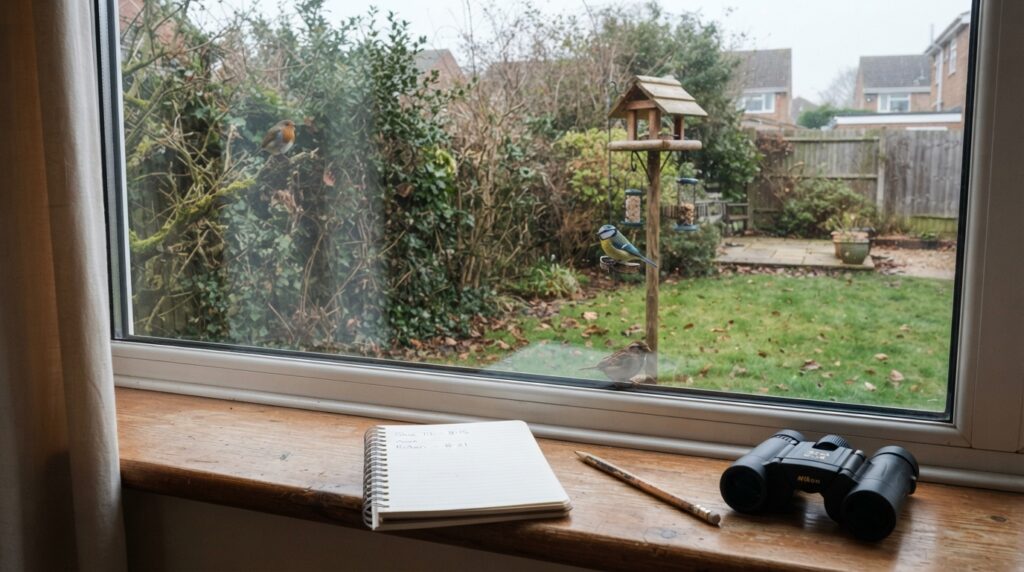
- Watch from indoors, and leave the box alone
Our nest box guide covers hole sizes and siting.
Common questions
When do blue tits fledge in the UK?
Usually late May to mid-June, about three weeks after hatching. Timing varies by region and by how the spring has run.
Why has my box gone quiet?
Most likely incubation. The female sits still for around two weeks and activity drops right off. It usually hasn’t been abandoned.
Can I look inside?
Best not, and it may be an offence. Opening a box with well-grown chicks can trigger premature fledging, which usually kills them. Fit a camera in autumn instead.
Will blue tits nest again if the brood fails?
Generally not — they raise one brood a year, timed to the caterpillar peak. Robins and blackbirds will usually try again.
Do the young come back to the box?
No. Once fledged they don’t return to the nest. They stay in cover nearby and are fed by the parents for a week or so.
When can I clean the box out?
Between 1 September and 31 January. Remove old material, scald with boiling water, let it dry, and add a handful of clean wood shavings for winter roosting.
Related guides
- When to put up a nest box (and exactly where to site it)
- Found a baby bird? What to do (and what not to)
- When do birds nest in the UK? A month-by-month guide
- How to attract blue tits to your garden
Sources: British Trust for Ornithology NestWatch and Nest Box Challenge data on incubation and fledging periods; RSPB species information and nest box guidance; Wildlife and Countryside Act 1981.
Compare nest boxes at Amazon UK. Prices and stock change often, so it is worth checking before you commit.
Browse nest boxes →