Affiliate disclosure: some links on this page go to Amazon. If you buy through one we may earn a small commission, at no extra cost to you. Full disclosure.
Peanuts in a mesh feeder and suet blocks are what bring woodpeckers in. Hang them near mature trees if you have them, and be patient — woodpeckers visit on a circuit rather than staying. A male has a red patch on the back of the neck; a female has none.
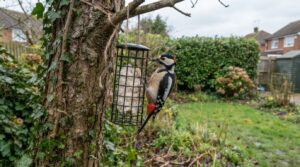
A great spotted woodpecker arriving on a peanut feeder is one of the more dramatic things that happens in an ordinary garden — noticeably larger than the tits, boldly patterned, and inclined to clear the feeder of smaller birds simply by landing on it.
They’re also considerably more common in gardens than they were a few decades ago, and increasingly likely to turn up if you offer the right thing.
Woodpecker quick facts
- Size: about 23cm — blackbird-sized
- Best foods: peanuts in mesh, suet blocks, sunflower hearts
- Male: red patch on the nape (back of the neck)
- Female: no red on the head at all
- Juvenile: red crown — confusingly, on top of the head
Identifying them
Great spotted woodpecker: boldly pied — black above with two large white oval shoulder patches, white barring on the wings, buff-white underparts, and a bright red patch under the tail. Strong dagger-like bill.
Telling age and sex is unusually easy, and worth knowing:
- Male — small red patch on the nape, at the back of the neck
- Female — no red on the head whatsoever
- Juvenile — a red crown on top of the head, which they lose in their first autumn
People frequently assume the red-crowned bird is the male. It’s a youngster.
Other woodpeckers you might see
Green woodpecker — larger, green-backed with a yellow rump and red crown. Feeds on ants on lawns rather than at feeders, so it’s a garden visitor but not a feeder bird. Its loud laughing “yaffle” call is distinctive.
Lesser spotted woodpecker — sparrow-sized, scarce, Red Listed and declining sharply. Very unlikely at a feeder, and a genuinely notable sighting if you get one.
What to feed them
Naturally they take insects and grubs from dead wood, plus nuts and seeds in autumn and winter. At a feeder:
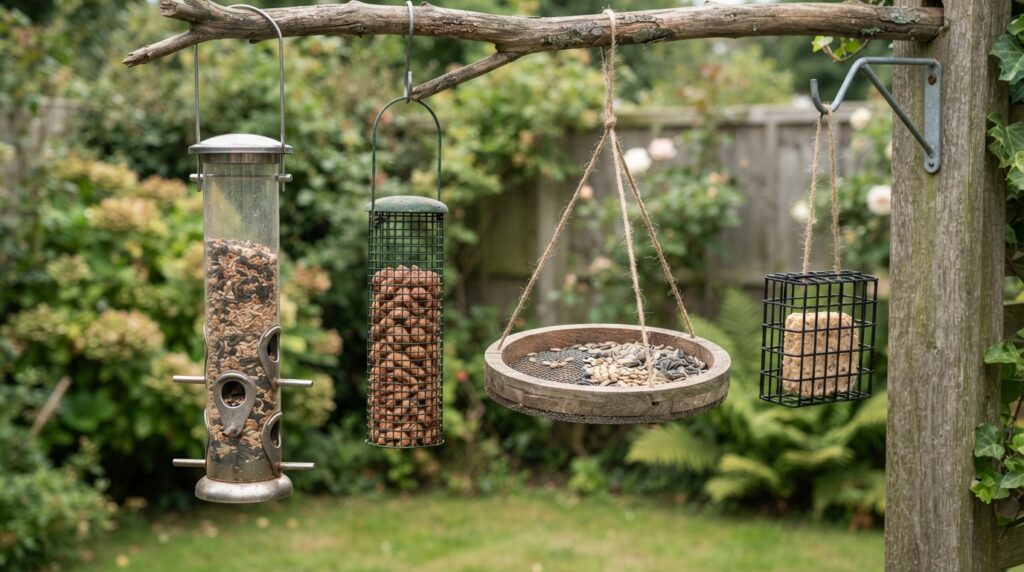
- Peanuts in a mesh feeder — the classic and most reliable. Mesh matters: it forces them to peck fragments rather than take whole nuts
- Suet blocks and fat balls in a cage — high energy, and approved year-round while seeds and peanuts pause from 1 May to 31 October
- Sunflower hearts — taken readily from a sturdy feeder
Only buy aflatoxin-free peanuts sold for wild birds. Poor-quality peanuts can carry aflatoxin, a fungal toxin that kills birds. Never use salted, roasted or supermarket snack peanuts.
A practical point on feeder choice: woodpeckers are heavy and strong. Flimsy plastic feeders get damaged. A metal mesh feeder on a sturdy hook lasts considerably longer.
Also worth knowing: caged feeders exclude them. If you’ve fitted a cage to keep squirrels or starlings out, you’ve also shut out the woodpeckers. Running one uncaged suet feeder alongside solves it.
The drumming
Frequently misunderstood — the rapid drumming you hear in late winter and spring is not feeding. It’s territorial signalling and mate attraction, the woodpecker equivalent of song.
Birds choose resonant dead branches, and sometimes metal, guttering or telegraph poles, precisely because they carry further. A woodpecker drumming on your drainpipe isn’t damaging it or looking for food; it’s advertising.
Peak drumming runs roughly February to May. Both sexes drum, though males more persistently.
Feeding on wood is a different, slower, irregular tapping — and their skull structure absorbs the impact of hammering that would concuss most animals.
The nest box problem
Worth being straightforward about, because it upsets people who don’t see it coming.
Great spotted woodpeckers raid nest boxes, hammering through the front to take nestlings. It’s natural predation, and they’re protected, but it’s distressing to watch a blue tit brood you’ve been following get taken.
How to protect a box:
- A metal hole protector plate screwed around the entrance — the standard and most effective fix. Inexpensive, and worth fitting as a matter of course
- Thicker box walls — cheap thin-walled boxes are easiest to break into
- Site boxes away from obvious perching branches
- Don’t site a box right beside a feeder that woodpeckers already visit
Our nest box guide covers siting more broadly.
How to attract them
- Hang a mesh peanut feeder and a suet block cage — the two things that work
- Use sturdy metal feeders, since they’re heavy birds
- Keep one feeder uncaged if you’re using cages elsewhere
- Site near mature trees if you have them — woodpeckers approach along treelines
- Leave dead wood standing where it’s safe to — a dead branch or a standing stump is a feeding and drumming site
- Be patient — they work a circuit and may visit once or twice a day rather than lingering
- Keep feeding through winter, when garden visits are most likely
Gardens near woodland, parks or mature trees do far better than open suburban plots. If you have no trees at all, they’re less likely — though not impossible, as they’ll cross open ground to a known food source.
Common questions
Is the one with the red head the male?
No — that’s a juvenile, with red on the crown. Males have red on the nape at the back of the neck; females have none.
Why is a woodpecker drumming on my house?
It’s signalling, not feeding. Metal, guttering and fascia boards are resonant, which is exactly the appeal. It’s seasonal — mostly February to May — and generally does no structural harm, though it’s undeniably loud at 6am.
A woodpecker attacked my nest box. Can I stop it?
Fit a metal hole protector plate. You can’t lawfully deter the woodpecker itself — they’re protected — but a plate is cheap and effective.
Why don’t woodpeckers get concussion?
Their skull and bill structure absorbs and redirects the force, and their brain is small, tightly packed and oriented to spread impact. It’s genuinely specialised anatomy.
Do they use nest boxes themselves?
Rarely. They excavate their own hole in a tree each year. Large boxes are occasionally used but it isn’t the norm.
Are they increasing?
Great spotted woodpeckers have increased substantially in the UK over recent decades and are far more common at garden feeders than they used to be. The lesser spotted woodpecker has gone the other way and is now Red Listed.
Related guides
- Types of bird feeder: which one should you actually buy?
- When to put up a nest box (and exactly where to site it)
- Best bird food for winter: what to put out and what to skip
- Common garden birds in the UK: how to identify your visitors
Sources: RSPB species information and conservation status listings; British Trust for Ornithology population trends and Nest Box Challenge guidance; Woodland Trust; Wildlife and Countryside Act 1981.
Compare sunflower hearts and suet at Amazon UK. Prices and stock change often, so it is worth checking before you commit.
Browse bird food →