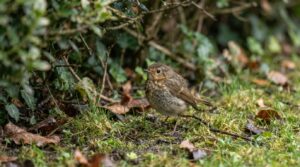
Most baby birds found on the ground do not need rescuing. If it has feathers and is hopping about, it’s a fledgling — that’s a normal stage, its parents are almost certainly nearby, and the best thing you can do is leave it alone and keep cats indoors.
Here’s how to tell the difference, and what to do in each case.
The quick answer
- Feathered, hopping, alert → fledgling. Leave it. Move away and keep cats in
- Bare or fluffy, eyes closed, can’t stand → nestling. Put it back in the nest if you can find it
- Obviously injured, or a cat has caught it → contact a wildlife rescue or vet
- Never give a baby bird bread, milk or water
Fledgling or nestling?
This is the whole question, and it takes about ten seconds to answer.
| Fledgling | Nestling | |
|---|---|---|
| Feathers | Feathered, though often scruffy with short tail | Bare skin, or thin fluffy down |
| Eyes | Open and alert | Often closed or only just open |
| Movement | Hops, walks, flutters, grips a finger | Can’t stand or grip; sprawls |
| Behaviour | Calls, moves away from you | Helpless, mouth gaping for food |
| What to do | Leave it alone | Return it to the nest if possible |
If it’s a fledgling: leave it
This is the part that feels wrong and is almost always right.
Fledglings leave the nest before they can fly properly. It’s a normal, deliberate stage — for many species, spending a few days on the ground and in low cover while the parents continue to feed them is exactly how it’s supposed to go. Blackbirds, robins, thrushes and dunnocks all do this.
The parents are usually watching from nearby and will not come down while you’re standing there. A fledgling that looks abandoned is generally a fledgling whose parents are waiting for you to leave.
What to do:
- Move away and watch from a distance or a window for an hour or so. You’ll usually see a parent visit
- Keep cats indoors — this is genuinely the single most useful thing you can do, and worth doing for a few days
- Keep dogs on a lead in that part of the garden
- Don’t mow or strim nearby for a few days
If it’s somewhere genuinely dangerous — a road, a path, an open driveway — you can move it a short distance to the nearest cover, such as a hedge or shrub base. Move it as little as possible, ideally a few metres at most, so the parents can still find it.
The “parents will reject it if you touch it” idea is a myth. Most birds have a poor sense of smell and won’t abandon a chick because a human handled it. Don’t let that stop you moving a bird out of immediate danger. That said, handle as little and as briefly as possible — the stress itself is harmful.
If it’s a nestling: try to return it
A featherless or downy chick that can’t stand has fallen or been taken from the nest, and it won’t survive on the ground.
- Look for the nest — check directly above, in hedges, shrubs, climbers, and under eaves
- If you find it and can reach it safely, put the chick back. This is by far the best outcome
- Handle gently and briefly, with clean hands or light gloves
- Watch from a distance to check the parents return
If the nest has been destroyed or is out of reach, a small container lined with dry grass, fixed securely as close to the original site as possible and sheltered from sun and rain, sometimes works — parents will often continue feeding.
If none of that is possible, contact a wildlife rescue centre. A nestling needs specialist feeding every 20-30 minutes through daylight hours, which is not something to attempt at home.
When to get help
Contact a wildlife rescue or vet if the bird:
- Has visible injuries, blood, or a drooping wing
- Has been caught by a cat — even with no visible injury (see below)
- Is cold, limp, or unresponsive
- Has flies or maggots on it
- Is a nestling with no findable nest
- Has been alone with confirmed dead parents
Any bird caught by a cat needs veterinary attention urgently, even if it looks unhurt. Cats’ mouths carry bacteria that cause rapidly fatal infection in birds. Without prompt antibiotic treatment, a bird that seems fine can die within a day or two. This is one of the most important things to know on this page.
Who to contact in the UK
- England and Wales: RSPCA
- Scotland: Scottish SPCA
- Northern Ireland: USPCA
- Your nearest independent wildlife rescue centre — often faster and more specialised than national charities. Worth looking up your local one now rather than during an emergency
- Many vets will accept injured wildlife and won’t charge for it
Note that the RSPB does not operate a bird rescue service and can’t collect or treat individual birds.
What not to do
Never give a baby bird bread, milk, or water.
Birds cannot digest milk — it will kill them. Bread has no nutritional value. And pouring water into a bird’s beak can send it into the airway and drown it. Baby birds get their moisture from food.
Also avoid:
- Trying to raise it yourself. Hand-rearing wild birds requires specialist knowledge, feeding every 20-30 minutes, and species-appropriate food. Well-intentioned attempts usually end badly
- Putting it in a cage or handling it repeatedly — stress alone can kill a small bird
- Feeding it commercial bird seed — chicks need soft, protein-rich food, and the wrong food causes serious harm
- Keeping it. In the UK it’s an offence to keep most wild birds. Rehabilitation is for licensed and experienced rescuers, with release as the goal
Preventing the problem
Through the breeding season, roughly March to August:
- Keep cats indoors at dawn and dusk, when fledglings are most vulnerable. A bell collar helps but isn’t a complete solution
- Don’t cut hedges or dense shrubs — it’s an offence to damage an active nest under the Wildlife and Countryside Act 1981, and this is the commonest way it happens accidentally
- Check before strimming long grass and rough corners
- Leave dense low cover so fledglings have somewhere to hide
- Delay tree work until autumn
Common questions
It’s been on the ground for hours. Surely it’s abandoned?
Unlikely. Parents feed fledglings periodically, not constantly, and won’t approach while people are nearby. Watch from indoors for an hour before concluding anything.
Will the parents reject it because I touched it?
No — this is a myth. Most birds have a limited sense of smell. Handle briefly, but don’t let this stop you moving a bird out of danger.
Can I put it back in the nest if I find it?
For a nestling, yes — that’s the best outcome. For a feathered fledgling, no: it left deliberately and will simply hop out again.
What if my cat brought it in?
Contact a vet or wildlife rescue urgently, even if it looks unharmed. Bacteria from a cat’s mouth cause rapidly fatal infection without antibiotics.
Is it illegal to pick up a wild bird?
Moving a bird out of immediate danger, or taking an injured one to a rescue, is fine. Keeping a wild bird is an offence. Rehabilitation should be handled by licensed rescuers with release as the aim.
What species is it? It doesn’t look like anything.
Very common — juveniles often look nothing like adults. Young robins are brown and spotted with no red; young starlings are plain grey-brown. For identification, our brown bird guide covers the usual suspects. But identification doesn’t change what to do.
Related guides
- When to put up a nest box (and exactly where to site it)
- Sick birds at your feeder: spotting trichomonosis and what to do
- Small brown birds in your garden: how to tell them apart
Sources: RSPCA and Scottish SPCA guidance on found young birds; RSPB advice on baby birds; British Trust for Ornithology; Wildlife and Countryside Act 1981.
This page carries no product links. If you’ve found a baby bird, you need a clear answer quickly — not a shopping list.
Compare nest boxes at Amazon UK. Prices and stock change often, so it is worth checking before you commit.
Browse nest boxes →