Affiliate disclosure: some links on this page go to Amazon. If you buy through one we may earn a small commission, at no extra cost to you. Full disclosure.
Water is the priority, not food. Put out several shallow dishes in shade, changed daily with fresh tap water. Soak a patch of lawn so blackbirds and thrushes can reach worms through baked ground. Cut right back on suet — it goes rancid fast in heat and smears feathers. Seeds and peanuts are paused anyway from 1 May to 31 October.
Hot, dry spells are harder on garden birds than most people realise, and they arrive at the worst possible point in the year — during or just after the breeding season, when adults are exhausted and young birds are inexperienced.
The useful responses are also slightly counterintuitive, because the seasonal feeding pause means the usual instinct to put more food out doesn’t apply.
Priorities in hot weather
- Water first — several shallow dishes, in shade, changed daily
- Soak the lawn — baked ground means no worms
- Reduce or stop suet — it goes rancid and smears feathers
- Feed early and late, not in the heat of the day
- Seeds and peanuts stay paused until 1 November
Water is the whole thing
In a dry spell, natural water sources disappear — puddles, ditches, shallow pond edges. Birds need water both for drinking and for bathing, and bathing matters more than it looks.
Clean, well-maintained feathers regulate temperature. A bird that can’t bathe and preen properly loses that ability, which compounds the problem in heat.
What to provide:
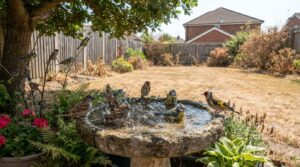
- Several shallow dishes rather than one deep bath. Plant saucers work perfectly, and a few spread around beats one big one
- No more than about 10cm deep, with sloping sides and a few pebbles for grip
- Site in shade — water in full sun heats up and evaporates within hours
- About 2m from cover, so birds can escape but nothing can ambush
- One at ground level and one raised — different species use different heights
- Top up morning and evening in real heat, not just once
The daily change still applies, and matters more in heat. Warm standing water grows organisms fast. Current guidance is to only offer water if you can change it every day with fresh tap water, and clean the container weekly.
If you’re away and can’t maintain it, better to remove it than leave stagnant water out. Our guide to keeping a bath clean covers the routine.
The hard ground problem
This is the one most people don’t think of, and it’s genuinely serious for some species.
Blackbirds, song thrushes and robins feed largely on earthworms. In a drought the soil bakes hard and worms retreat deep beyond reach — so a bird that has raised chicks on worms suddenly has nothing, at precisely the point when fledglings are still being fed.
What helps:
- Water a patch of lawn or border thoroughly, even a square metre, and let it soak in. Worms come nearer the surface and birds find it quickly
- Water in the evening so it penetrates rather than evaporating
- Turn over a small area of soil if you’re gardening anyway — a robin will appear within minutes
- Keep some ground shaded and mulched, which holds moisture
- Offer soaked dried mealworms in a shallow dish at ground level — soaked, not dry, so they add moisture rather than taking it
Be mindful of hosepipe restrictions, which are common in UK droughts. A watering can over one small patch uses very little and does the job.
What to feed — and what to stop
Current RSPB guidance pauses seeds and peanuts between 1 May and 31 October, which covers the whole heatwave season. So the question is really about the year-round foods.
Suet and fat need care above about 15°C, and real caution in a heatwave.
Fat goes rancid quickly in heat, and — more importantly — it softens and smears onto plumage. Fat on feathers destroys the waterproofing and insulating structure, which is dangerous at any time of year.
In a genuine heatwave, take fat products in. If you keep offering them, put out very small amounts in deep shade and check daily, removing anything soft, smelly or discoloured.
Better hot-weather options:
- Soaked dried mealworms — protein and moisture. Soak them properly first
- Soft fruit — halved grapes, chopped apple, overripe pears. Blackbirds and thrushes take them, and it’s mostly water
- Small amounts only, put out early morning and cleared before it gets hot
If you have hedgehogs, keep dried mealworms in a raised dish rather than scattered — they cause serious bone problems in hedgehogs. Our guide on night visitors covers it.
Behaviour you’ll see, and what it means
Birds do several odd-looking things in heat that worry people unnecessarily.
Panting with the beak open. Birds don’t sweat. They lose heat by holding the beak open and fluttering the throat — sometimes called gular fluttering. It’s normal thermoregulation, not distress.
Holding wings away from the body. Increasing airflow. Normal.
Sunbathing — lying flat, wings and tail spread, looking collapsed. This looks alarming and is deliberate, related to feather maintenance and parasite control. Leave them to it.
Dust bathing. Sparrows especially, scuffling in dry soil. Helps control parasites and absorb excess preen oil. A dry, sunny patch of bare earth is genuinely useful to provide.
Going very quiet. Gardens fall silent in heat and again during the summer moult. Birds are conserving energy and staying in cover. Normal.
Our guide to moulting and scruffy birds covers the late-summer quiet.
Shade and shelter
- Don’t cut hedges — quite apart from the nesting season running to August, hedges are where birds shelter from heat
- Leave dense shrubs and ivy for cool, shaded cover
- Leave nest boxes up, though be aware boxes in full sun get dangerously hot — a box facing north to east is the standard advice for exactly this reason
- Keep a shaded corner damp if you can
If you find a bird in trouble
Genuine heat distress looks different from normal panting — a bird sitting on the ground, unresponsive, unable to fly, or collapsed in full sun.
- Move it into shade if it’s in direct sun, using gloves or a towel
- Offer shallow water nearby — never pour water into a bird’s beak, which can drown it
- Don’t submerge or soak it
- Contact a wildlife rescue — RSPCA in England and Wales, Scottish SPCA, USPCA in Northern Ireland, or a local centre
Fledglings on the ground in summer are usually fine and being fed by parents — see our guide on finding a baby bird before intervening.
Common questions
Should I feed more in a heatwave?
No — water matters far more, and seeds and peanuts are paused until 1 November anyway. Small amounts of soaked mealworms and soft fruit are the useful additions.
Is it safe to leave suet out in hot weather?
Best not in a genuine heatwave. Fat softens and smears onto feathers, damaging waterproofing, and goes rancid quickly. Take it in or offer tiny amounts in deep shade.
Why is a bird sitting with its beak open?
Panting. Birds don’t sweat and lose heat through the open beak and throat. Normal, not distress.
Can I use water from a water butt?
Fresh tap water is recommended. Butt water sits and develops its own organisms, which is the opposite of what you want in warm weather.
How do I help blackbirds when the ground is baked?
Water a patch of lawn thoroughly in the evening. Worms come nearer the surface and blackbirds find it fast. Soaked mealworms help too.
Should I put ice in the bird bath?
Not necessary, and shallow water in shade stays cool enough. The daily change matters far more than the temperature.
Related guides
- Bird baths: choosing one, siting it, and stopping it freezing
- When to feed garden birds: the new UK guidance explained
- Why is my blackbird bald? Scruffy birds in late summer explained
- Found a baby bird? What to do (and what not to)
Sources: RSPB guidance on providing water and helping birds in hot weather; RSPB feeding guidance (April 2026); British Trust for Ornithology; RSPCA guidance on wild birds in distress.
Compare sunflower hearts and suet at Amazon UK. Prices and stock change often, so it is worth checking before you commit.
Browse bird food →