A bird lying flat on the ground with wings and tail spread and its beak open is almost certainly sunbathing, not dying. It’s deliberate, related to feather maintenance and parasite control, and the bird will get up and fly off when it’s finished. Most odd garden bird behaviour is normal — the few exceptions are listed at the end.
Birds do a number of things that look like emergencies and aren’t. The sunbathing one in particular generates a lot of worried searching every summer, usually from people who think they’re watching something die on the lawn.
Here’s what’s actually going on, and where the genuine warning signs are.
Normal, despite appearances
- Lying flat, wings spread, beak open — sunbathing
- Rubbing ants through the feathers — anting
- Scuffling in dry soil — dust bathing
- Bathing in freezing weather — feather maintenance
- Attacking a window or car mirror — territorial, seasonal
- Sitting fluffed up — insulation, unless combined with lethargy
Sunbathing
The one that alarms people most.
A bird — often a blackbird, robin or starling — drops to the ground in a sunny spot, spreads its wings and tail flat, fluffs its feathers, tilts its head to one side and holds its beak open. It may stay like that for several minutes, apparently oblivious, and looks for all the world like it’s collapsed.
It’s entirely deliberate. The leading explanations are that heat helps spread preen oil through the plumage, that it makes parasites move and become easier to remove during preening, and that warmth may help with feather condition directly.
What to do: nothing. Keep cats indoors if you can, and leave it alone. It’ll get up and go when it’s done.
How to tell it apart from a bird in trouble: a sunbathing bird is in a chosen sunny spot, its posture is symmetrical and relaxed, and it reacts if genuinely threatened. A bird in trouble is usually hunched rather than spread, unresponsive, or has visible injuries.
Anting
Rarer to witness and genuinely strange.
Some birds deliberately involve ants in their feather care. Active anting is picking up an ant and rubbing it through the plumage. Passive anting is sitting on an ant nest with wings spread and letting the ants swarm through the feathers.
The usual explanation is that formic acid from the ants helps control feather mites, lice and fungi. Other suggestions include that it removes irritants from the ants themselves before eating them, or that it simply feels good.
Blackbirds, starlings and jays are the most frequently recorded. If you see it, you’ve seen something most people never do.
Dust bathing
House sparrows especially, and often communally — several birds scuffling in a shallow scrape of dry earth, flicking soil through their feathers and looking like a small chaotic fight.
Dust absorbs excess preen oil and helps dislodge parasites. It complements water bathing rather than replacing it.
Worth providing: a dry, sunny patch of bare, fine soil or sand. If you have a border that dries out, leaving a bit of it bare is genuinely useful — and it’s a behaviour that’s lovely to watch.
Bathing in freezing weather
Counterintuitive, and important.
Birds bathe on genuinely cold days, and people often assume it’s a mistake. It isn’t — clean, correctly aligned feathers trap air and insulate far better, so feather maintenance matters more in cold weather, not less.
It’s part of why keeping water available through winter is worth the effort. Our guide on freezing weather covers how to keep it unfrozen safely.
Attacking windows, mirrors and hubcaps
Different from a window strike, and worth distinguishing.
A bird repeatedly flying at, pecking or fluttering against a window, wing mirror or shiny hubcap — returning to it again and again over days — is fighting its own reflection. It has decided there’s a rival in its territory that won’t back down.
Peak season is spring, and robins, blackbirds, chaffinches and pied wagtails are the usual culprits. It’s exhausting for the bird and can go on for weeks.
What helps:
- Break up the reflection on the outside — soap, temporary window film, or paper taped to the outside of the glass
- Cover a wing mirror with a bag while parked
- Close curtains or blinds so the interior is darker, reducing the mirror effect
- Wait it out — it stops once the breeding urge subsides
This is separate from birds flying into glass at speed and being injured, which is a different problem with different solutions — see our window strike guide.
Fluffing up
A bird that looks twice its normal size is trapping a layer of air in its feathers for insulation. Completely normal in cold weather.
The important caveat: fluffed up plus lethargic plus not reacting when approached is a different picture, and may indicate illness. Our sick birds guide covers the signs.
Fluffed but alert and feeding is fine. Fluffed and unresponsive is not.
“Drunk” birds on berries
Occasionally reported in autumn and winter, and it’s real.
Berries left on the plant into winter can ferment, and birds eating large quantities — blackbirds, thrushes, waxwings — can show genuine signs of intoxication: unsteadiness, poor coordination, flying into things.
They generally sleep it off. If a bird is affected, the useful response is to keep cats away and let it recover somewhere quiet.
Other behaviours you might see
- Carrying food away instead of eating it — caching. Coal tits, nuthatches and jays all do this. A coal tit taking one seed and vanishing repeatedly is stockpiling
- Smashing snails on a stone — a song thrush at its anvil. See our song thrush guide
- Hanging upside down — normal tit behaviour, not distress
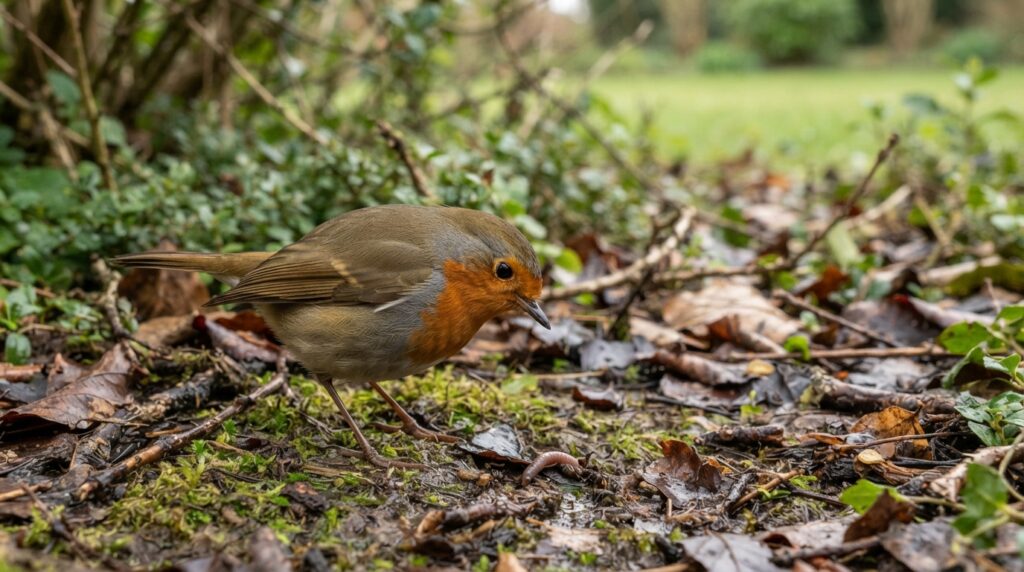
- A bird following you while you dig — a robin taking invertebrates from turned soil. They do this with wild boar and deer too
- Mobbing — small birds diving at a cat, magpie or owl together, calling loudly. Deliberate group harassment of a predator
- Wing-flicking and calling at a parent — a fledgling begging. It’s fine and being fed
When it isn’t normal
Seek advice if a bird:
- Has been caught by a cat — urgently, even with no visible injury. Bacteria in a cat’s mouth cause rapidly fatal infection without antibiotics
- Is fluffed up and lethargic, slow to react, or struggling to swallow or drooling — possible trichomonosis
- Has visible wounds, blood or a drooping wing
- Can’t fly or stand
- Has crusted or swollen eyes, or wart-like growths on the face
Contact the RSPCA (England and Wales), Scottish SPCA, USPCA (Northern Ireland), or a local wildlife rescue. Many vets accept wildlife without charge.
Common questions
There’s a bird lying flat on my lawn with its wings out. Is it dying?
Almost certainly sunbathing. It’s deliberate and normal. Keep cats in, leave it be, and it’ll fly off when it’s finished.
Why is a bird attacking my window every morning?
It’s fighting its reflection, thinking it’s a rival. Common in spring with robins and blackbirds. Break up the reflection on the outside of the glass.
Why do birds bathe when it’s freezing?
Clean feathers insulate better. Feather maintenance matters more in cold weather, not less.
What’s a bird doing rolling in dry soil?
Dust bathing — it absorbs excess preen oil and helps control parasites. Sparrows do it communally.
Why does a robin follow me around the garden?
You’re turning over soil and exposing invertebrates. In woodland robins follow wild boar and deer for the same reason — you’re standing in for a large digging animal.
Small birds are mobbing a magpie. Should I intervene?
No. Mobbing is deliberate group behaviour to drive a predator away, and it usually works. Let them get on with it.
Related guides
- Why is my blackbird bald? Scruffy birds in late summer explained
- Birds flying into windows: why it happens and what works
- Sick birds at your feeder: spotting trichomonosis and what to do
- Do garden birds recognise you? And how long do they live?
Sources: RSPB species information and guidance on bird behaviour and unwell birds; British Trust for Ornithology Garden BirdWatch observations on sunning, anting and dust bathing; RSPCA guidance on injured wild birds.
Compare current prices on bird food and feeders at Amazon UK. Prices and stock change often, so it is worth checking before you commit.
Browse bird food →