Affiliate disclosure: some links on this page go to Amazon. If you buy through one we may earn a small commission, at no extra cost to you. Full disclosure.
Birds hit windows because they don’t see glass — they see the reflection of sky, trees and open space, and fly straight at what looks like a clear route.
The fix is to break up that reflection on the outside of the glass, using marks spaced closely enough that birds won’t try to fly between them. And the popular single hawk-shaped sticker doesn’t do this, which is why it doesn’t work.
The essentials
- Treatments must go on the outside — internal blinds and stickers barely reduce reflection
- Spacing is everything — marks roughly 10cm apart across the whole pane
- One sticker doesn’t work — birds simply fly around it
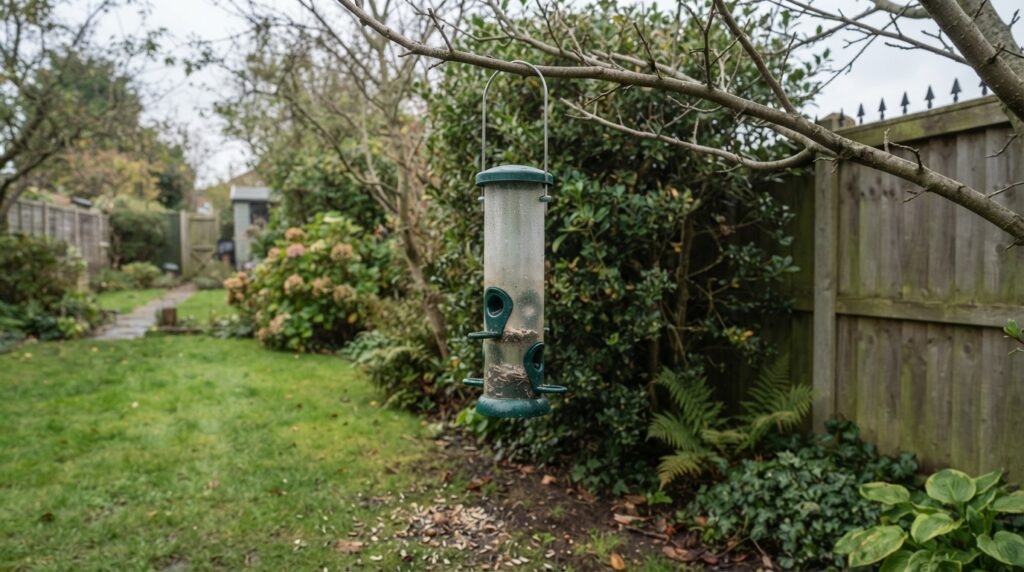
- Feeder distance: either within 1m of the glass, or more than 10m away
- Stunned bird: leave it quiet and dark in a ventilated box, then release outdoors
Why it happens
Two distinct causes, and they need different responses.
Reflection strikes
The common one. Glass reflects sky, clouds and vegetation, and to a flying bird that reflection reads as continuous open space or habitat. It flies at full speed into what appears to be a gap.
Worst when there’s bright light outside and a dark interior, and worst on large panes, patio doors and glass that faces greenery.
Territorial attacks
Different problem entirely. A bird repeatedly flying at, tapping or fluttering against the same window is usually a male seeing his own reflection and attacking what he takes to be a rival in his territory.
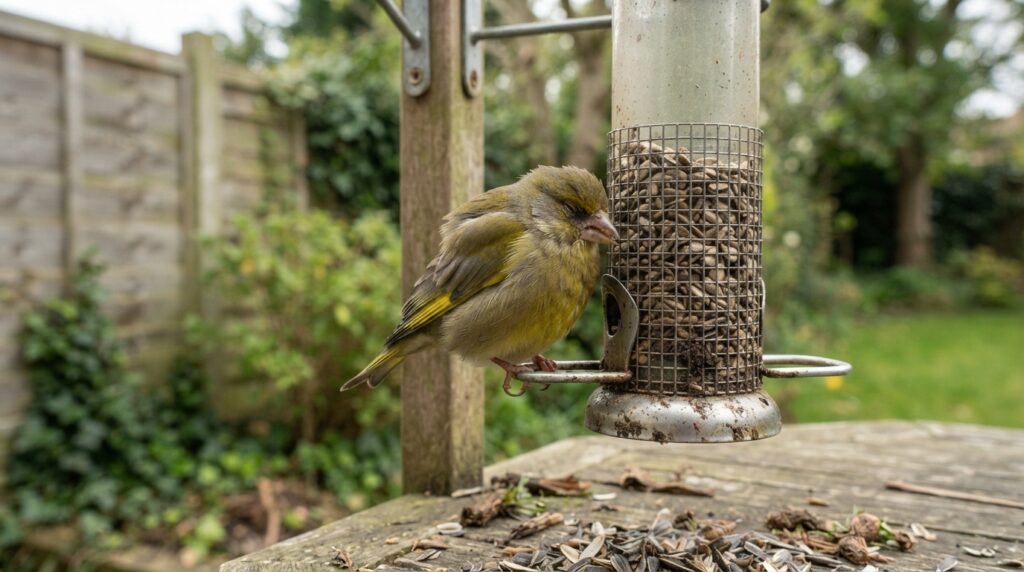
Robins, blackbirds, chaffinches and pied wagtails are the usual culprits. It peaks in spring, it’s persistent, and the bird isn’t stunned — it keeps coming back. Same solution (break up the reflection), but it usually stops of its own accord once the breeding season settles.
What actually works
The spacing rule
This is the key principle, and it explains why most attempts fail.
Birds will attempt to fly through any gap they think they can fit through. So a single sticker in the middle of a large window achieves nothing — the bird just aims to one side of it.
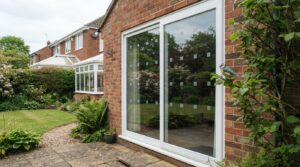
Marks need to cover the whole pane, spaced roughly 10cm apart. That’s close enough that no gap looks passable.
Options, roughly in order of effectiveness
- External patterned film or decals applied across the whole window at close spacing. Some products are near-transparent to human eyes but visible to birds because they reflect ultraviolet light, which many birds can see and we can’t
- Cords or strings hung vertically outside the glass, spaced around 10cm apart. Unobtrusive, very effective, and cheap. Sometimes sold as “acopian bird savers”
- External netting or mesh fitted a few centimetres from the glass — birds bounce off harmlessly rather than striking. The most effective option, though visually intrusive
- Insect screens — dual purpose and effective
- Soap or chalk marks in a grid on the outside. Free, temporary, works, looks rough. Fine as an immediate stopgap after a strike
- External shutters or awnings, which cut the reflection by shading the glass
What doesn’t work well
- A single hawk silhouette sticker. The most widely sold solution and among the least effective. Birds don’t read it as a predator; they simply avoid that one patch of glass and hit the rest
- Anything applied inside the glass. The reflection is on the outer surface — internal decals are largely invisible to an approaching bird
- Closing internal blinds alone. Helps a little by darkening the interior, but doesn’t remove the outside reflection
- Ultrasonic devices. No good evidence of effectiveness
Feeder placement — the 1m / 10m rule
Where you put the feeder has a large effect on strike risk, and the relationship isn’t linear.
Within about 1 metre of the window: safest. A bird taking off from a feeder that close can’t build up enough speed to injure itself if it does hit the glass.
More than about 10 metres away: also relatively safe. Birds are far enough out to see the house as a solid structure.
The danger zone is in between — roughly 2 to 8 metres. Close enough that startled birds fly towards the house, far enough to reach full speed before impact.
If you’ve had repeated strikes, moving the feeder much closer to the glass is often the single most effective change.
If a bird has hit the window
- Note where it is and keep cats and dogs indoors immediately
- If it’s able to fly off, leave it. Many stunned birds recover within minutes
- If it’s on the ground and dazed, gently place it in a ventilated cardboard box lined with kitchen paper
- Keep it somewhere quiet, dark and warm — a shed or a quiet room. Darkness reduces stress considerably
- Don’t handle it, check on it constantly, or show it to anyone. Stress kills small birds
- Don’t give it food or water, and never pour water into its beak
- After 30 minutes to a couple of hours, take the box outside, open it, and step back. A recovered bird will fly
If the bird doesn’t recover within a couple of hours, or has obvious injuries — a drooping wing, bleeding, an inability to stand — contact a wildlife rescue or vet. In England and Wales, the RSPCA; in Scotland, the Scottish SPCA; in Northern Ireland, the USPCA. Local independent wildlife rescues are often faster.
Internal injuries from window strikes are common and not always visible.
Working out which window is the problem
If you’re not sure where strikes are happening:
- Look for faint dusty outlines on the glass — a bird’s feathers leave a powdery print, sometimes strikingly detailed
- Check beneath large windows for feathers or casualties
- Go outside and look at the glass from a bird’s eye level, from the direction they’d approach. What reflects back is what they’re aiming at
- Note the time of day — strikes often cluster when sun angles create the strongest reflections
Common questions
Why does the same bird keep tapping my window every morning?
That’s territorial behaviour, not a collision. A male is attacking his own reflection. Break up the reflection on the outside — even temporarily with soap marks — and it usually stops. It also tends to end naturally once the breeding season passes.
Do hawk stickers work?
Not really, on their own. Birds don’t interpret a static silhouette as a threat, and a single sticker leaves most of the pane reflective. If you like the look, use many of them at close spacing on the outside — but the spacing is doing the work, not the shape.
Should I put decals inside or outside?
Outside, always. The reflection is on the outer surface of the glass.
Is it my fault for having a feeder?
Not really — but feeder placement does affect risk, and moving it to within a metre of the glass, or well beyond ten metres, meaningfully reduces injuries.
How long should I keep a stunned bird boxed?
Check quietly after about half an hour. Most recover within an hour or two. If there’s no improvement after a couple of hours, seek help rather than continuing to wait.
Do conservatories cause more strikes?
Yes — large glass panels and the “see-through” effect of glass on two sides are among the worst cases. External treatment across the whole surface is worth the effort there.
Related guides
- I’ve found a baby bird — what should I do?
- Types of bird feeder: which one should you actually buy?
- Why have the birds stopped coming to my feeder?
- Sick birds at your feeder: spotting trichomonosis and what to do
Sources: RSPB advice on birds and windows; British Trust for Ornithology guidance on window collisions; RSPCA advice on stunned and injured wild birds.
Compare anti-collision window decals at Amazon UK. Prices and stock change often, so it is worth checking before you commit.
Browse window decals →