Affiliate disclosure: some links on this page go to Amazon. If you buy through one we may earn a small commission, at no extra cost to you. Full disclosure.
Switch to sunflower hearts. Cheap mixed seed is padded with wheat, barley and millet that birds reject and that germinates readily — hearts have the husk removed, birds eat virtually all of them, and almost nothing reaches the ground to grow. Clearing beneath weekly and rotating the feeder position handles the rest.
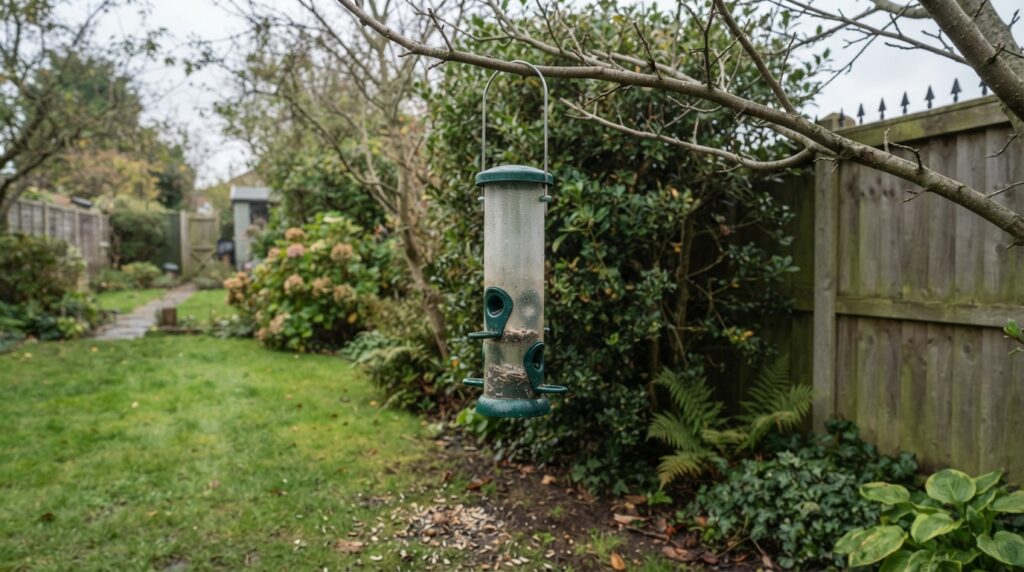
A ring of unfamiliar grassy seedlings around the base of a bird feeder is one of those small garden annoyances nobody warns you about.
It’s entirely fixable, and the fix is the same one that reduces mess, cuts waste and deters rats — so it’s worth doing regardless.
Why it happens
- Cheap mixes are padded with cereals birds won’t eat
- Rejected seed falls and lands on soil or lawn
- Wheat, barley and millet germinate readily in ordinary garden conditions
- Husks smother grass, creating the bare patch seedlings then colonise
Which seeds sprout and which don’t
This is the useful table, because the answer really does come down to what you’re buying.
| Food | Will it grow? | Why |
|---|---|---|
| Sunflower hearts | Rarely | Husk removed and the kernel is usually broken or damaged. Birds also eat nearly all of them |
| Nyjer | No | Heat-treated before sale specifically to sterilise it — a legal requirement for import |
| Suet and fat products | No | No viable seed |
| Peanuts | Rarely | Usually kibbled or eaten in place |
| Black sunflower seeds | Sometimes | Whole seed with an intact husk — will germinate if dropped |
| Cheap mixed seed | Yes, heavily | Wheat, barley, millet and split peas are viable and get rejected in quantity |
The pattern is clear enough: the more a food gets rejected and dropped, the more it grows. Which is also why cheap mixes are a false economy — you’re paying to seed your lawn.
The fixes, in order of effectiveness
1. Switch to sunflower hearts
This solves most of it in one change.
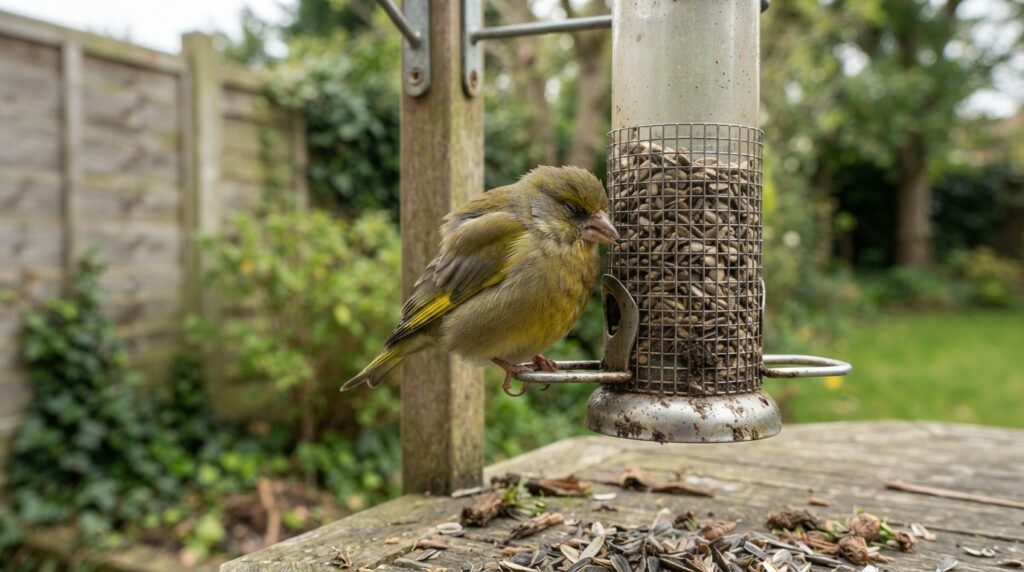
The husk is already removed, so birds eat the whole thing and there’s almost nothing to fall. What does fall is generally a broken kernel that won’t germinate. And because virtually every garden bird takes them, very little gets rejected in the first place.
More expensive per kilo, considerably cheaper in practice — no waste, no weeding, no rat interest.
2. Check what’s actually in your mix
If you’d rather stay with a mix, read the ingredients list.
Bad sign: wheat, barley, split peas, lentils, dried rice or milo near the top. These are bulk fillers most garden birds won’t eat, and they’re exactly what germinates.
Good sign: sunflower hearts or black sunflower first, then kibbled maize, peanut granules and small amounts of millet.
Some suppliers sell “no-grow” or “no-mess” mixes — husk-free and heat-treated so nothing germinates. They cost more and genuinely work if you want variety without the weeding.
3. Clear beneath the feeder weekly
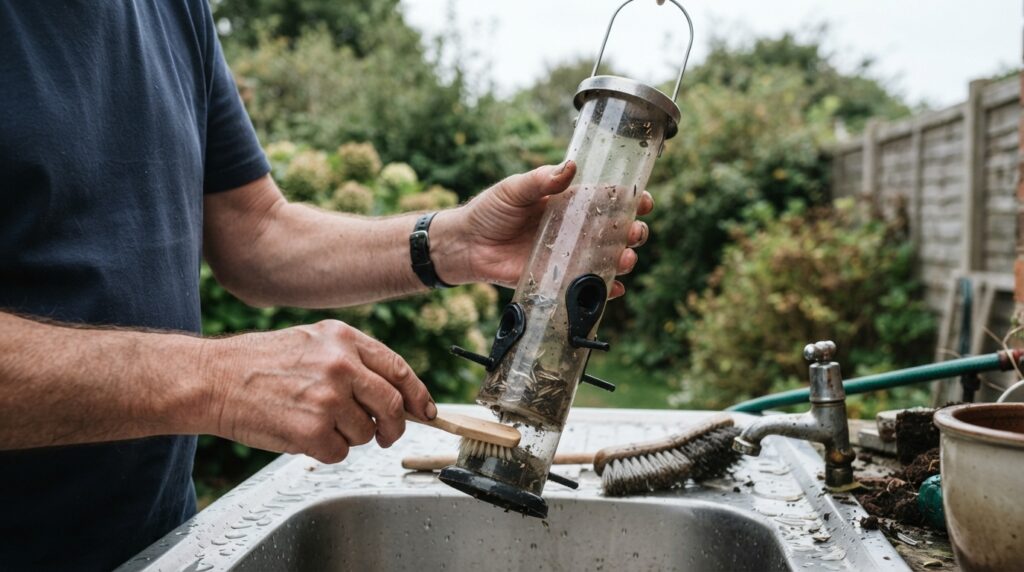
Do this at the same time as the weekly feeder clean, which current RSPB guidance recommends anyway.
Rake or sweep up husks, dropped seed and droppings. It takes a couple of minutes and prevents seedlings, the smothered bare patch, and the accumulated debris that spreads disease.
4. Move the feeder around
Current guidance is to move feeders to a fresh spot after each clean — primarily for disease reasons, since dropped food and droppings accumulating in one patch is exactly how trichomonosis spreads.
It also means no single patch of ground gets enough dropped seed to produce a visible crop. Two or three positions rotated between works well.
5. Put the feeder somewhere seedlings don’t matter
Over a border, a gravel area, or bark mulch rather than in the middle of a lawn. Seedlings in a mulched border are trivial to pull; seedlings in a lawn are conspicuous.
Just keep the other placement rules — about 2m from cover, 1.5m up, 3m from squirrel launch points, and either within 1m of a window or beyond 10m.
What about a seed catching tray?
The obvious answer, and unfortunately not one that’s recommended any more.
Trays fitted beneath hanging feeders are precisely the flat surfaces current RSPB guidance advises against — regurgitated food from infected birds collects on them and is picked up by healthy ones. The RSPB removed flat-surfaced feeders from sale in December 2024.
So the answer to dropped seed isn’t to catch it. It’s to produce less of it.
Our feeder types guide covers this properly.
The bare patch
Usually appears alongside the seedlings, and has a different cause: a mat of husks smothering the grass, plus droppings and constant traffic from ground-feeding birds.
To fix it:
- Move the feeder to a new position and let the patch recover
- Rake off the husk layer thoroughly
- Reseed in spring or autumn
- Rotate positions permanently so no single spot takes the load
Can you just let it grow?
A fair question, and the honest answer is: not really worth it.
What comes up from a spilled bird mix is mostly wheat, barley and millet — annual cereals that look scruffy, produce little of value, and die off. It isn’t a wildflower meadow.
The exception is sunflowers, which sometimes appear from dropped black sunflower seed and are genuinely worth leaving. A sunflower left to set seed and stand over winter feeds finches directly, with none of the disease transmission risk a shared feeder carries.
If you want that deliberately, our plants guide covers growing food for birds properly — teasel, sunflowers and knapweed all work, and cost far less than seed.
Common questions
What are the grassy seedlings under my feeder?
Almost certainly wheat, barley or millet from a cheap mixed seed. They’re annual cereals and easy to pull, but the real fix is changing what you feed.
Do sunflower hearts grow?
Rarely. The husk is removed and kernels are often broken, so germination is uncommon — and birds eat nearly all of them anyway.
Is nyjer sterilised?
Yes. Nyjer imported for bird food is heat-treated to prevent germination, so it won’t sprout.
Can I use weedkiller under the feeder?
Best not. You’d be spraying herbicide directly where ground-feeding birds forage and where dropped food lands. Raking and changing the seed are safer and address the cause.
Will a catching tray fix it?
It would catch the seed, but flat-surfaced feeders are no longer recommended for disease reasons. Reducing waste at source is the better route.
Why is the grass dying under my feeder?
A build-up of husks smothering it, plus droppings and traffic. Rake it off, move the feeder, and reseed.
Related guides
- Bird droppings and mess under the feeder
- Best bird food for winter: what to put out and what to skip
- Rats under the bird feeder: how to stop attracting them
- Best plants to attract birds to a UK garden
Sources: RSPB feeding and hygiene guidance (April 2026), including advice on moving feeders and clearing beneath them; RSPB flat-surface feeder sales suspension (December 2024); Royal Horticultural Society.
Compare hanging bird feeders at Amazon UK. Prices and stock change often, so it is worth checking before you commit.
Browse bird feeders →