Affiliate disclosure: some links on this page go to Amazon. If you buy through one we may earn a small commission, at no extra cost to you. Full disclosure.
Melt hard fat — suet or lard, never margarine or cooking oil — and stir in roughly twice its volume of dry ingredients: sunflower hearts, raw oats, dried mealworms. Press into moulds, chill until solid, and use a cage feeder, never netting. Best made between November and April.
Making your own fat balls costs a fraction of buying them, uses up odds and ends, and is one of the few genuinely useful things you can do with children on a wet afternoon.
It’s also easy to get wrong in ways that harm birds, and the errors aren’t obvious. The recipe below is straightforward; the section on which fats to use matters more than the measurements.
The essentials
- Use hard fat only — suet or lard
- Never margarine, spreads, vegetable oil or cooking fat
- Ratio: roughly one part fat to two parts dry ingredients
- Never use netting — birds get beaks and feet trapped
- Best season: November to April. Fat goes rancid fast in warm weather
Which fat to use — the part that matters
Get this wrong and you can genuinely harm birds, so it’s worth being precise.
Use these
- Beef suet — shredded or block. The traditional choice and the best
- Lard — plain block lard from any supermarket
Both are hard, saturated fats that set solid at room temperature. That’s the whole point.
Never use these
Margarine, sunflower spreads, “buttery” spreads, vegetable oil, olive oil, or fat from a roasting tin.
Soft and liquid fats smear onto plumage rather than being pecked off cleanly. Fat on feathers destroys their waterproofing and insulating structure, and a bird that can’t insulate itself in winter is in serious trouble. Polyunsaturated fats also go rancid quickly and don’t provide the same energy.
Roasting tin fat carries the additional problem of meat juices and salt — it spoils fast and grows bacteria.
Also avoid: anything salted, and coconut oil (which softens at room temperature).
The basic recipe
You’ll need:
- 250g suet or lard
- Roughly 500g dry ingredients (about twice the fat by volume)
- Yoghurt pots, silicone moulds, or empty coconut shells
- String, if hanging
Method:
- Let the fat soften at room temperature, or melt it gently in a pan. Don’t boil it
- Stir in the dry ingredients until the mixture is stiff and holds together — it should look like coarse crumbs binding, not a runny liquid
- Press firmly into moulds. If hanging, lay a loop of string through the middle before it sets
- Chill for a few hours until completely solid
- Turn out and use, or keep in the fridge for a couple of weeks
If the mixture crumbles, add a little more melted fat. If it stays greasy and soft, add more dry ingredients.
What to put in
| Good ingredients | Who it appeals to |
|---|---|
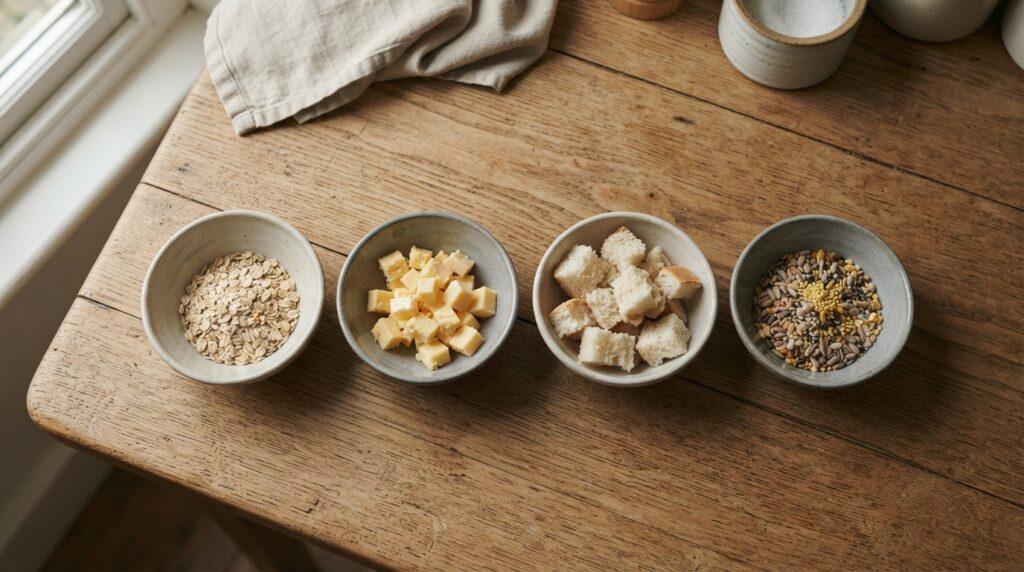
| Sunflower hearts | Almost everything. The best single addition |
| Raw porridge oats | Blackbirds, sparrows, thrushes. Uncooked only |
| Dried mealworms | Robins, wrens, blackbirds |
| Peanut granules | Tits, woodpeckers. Bird-grade only |
| Mild grated cheese | Robins and wrens especially |
| Nyjer or millet | Finches, sparrows |
| Chopped unsweetened dried fruit | Blackbirds, thrushes |
Leave these out
- Anything salted — birds can’t process salt, and trivial amounts are harmful
- Desiccated coconut — can swell inside a bird
- Bread — bulks it out with almost no usable energy
- Cooked oats — set hard around beaks. Raw only
- Chocolate — toxic
- Whole peanuts — a choking risk if carried to chicks. Granules or crushed instead
If you have a dog, leave out raisins, sultanas and currants entirely. Dried vine fruit is toxic to dogs and can cause kidney failure, and bird cake ends up on the ground.
Three variations worth trying
Coconut shell feeders. Halve a fresh coconut, drain and eat the flesh, then fill the empty shell with the mixture and hang it upside down. Effective, looks good, and reuses the shell for years. Never use dry desiccated coconut halves sold as decorations.
Pine cone feeders. Press the mixture into the scales of an open pine cone and hang it. The classic children’s version, and genuinely useful — tits work at it happily.
Bird cake in a tub. Skip the moulding entirely. Pour the mixture into an old plastic tub, chill, then turn it out and wedge it into a suet cage. Less work than shaping balls.
Never use netting
This applies to shop-bought fat balls as much as homemade ones.
Birds regularly get their beaks and feet caught in plastic netting, causing serious injury and sometimes death. It’s one of the more avoidable hazards in garden bird feeding, and the RSPB is explicit about it.
Use a cage feeder instead, or hang a coconut shell or pine cone directly.
When to put them out
Suet and fat products are approved year-round under current RSPB guidance, unlike seeds and peanuts which pause from 1 May to 31 October. So homemade fat balls are one of the few things you can offer all year.
But warm weather changes things. Fat goes rancid quickly above about 15°C, and soft fat smears onto feathers. In summer:
- Put out much smaller amounts
- Check daily and remove anything soft, smelly or discoloured
- Site the feeder in shade
- Consider skipping it entirely in a heatwave
November to April is when they’re most useful and safest.
Storage and hygiene
- Fridge for two to three weeks, or freeze for several months
- Wrap or box them — fat absorbs other smells
- Bin anything that smells off, has gone soft, or shows mould
- Clean the cage feeder weekly — suet leaves a greasy residue that needs proper scrubbing, not just a rinse
- Wash hands after handling raw fat and after cleaning feeders
The weekly clean matters more with fat than with seed. Our cleaning guide covers the method.
Making it with children
It works well as an activity, with a few sensible adjustments:
- Let the fat soften at room temperature rather than melting it on the hob — no hot liquid
- Mixing by hand in a bowl is the fun part
- Yoghurt pots and pine cones are easier for small hands than shaping balls
- Wash hands thoroughly afterwards
- Hang the results somewhere visible from a window, so they get to watch
Common questions
Can I use butter or margarine?
No. Both are too soft and smear onto feathers, damaging waterproofing. Only hard suet or lard.
Can I use fat from the roasting tin?
No — it’s mixed with meat juices and usually salt, goes rancid quickly, and stays soft. Use raw block fat instead.
Why won’t my fat balls set?
Either too much fat relative to dry ingredients, or the wrong fat. Add more dry mix; if it still won’t firm up, the fat is too soft to use.
How long do they last outside?
In cold weather, several days to a week. In warm weather, a day or less. Check daily and remove anything soft or smelly.
Is homemade cheaper than shop-bought?
Usually, especially if you’re already buying sunflower hearts and oats. The bigger advantage is knowing exactly what’s in it and avoiding netting entirely.
Can I make them in summer?
Yes — suet stays approved year-round. But make small batches, site them in shade, check daily, and skip it in hot spells.
Related guides
- Best bird food for winter: what to put out and what to skip
- Can birds eat bread, porridge oats or cheese?
- How to clean a bird feeder — and why it now matters more
- Feeding garden birds on a budget
Sources: RSPB guidance on fat and suet products, including warnings on soft fats and netting; RSPB feeding guidance (April 2026); British Trust for Ornithology.
Compare current prices on bird food and feeders at Amazon UK. Prices and stock change often, so it is worth checking before you commit.
Browse bird food →