Affiliate disclosure: some links on this page go to Amazon. If you buy through one we may earn a small commission, at no extra cost to you. Full disclosure.
Most storm problems come down to height and leverage. Lower the feeder, take some off the top of a feeding station, move it to the sheltered side of the house or a hedge, and use a shorter hanging chain so it swings less. In a severe storm, bring feeders in and put them back out at first light — that’s when birds need them most.
Winter gales cause three separate problems: feeders swinging so violently that birds can’t use them, seed being blown out and wasted, and feeding stations toppling over entirely.
All three are largely fixable, and the fixes are cheap or free.
Quick fixes
- Lower the feeder — less leverage, less swing
- Shorten the hanging chain — a long chain acts like a pendulum
- Move to the sheltered side — usually the east or north-east of a building in UK weather
- Take a feeder off the top arm of a station — top weight is what topples it
- Fill less in windy weather — less to spill
Why feeders blow over
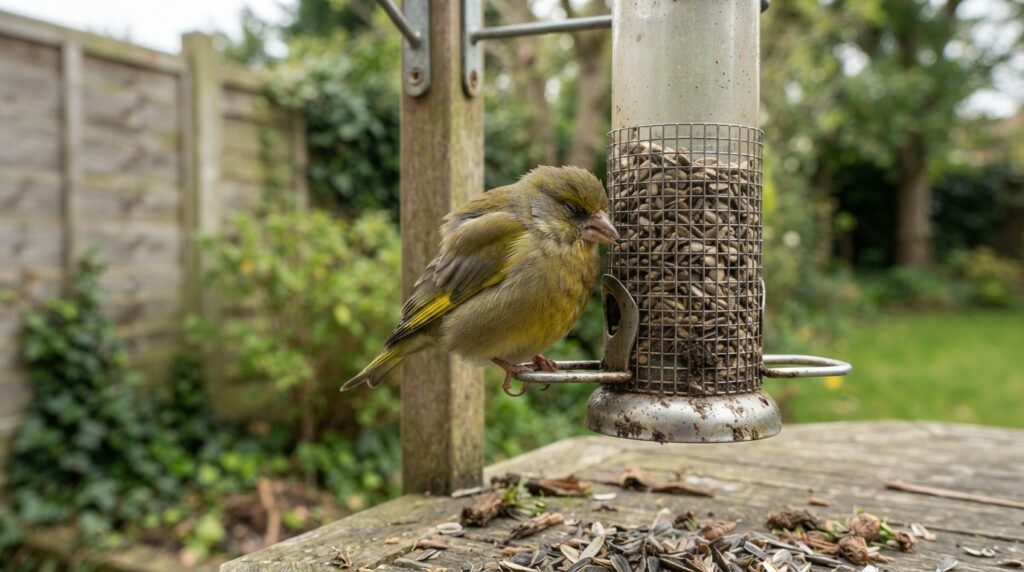
A feeding station is essentially a lever. The higher the weight sits above the ground anchor, the more force the wind applies at the base.
Load the top arm with a full seed feeder and you’ve made the problem considerably worse — that’s the weight furthest from the anchor point and most exposed to the wind.
Add saturated soil, which most UK gardens have by December, and a ground spike that held fine in October simply pulls out.
Securing a feeding station
- Push the spike in deeper. Obvious, and frequently the whole problem. Most spikes need more depth than people give them
- Leave the top arm empty, or hang the lightest feeder there. Put the heavy seed feeder on a lower arm
- Use a weighted base plate instead of a spike on paving, or as well as one in soft ground
- Guy it in an exposed garden — two thin lines to ground pegs, like a tent. Unglamorous and very effective
- Move it beside a hedge or wall on the sheltered side rather than standing in open lawn
- Check it after every storm. A pole that’s loosened will come down in the next one
Stopping hanging feeders swinging
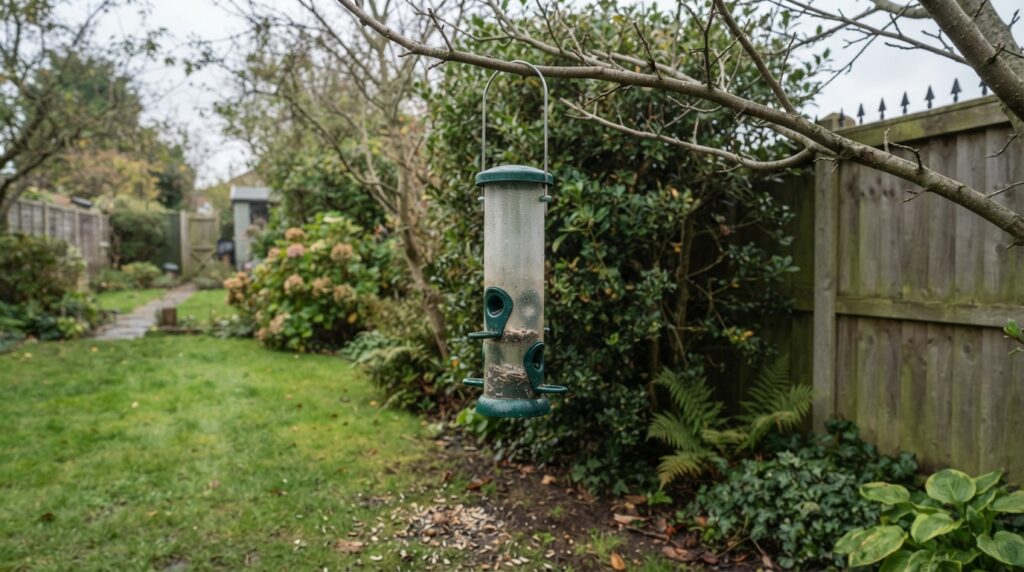
A feeder swinging wildly is not just messy — birds won’t use it. Small birds need a stable perch, and a feeder moving unpredictably is effectively out of service.
- Shorten the chain or hook. The longer the drop, the bigger the swing. A feeder hung on a short S-hook moves far less than one on 30cm of chain
- Hang closer to the trunk if you’re using a tree, rather than out on a thin branch that whips about
- Use a bracket on a wall rather than a branch — the sheltered side of the house is usually the calmest spot in the garden
- Choose heavier feeders for exposed positions. A metal feeder holds steadier than a light plastic one
- Avoid rotating or spinning feeders in exposed gardens
Reducing seed waste
Wind blows seed straight out of open ports, which wastes food and puts it on the ground where it attracts rats.
- Fill less during a windy spell. Half-full loses less than full
- Use sunflower hearts — heavier than mixed seed and less prone to blowing out. They’re also the least wasteful food generally
- Suet cages don’t spill at all, which makes them the sensible choice in a genuinely rough week
- Nyjer feeders are the worst offenders — the seed is very light. Consider taking them in during a storm
- Sweep up underneath afterwards. Wind-scattered seed on wet ground is exactly what draws rats
Where to move things
The prevailing wind in most of the UK comes from the south-west, so the north-east side of a building, wall or hedge is usually the most sheltered spot.
Bear in mind you still need the other placement rules to hold:
- About 2m from cover, so birds can escape but cats can’t ambush
- 3m from any squirrel launch point
- Either within 1m of a window or beyond 10m, to reduce strike risk
- Not directly under branches birds roost on
A sheltered corner that breaks all of those isn’t an improvement. Our feeder placement guide covers the trade-offs.
During a severe storm
For a genuinely bad named storm, taking feeders in is sensible — they’ll otherwise end up damaged, emptied, or across a neighbour’s garden.
Put them back out at first light. This is the part that matters. Birds come through a stormy night having burned energy holding on in the wind, unable to forage properly, and needing to refuel urgently. Food available at dawn after a storm is genuinely valuable.
Nest boxes should stay up. Birds roost in them, and a box in a storm is shelter rather than a hazard.
After a storm
- Check the pole or bracket hasn’t loosened
- Clear scattered seed from the ground
- Refill and put everything back promptly
- Check for damage — cracked plastic, bent perches, a chewed or split feeder
- Look for storm-blown birds. Occasionally severe weather brings unusual species into gardens
- Check nest boxes are still secure and haven’t twisted on their fixing
Trees and branches: if a storm has brought down a branch, check before clearing it — during the breeding season, roughly March to August, it may contain an active nest, and disturbing one is an offence under the Wildlife and Countryside Act 1981. Outside those months, brash piled in a corner makes excellent shelter rather than something to take to the tip.
Helping birds through a stormy spell
Storms are harder on birds than the wind damage suggests. They burn energy simply staying put, foraging is difficult, and prolonged rain soaks plumage and destroys its insulating value.
What helps most:
- High-fat food — suet and fat balls, which don’t spill and deliver the most calories per beakful
- Feeding at first light, when reserves are lowest
- Sheltered feeding positions, so birds aren’t fighting the wind while they eat
- Dense cover — hedges, evergreens, ivy. Don’t cut anything back before winter
- Nest boxes left up as roost sites
One thing worth checking on your house
If you have a fixed bird box, bracket or anything else mounted outside, storm season is the time to check the fixing.
Anything that comes loose in a gale and damages a neighbour’s property raises a liability question, and the usual test is whether you took reasonable care. A well-maintained fixing that fails in exceptional wind is treated differently from one that was visibly insecure beforehand.
Five minutes with a screwdriver in October is worth it.
Common questions
Should I take feeders in every windy day?
No — birds need them most in bad weather. Only for genuinely severe storms, and put them straight back out at first light.
My feeding station keeps falling over. What’s the fix?
Usually top weight and spike depth. Leave the top arm empty or hang the lightest feeder there, push the spike deeper, and move it beside a hedge or wall rather than standing in open lawn.
Do birds stop feeding in high wind?
They feed less, and avoid feeders that are swinging too much to perch on. A stable, sheltered feeder gets used when an exposed swinging one doesn’t — which is the whole argument for moving it.
Where do birds go during a storm?
Deep into dense cover — evergreens, thick hedges, ivy, building crevices — and they sit tight. It’s why gardens go silent in bad weather and busy again the moment it eases.
Is a hanging feeder or a pole better in wind?
A wall bracket on the sheltered side of the house beats both. Between the two, a well-anchored pole in a sheltered spot is steadier than a feeder swinging from a branch.
Related guides
- How to help garden birds in freezing weather
- Bird feeding station vs separate feeders
- Where do garden birds sleep at night?
- Rats under the bird feeder: how to stop attracting them
Sources: RSPB guidance on feeder placement and helping birds in severe weather; RSPB feeding guidance (April 2026); Wildlife and Countryside Act 1981.
Compare hanging bird feeders at Amazon UK. Prices and stock change often, so it is worth checking before you commit.
Browse bird feeders →