Stake your old real Christmas tree upright next to a feeder and it becomes instant winter cover — dense, evergreen, and exactly what small birds want within a couple of metres of where they feed. It lasts a month or two, costs nothing, and it’s genuinely useful in a bare January garden. When the needles drop, it goes on the compost or into a log-and-brash pile.
Every January, millions of real Christmas trees go to the tip. A good number of them could spend a useful second life in the garden first, and for anyone feeding birds it solves a real problem — the lack of cover in a bare midwinter garden.
The quick version
- Stake it upright about 2m from a feeder
- Instant dense cover for small birds to bolt into
- Lasts a month or two before the needles drop
- Then compost the chippings or add it to a log pile
- Only untreated trees — no flocked or sprayed ones
Why a bare garden needs it
January is the hardest month for cover. Deciduous shrubs and hedges are bare, herbaceous growth has died back, and in a new or minimal garden there may be very little dense evergreen at all.
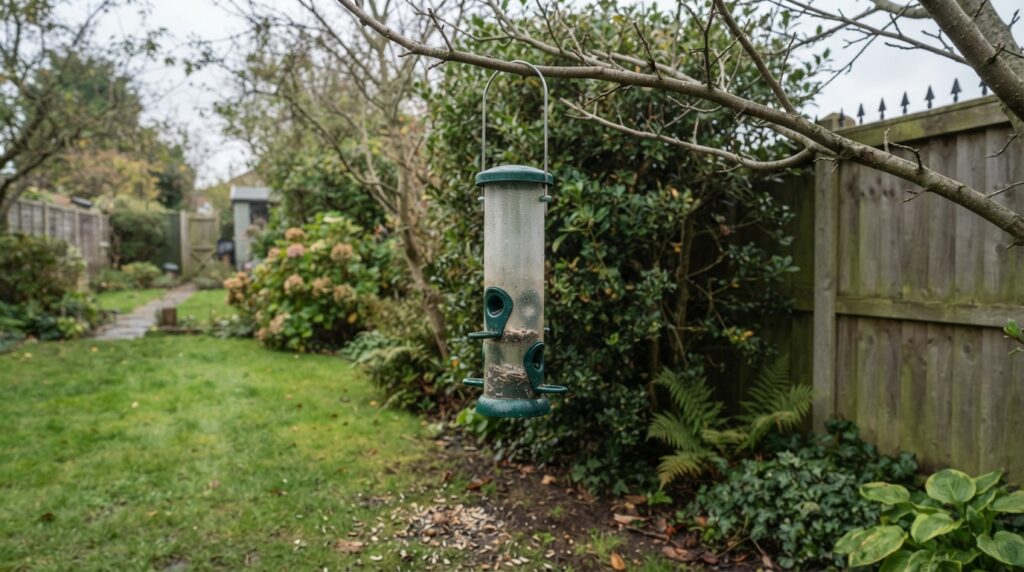
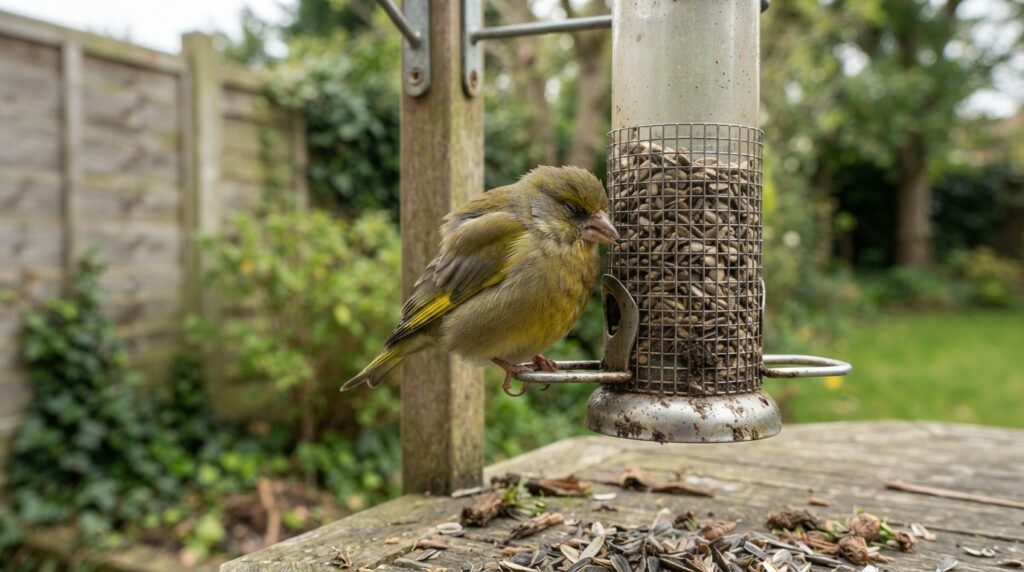
That matters because small birds won’t feed comfortably without an escape route. A feeder in the open, with nothing to dive into when a sparrowhawk appears or a cat wanders through, gets used nervously if at all. The workable distance is about two metres from cover — close enough to reach in a second, far enough that nothing can ambush from it.
A staked Christmas tree provides exactly that, immediately, for free, at precisely the point in the year cover is scarcest. Our sparrowhawk guide covers why escape cover matters so much.
How to set it up
- Strip everything off — every bit of tinsel, every hook, all the lights and any stray decorations. Nothing but the tree
- Stake it upright about 2m from your feeder, in a border, against a fence, or in a large pot weighted with rubble. It needs to stand firm through winter wind
- Or lay it on its side against a fence or hedge if staking isn’t practical — less good than upright, but still useful low cover
- Leave it. Birds will start using it within days as a staging perch before dropping to the feeder, and as shelter in bad weather
You can improve it slightly by tucking a fat ball cage into the branches, or hanging a suet feeder from it — though the cover itself is the main value.
Only use an untreated tree. Skip anything flocked (sprayed with fake snow), painted, or treated with fire retardant or artificial scent. Those coatings aren’t something you want shedding into a garden where birds feed and forage. A plain, untreated tree is fine.
What to do when the needles drop
After a month or two the tree browns and sheds, and its job as cover is done. It still has uses.
- Shred or chip it for mulch, if you have access to a shredder — pine chippings make good path or border mulch
- Cut it up for a log-and-brash pile in a quiet corner. Brash piles shelter wrens, invertebrates and hibernating hedgehogs
- Compost the smaller material — it breaks down slowly but it gets there
- Use the trunk as a low log for a log pile, or a rustic edge for a border
- Council collection — most UK councils run a January real-tree recycling scheme, chipping them for compost. A fair fallback if you can’t use it, and far better than landfill
Check a brash pile before disturbing or burning it from late autumn onwards — hedgehogs hibernate in exactly this kind of pile between roughly November and March. Build it somewhere it can stay undisturbed until spring.
Other winter reuses
If cover isn’t what you need, the tree has other jobs.
Pond protection. A branch or two laid across a pond gives a bird that falls in something to climb out on, and offers cover to pond life.
Plant support. The trunk, cut and dried, makes a rustic stake for next year’s beans or sweet peas.
Cut branches as border mulch. Pine needles are slow to break down and make a good weed-suppressing mulch around shrubs.
A windbreak for tender plants, propped around a pot or a young plant for a few weeks of frost protection.
A note on live, potted trees
If you had a living tree with roots rather than a cut one, it has a better second life still — plant it out, or keep it potted for next year.
A planted conifer becomes permanent evergreen cover, and a small pine, spruce or yew is genuinely good for garden birds year-round. Goldcrests and coal tits are conifer specialists, and dense evergreen is prime winter roosting habitat. Our guide on where birds sleep covers roosting cover.
Potted trees need care to survive — they dry out fast indoors and shouldn’t spend more than a week or so in a warm room — but a tree that lives is worth far more to wildlife than one that’s reused for a month and composted.
The wider point
This connects to something worth carrying into the rest of the year: a slightly untidy garden is a better garden for birds.
The Christmas tree is a one-off, but the principle behind it — dense cover near feeding areas, brash piles in corners, evergreen shelter for winter roosting — applies all year. Our guides on planting for birds and bare and new-build gardens cover the permanent versions.
Common questions
Does a Christmas tree really help birds?
As temporary winter cover, yes — it gives small birds somewhere to shelter and to bolt into near a feeder, at the point in the year cover is scarcest.
Can I use a flocked or sprayed tree?
No — skip anything with fake snow, paint or fire-retardant coating. Only plain untreated trees.
How long does it last?
A month or two before it browns and sheds. After that, chip it, compost it, or add it to a log pile.
Should I stake it or lay it down?
Upright is better — it works more like a real shrub. Lying against a fence still provides useful low cover if staking isn’t practical.
What if I had a potted living tree?
Plant it out or keep it for next year. A living conifer is far more valuable to wildlife than a reused cut one — permanent cover and good for goldcrests and coal tits.
Can the council still take it afterwards?
Yes — most UK councils run January tree recycling. Using it as cover first and putting it out for collection when it sheds is perfectly workable.
Related guides
- A sparrowhawk killed a bird at my feeder: what to do
- Where do garden birds sleep at night?
- How to attract birds to a new-build garden with no trees
- How to help garden birds in freezing weather
Sources: RSPB guidance on providing cover and gardening for wildlife; Royal Horticultural Society guidance on Christmas tree reuse and mulching; British Hedgehog Preservation Society guidance on brash and bonfire piles; local authority real-tree recycling schemes.
Compare current prices on bird food and feeders at Amazon UK. Prices and stock change often, so it is worth checking before you commit.
Browse bird food →