Victorian postmen wore bright red uniforms and were nicknamed “robins” or “redbreasts”. When Christmas cards became popular in the 1860s and 70s, illustrators drew robins carrying envelopes in their beaks — a visual joke about the postman delivering your card. The joke outlived the uniform, and the bird stayed.
Almost every British Christmas card range has a robin on it, and the bird has no religious connection to Christmas, no particular seasonal behaviour that suggests one, and doesn’t feature in the story at all.
The real explanation is a Victorian pun about the postal service.
The short version
- 1840: the Penny Post makes sending letters affordable
- 1843: the first commercial Christmas card
- Postmen wore red and were nicknamed “robins”
- 1860s–70s: cards show robins carrying letters — the joke
- Robins are genuinely visible in winter, which helped it stick
The postman connection
The pieces came together in the middle of the nineteenth century.
The Penny Post, introduced in 1840, made sending a letter affordable for ordinary people for the first time. Postal volumes rose enormously.
The first commercial Christmas card was commissioned by Sir Henry Cole in 1843, and by the 1860s cheap printing had turned card-sending into a mass Victorian habit.
Postmen at the time wore scarlet tunics, and the public nicknamed them “robins” or “redbreasts” — the same joke, made everywhere, about a man in a red coat bringing something to your door.
So when illustrators designed Christmas cards, they drew the obvious visual gag: a robin with an envelope in its beak, delivering the card you were holding. Some early designs show robins tapping at windows or perched on letterboxes.
The uniform changed. The nickname faded. The bird stayed on the cards, and by the time anyone had forgotten why, the association was permanent.
Why it stuck — the bird helped
A joke alone wouldn’t have lasted 150 years. The robin happens to be genuinely well suited to the role.
Robins are visible in winter when other birds aren’t. Unusually among British birds, they hold territories year-round and sing right through the winter — including on Christmas Day, when most of the garden is silent. A conspicuous, singing, red-breasted bird in December is a gift to an illustrator.
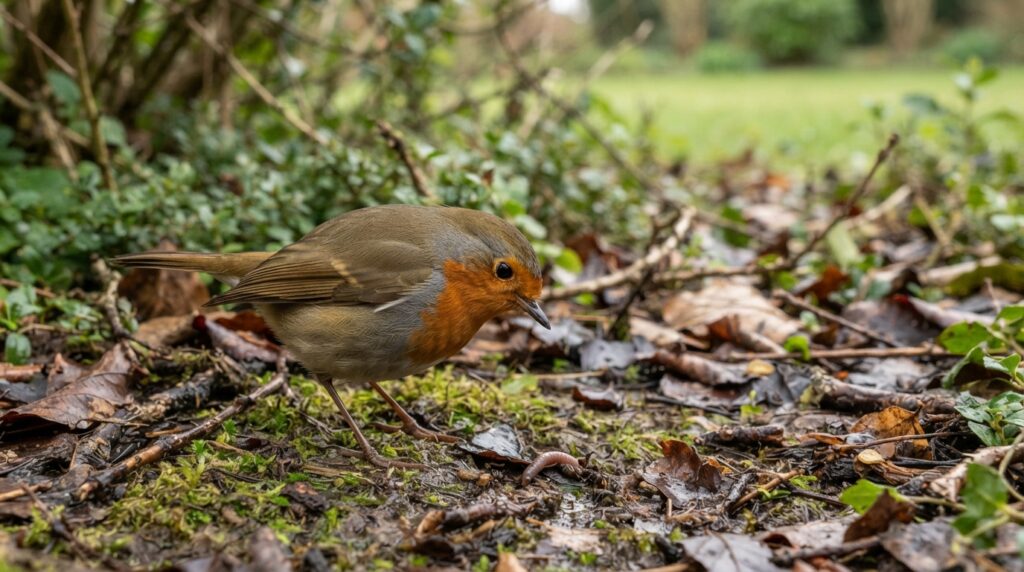
They’re tame. British robins are famously bold around people, a trait linked to their habit of following large animals — historically wild boar and deer — to take invertebrates from disturbed ground. A gardener with a spade fills the same role, which is why a robin appears within moments of you starting to dig.
Continental robins are noticeably shyer, which makes the tameness a particularly British experience.
The red is striking against snow and evergreen, which is exactly the palette of a Christmas card.
Our full robin guide covers feeding and behaviour properly.
The older folklore
The postman story is the historical explanation. There’s also a set of older legends that are almost certainly retrofitted, but worth knowing because they come up constantly.
The most common holds that the robin’s breast was stained red by blood when the bird tried to remove a thorn from Christ’s crown, or was scorched fanning a fire to keep the infant Jesus warm.
These stories are genuinely old in some form, but they don’t explain the Christmas card connection, which is much better documented and much more recent. The cards came from the postal joke, not from folklore.
There’s also a long-standing British superstition that harming a robin brings bad luck — which, whatever its origin, has probably done the species no harm at all.
Britain’s national bird
Worth knowing, since it’s frequently misstated.
In 2015 a public vote organised by the ornithologist David Lindo saw the robin chosen as Britain’s national bird, with a large margin over the barn owl and blackbird.
It’s an unofficial designation — the UK has no legally adopted national bird — but it’s widely cited and reflects genuine public affection. The robin had also been informally regarded as the national bird since a similar poll in the early 1960s.
Is it the same robin each Christmas?
Quite possibly, and quite possibly not.
Robins hold small territories year-round, so the bird in your garden in December is very likely the same individual you saw in October. But typical robin lifespan is only around two years, with very high mortality in the first winter.
Over several Christmases, you’ll have had several robins — each one taking over the vacant territory when the previous holder died. Which is why people often feel “their” robin has come back after an absence.
Our guide on whether birds recognise you covers lifespans and territory in more detail.
A note on the winter singing
One detail worth appreciating in December: female robins sing too.
Unusually among British birds, both sexes hold separate winter territories and both defend them with song. So the robin singing in your garden on Christmas morning is as likely to be female as male — and you can’t tell by looking, because the sexes are identical.
If something is singing in the middle of the night, that’s also usually a robin, often confused by streetlighting. See our guide on birds singing at night.
Common questions
Why are robins on Christmas cards?
Victorian postmen wore red uniforms and were nicknamed “robins”. Early Christmas cards showed robins carrying envelopes as a visual joke about the postman delivering your card.
Is the robin Britain’s national bird?
Unofficially, yes — it won a public vote in 2015. The UK has no legally designated national bird.
Do robins really sing at Christmas?
Yes. They hold territories year-round and sing through the winter, when most other garden birds are silent. Both males and females sing.
Why are British robins so tame?
They evolved following large animals that disturb the ground, taking invertebrates from the turned soil. A gardener with a spade is doing the same job. Continental robins are far shyer.
What should I feed a robin in winter?
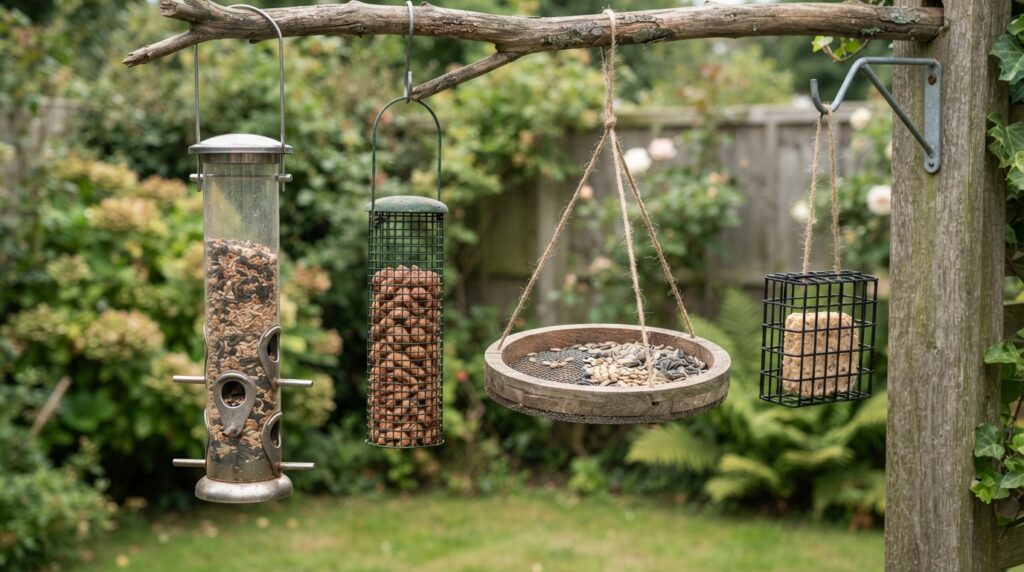
Mealworms above all, plus suet and grated mild cheese. They feed at or near ground level and won’t use a hanging feeder. December falls inside the main feeding season, so the full range is fine.
Is it bad luck to harm a robin?
It’s a long-standing British superstition, and it’s also unlawful — all wild birds are protected under the Wildlife and Countryside Act 1981.
Related guides
- What do robins eat? Feeding Britain’s favourite garden bird
- Christmas leftovers and garden birds: what’s safe from the festive table
- Which bird is singing at night?
- How to help garden birds in freezing weather
Sources: RSPB species information and historical background on the robin; British Trust for Ornithology ringing data on robin survival; Postal Museum historical material on Victorian postal uniforms and the Penny Post; contemporary reporting on the 2015 national bird vote.
Compare dried mealworms at Amazon UK. Prices and stock change often, so it is worth checking before you commit.
Browse mealworms →