Most common garden birds occur across the whole UK, but there are real gaps. Ireland has no green woodpecker, no nuthatch and no tawny owl — the great spotted woodpecker only recolonised in the 2000s. Scotland has the crested tit and the Scottish crossbill, the UK’s only endemic bird, both confined to the Highlands. Wales is where red kites survived when they were lost everywhere else.
Identification guides tend to be written as though Britain and Ireland are one uniform place. They aren’t, and if you’re in Belfast trying to identify a nuthatch or in Inverness looking for a nightingale, a generic guide will send you round in circles.
Here’s what genuinely differs, nation by nation.
The headline differences
- Northern Ireland: no green woodpecker, nuthatch, tawny owl, marsh or willow tit
- Scotland: crested tit and Scottish crossbill in the Highlands; more siskins and redpolls
- Wales: red kites overhead, and a stronghold for pied flycatchers
- England: the full species list, plus the southern specialities
- Everywhere: ranges are shifting, mostly northwards
Northern Ireland — the biggest gaps
The most striking regional difference in these islands, and one most guides skip entirely.
Ireland was separated from Britain by rising sea levels earlier than Britain was from the continent, which left several species stranded on the wrong side of the water. The result is a noticeably shorter list.
Species absent or extremely scarce in Ireland:
- Green woodpecker — absent. If you see a woodpecker on your lawn in Ireland, it isn’t one
- Nuthatch — absent. No amount of peanuts will produce one
- Tawny owl — absent, which is why the classic “twit-twoo” isn’t part of the Irish night
- Marsh tit and willow tit — both absent
- Little owl — absent
The great spotted woodpecker is the exception, and it’s a genuinely recent story. Historically absent from Ireland, birds began appearing and breeding from around the mid-2000s, and the species is now establishing itself, particularly in the east. If you’re in Northern Ireland and get one on a peanut feeder, that’s a record worth submitting.
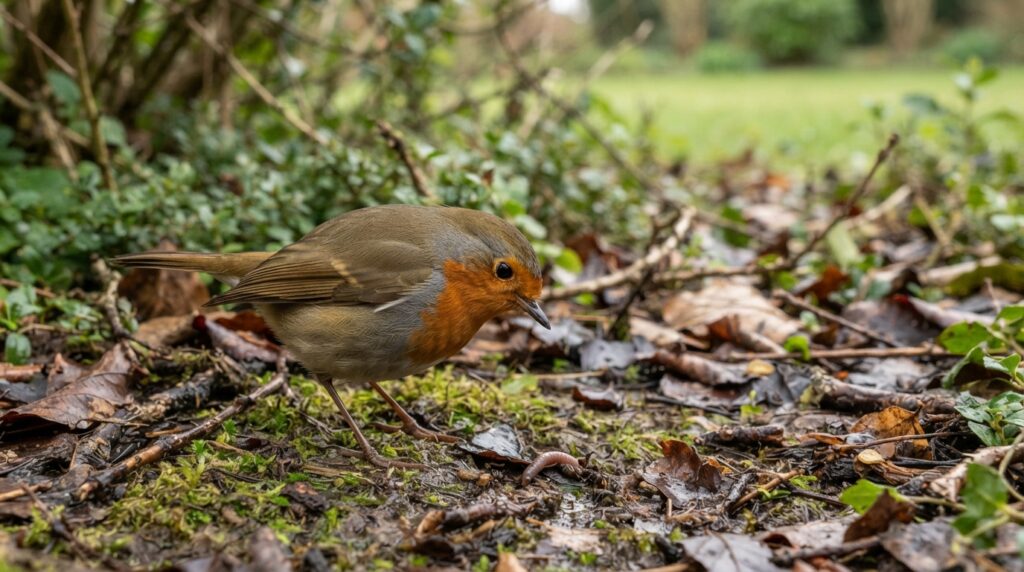
What Northern Ireland does have is the full set of core garden birds — robin, blackbird, blue tit, great tit, coal tit, chaffinch, house sparrow, starling, dunnock, wren, goldfinch — plus jays and magpies. Irish coal tits and jays are distinct subspecies, slightly different in plumage tone from British birds.
Scotland — the Highland specialities
Scotland has species that occur nowhere else in the UK, though both are habitat-restricted rather than widespread.
Crested tit. Confined largely to the ancient Caledonian pinewoods of Strathspey and the surrounding Highlands. It’s the only British tit with a crest — a speckled black-and-white pointed crown that makes it unmistakable. It does visit garden feeders within its range, taking peanuts and sunflower hearts. Outside that fairly small area you won’t see one.
Scottish crossbill. The UK’s only endemic bird species, found nowhere else on earth — also in the Caledonian pinewoods. Not a garden bird, and genuinely difficult to separate from common crossbill without analysing the call, but worth knowing exists.
More broadly across Scotland:
- Siskins are more numerous and more reliable at garden nyjer feeders, given the extent of conifer forest
- Lesser redpolls likewise
- Coal tits do well, for the same reason
- Nuthatches were historically absent from Scotland but have been spreading north in recent decades and now occur in parts of the south — a genuine range expansion within living memory
- Winter thrushes — redwings and fieldfares arrive early and in numbers
Scotland also has a small breeding population of redwings, which are otherwise winter visitors elsewhere in the UK.
Wales — the red kite story
Wales’s distinguishing feature isn’t a garden feeder bird, but it’s over a great many Welsh gardens.
Red kites were persecuted almost to extinction in Britain, and by the twentieth century the only surviving population was a tiny remnant in mid-Wales. Every red kite in Wales today descends from that population, supplemented by later reintroductions elsewhere in the UK.
They’re now a common sight over much of mid and west Wales — a large, rusty-brown bird of prey with a deeply forked tail, circling low over farmland and villages. Nothing else in the UK has that tail shape.
Also more likely in Wales: pied flycatchers in the western oak woodlands, and choughs on the coast — a red-billed, red-legged crow that’s genuinely scarce elsewhere.
Garden feeder species are otherwise much as England.
England — everything, plus the southern extras
England has the fullest species list, largely because it’s closest to the continent and has the widest range of habitats.
More likely in southern England specifically:
- Nightingale — largely south and east, and declining sharply
- Firecrest — scarce but increasing, mainly southern
- Little owl — introduced in the nineteenth century, absent from Ireland
- Turtle dove — now severely declining, and largely confined to the east
Regional variation within England matters too. House sparrow declines have been far steeper in some cities than in rural areas, and willow tits have disappeared from large parts of their former range. Two gardens 200 miles apart in England can have noticeably different visitor lists.
What this means for identification
The practical value of knowing this is ruling things out.
If you’re in Northern Ireland and think you have a nuthatch, you almost certainly have something else — probably a coal tit or a treecreeper. If you’re in the Outer Hebrides and think you have a green woodpecker, reconsider. If you’re in Cornwall and think you have a crested tit, it’s a great tit having a bad hair day.
Equally, it tells you what’s genuinely worth reporting. A great spotted woodpecker in Northern Ireland is a useful record. The same bird in Surrey is a Tuesday.
Where to check and report: BTO BirdTrack and eBird both take casual records and both hold distribution maps you can check against. The RSPB’s bird identifier also shows range maps by species.
Ranges are shifting
Worth knowing, because the picture isn’t static.
Several species have expanded northwards over recent decades. Nuthatches have moved well into Scotland. Great spotted woodpeckers have colonised Ireland. Little egrets, unheard of as British breeders a few decades ago, are now widespread in the south.
Others have contracted. Willow tits have declined severely and vanished from much of England. Turtle doves have retreated to a small eastern core.
So a guide that was accurate in 1990 isn’t now, and one written today will be out of date in twenty years. If something turns up that “shouldn’t” be in your area, it’s worth a second look rather than dismissing it.
Common questions
Are there woodpeckers in Ireland?
Great spotted woodpeckers only, and only since around the mid-2000s when they began colonising naturally. Green woodpeckers remain absent.
Why don’t I get nuthatches in Northern Ireland?
They don’t occur in Ireland at all. If a bird is working along a branch there, it’s more likely a treecreeper or a coal tit.
Where can I see a crested tit?
The Caledonian pinewoods of the Scottish Highlands, particularly around Strathspey. They visit feeders within that range and occur nowhere else in the UK.
What’s the UK’s only endemic bird?
The Scottish crossbill, found only in the Scottish Highlands. Not a garden bird, and very hard to separate from common crossbill in the field.
Why are there red kites everywhere in mid-Wales?
That’s where the last British population survived persecution. Every Welsh red kite descends from that remnant, and numbers have recovered substantially.
Does feeding advice differ by region?
Not materially — the RSPB’s 2026 guidance applies UK-wide. What differs is which species turn up. Scotland’s conifer cover makes nyjer more worthwhile for siskins; Ireland’s shorter list means some feeder specialists simply won’t appear.
Related guides
- Common garden birds in the UK: how to identify your visitors
- How to attract nuthatches to your garden
- Green woodpecker on your lawn: what it’s actually doing
- Winter visitors: birds that only appear in UK gardens in winter
Sources: RSPB species information and distribution maps; British Trust for Ornithology Bird Atlas and BirdTrack distribution data; Woodland Trust. Ranges shift over time — check current distribution maps for anything unexpected in your area.
Compare current prices on bird food and feeders at Amazon UK. Prices and stock change often, so it is worth checking before you commit.
Browse bird food →