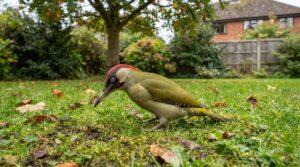
It’s eating ants. Green woodpeckers are the most ground-dwelling woodpecker in Europe and feed mainly on ants and their larvae, which is why you see them on lawns rather than tree trunks. They won’t use a bird feeder — the way to attract them is to stop treating your lawn.
A large green bird with a red head hopping awkwardly across the lawn is one of the more startling things to find in a garden, and the usual assumption is that it’s lost or injured.
It isn’t. It’s exactly where it wants to be.
Green woodpecker quick facts
- Size: about 32cm — noticeably bigger than a great spotted woodpecker
- Eats: ants, overwhelmingly. Plus larvae and some invertebrates
- Feeder use: none
- Call: a loud laughing “yaffle” — often heard before seen
- Male: red centre to the black moustache stripe. Female: all-black moustache
Identifying one
Look for: green upperparts, paler greenish-grey underparts, a bright red crown, a black mask around the eye, and a vivid yellow rump that’s unmistakable when it flies away.
Flight is deeply undulating — several wingbeats, then a closed-wing swoop, repeated. Very distinctive once you’ve seen it.
Male or female: both have the red crown. The difference is the moustache stripe below the eye — males have a red centre inside the black; females have solid black. It’s a clear, easy distinction at feeder-watching range.
Juveniles are heavily spotted and barred, looking scruffy and mottled, which catches people out in late summer.
Not to be confused with
The great spotted woodpecker — black and white, much smaller, and the one that actually uses peanut feeders. If it’s on your feeder, it isn’t a green woodpecker.
Why it’s on the grass
Green woodpeckers are ant specialists, and ants live in the ground.
They have an extraordinarily long tongue — considerably longer than the bill, and coated in sticky saliva with a barbed tip — which they push deep into ant nests and tunnels to extract ants and larvae.
What you’re watching when one hops across a lawn is a bird finding ant nests, then working at them. They’ll return to the same productive lawn repeatedly, sometimes for years.
An anthill with a hole dug into the side is the classic sign one has been about.
They do drum occasionally, but far less than great spotted woodpeckers, and they nest in tree holes like any other woodpecker. The ground feeding is a diet specialisation, not a lifestyle.
Why they won’t use your feeder
Worth stating plainly, because people spend money trying.
Nothing in a seed or suet feeder resembles an ant. Green woodpeckers occasionally take fallen fruit or come to a ground feeding area in hard weather, but they are not feeder birds and no product will change that.
They are also easily disturbed — considerably shyer than great spotted woodpeckers — so a bird on the lawn will usually leave the moment someone appears at a window.
How to actually attract them
This is one of the few garden birds where the advice is almost entirely about what not to do.
- Stop using ant powder, ant killer or lawn insecticides. You’re removing the entire food supply. This is the single biggest factor
- Tolerate anthills. A lawn with ant activity is a lawn a green woodpecker will visit. Yellow meadow ant hills in particular are a magnet
- Don’t over-manicure the lawn. Close-mown, heavily fed, weed-killed grass supports very little. A slightly rough lawn with some moss and clover supports far more
- Leave an area unmown if you can, or mow less often
- Keep mature trees — they nest in holes in deciduous trees, and need them nearby
- Leave dead wood standing where it’s safe to
- Watch from indoors. They’re shy and will leave if you go out
If you’ve had one once, you’ll likely get it again — they’re territorial and work a regular circuit.
The yaffle
The call is often the first sign, and it carries a long way.
A loud, ringing, laughing “yaff-yaff-yaff-yaff”, descending slightly — genuinely like distant laughter. The old country name for the bird is the “yaffle”, and several regional names reference the same thing.
Folklore in parts of Britain held that a yaffling green woodpecker predicted rain, which is why “rain bird” was another old name. There’s no evidence for it, but the name stuck.
Once learned, it’s unmistakable and tells you one is in the area even when you can’t see it.
Are they doing harm to the lawn?
Almost never. The holes are small, the grass recovers, and the bird is removing insects rather than eating the grass.
If you’re seeing genuine lawn damage in autumn, it’s more likely leatherjackets or chafer grubs being dug out — by badgers, crows or magpies, which make far bigger holes. In that case the woodpecker is a symptom rather than a cause, and the grubs are the underlying issue.
Common questions
Why is a woodpecker on my grass and not a tree?
It’s a green woodpecker, and it’s eating ants. They’re the most ground-feeding woodpecker in Europe and this is completely normal behaviour.
How do I get one to visit my feeder?
You won’t. They eat ants. The way to attract them is to stop treating your lawn with insecticide and tolerate anthills.
Is it male or female?
Check the moustache stripe below the eye. Red centre inside the black means male; solid black means female. Both have the red crown.
What’s the laughing bird call?
The green woodpecker’s “yaffle”. Loud, ringing and descending — it carries across several gardens.
Will it damage my lawn?
Not meaningfully. Larger holes and pulled turf in autumn usually mean badgers or corvids after leatherjackets, not woodpeckers.
Do green woodpeckers drum?
Occasionally, but far less than great spotted woodpeckers. They rely on the call for territorial signalling instead.
Related guides
- How to attract great spotted woodpeckers to your garden
- Best plants to attract birds to a UK garden
- Common garden birds in the UK: how to identify your visitors
- How to attract nuthatches to your garden
Sources: RSPB species information and conservation status listings; British Trust for Ornithology population trends; Woodland Trust; Royal Horticultural Society guidance on lawn invertebrates.
Compare current prices on bird food and feeders at Amazon UK. Prices and stock change often, so it is worth checking before you commit.
Browse bird food →