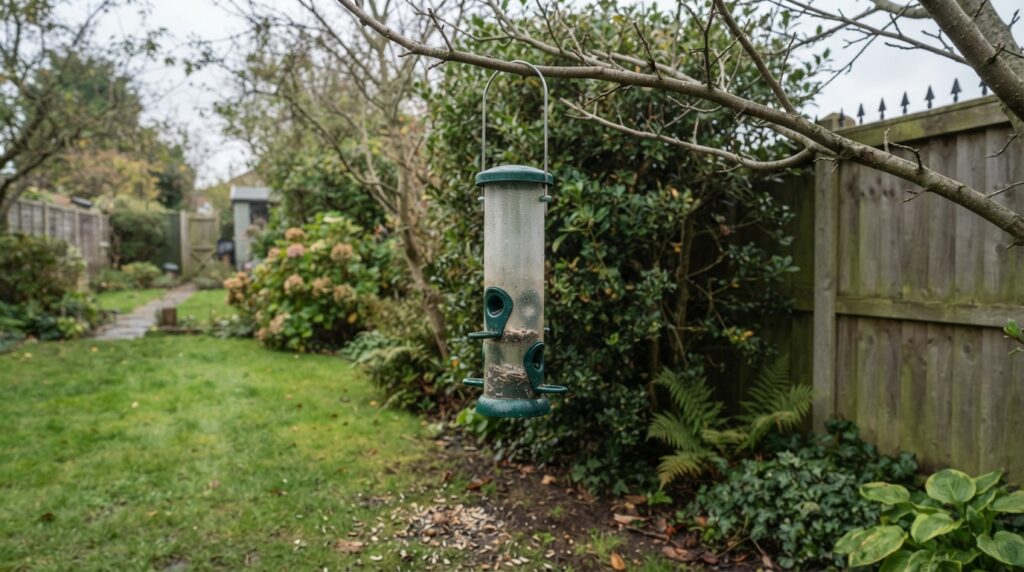
Movement and noise deter birds at first, then stop working. Birds habituate to anything predictable within days. Wind chimes near a feeder will reduce visits while they’re novel; a static gnome will be ignored within a week. The practical upshot: don’t hang chimes right next to a feeder, and don’t buy deterrents expecting lasting results.
Two versions of this question come up. Some people want to know whether their garden ornaments are why birds aren’t visiting. Others want to know whether shiny tape or a plastic owl will keep unwanted birds off.
The answer to both is the same, and it comes down to habituation.
The short version
- Moving and noisy things deter birds briefly, then stop
- Static ornaments are ignored within days
- Nothing deters selectively — it puts off wanted birds too
- Habituation beats every deterrent on the market
- Exclusion works where deterrence doesn’t
Why habituation beats everything
Birds constantly assess whether something is a threat. Anything that moves unpredictably or makes a sudden noise gets treated as dangerous until proven otherwise.
But they update fast. A hanging object that swings in the wind and never does anything harmful gets reclassified as background within a few days. After that it’s furniture.
This is why every visual and acoustic bird deterrent has the same lifecycle: promising for a week, useless by the third. It applies to hawk kites, shiny tape, plastic owls, reflective discs and ultrasonic devices alike.
The exception is something genuinely unpredictable and occasionally harmful — which is why a real cat is an effective deterrent and a model of one isn’t.
Wind chimes
The one most likely to be genuinely affecting your garden, because chimes combine both triggers: movement and sound.
Short term: yes, birds will be wary of a feeder hanging next to a chime, and visits will be reduced while it’s new.
Longer term: they habituate like everything else, particularly if the chime is a constant presence rather than an occasional one.
The practical advice: keep chimes a few metres from the feeder rather than adjacent to it. Not because they’ll ruin your garden permanently, but because the first few weeks of a new feeder are exactly when birds are deciding whether to trust it, and you don’t want an unfamiliar noise right next to it during that window.
If your feeder has been ignored for weeks and there’s a chime beside it, moving one of them is a cheap thing to try. See our guide on why birds aren’t coming for the more likely causes.
Garden ornaments
Gnomes, statues, solar lights, ceramic toadstools — essentially no lasting effect.
Static objects that never move and never do anything are ignored within days. Birds regularly perch on them.
The only ornaments worth thinking about are ones that move — spinners, whirligigs, anything on a pivot — and even those lose effect. Keep them away from the feeding area if you want, but they’re not the reason your garden is quiet.
Shiny tape, CDs and reflective discs
Popular, briefly effective, and with a cost people don’t anticipate.
Reflective objects flash unpredictably in sunlight, which triggers alarm. It works for a while.
The problem is that it isn’t selective. Shiny tape put up to discourage pigeons will discourage blue tits, robins and goldfinches just as effectively. You end up deterring the birds you wanted while the pigeons work out within a fortnight that the tape is harmless.
Net result: fewer songbirds, same pigeons.
Plastic owls and hawk silhouettes
The classic example of a deterrent that doesn’t work.
A model owl is static, silent and never hunts. Birds treat it as an object, and it’s common to see small birds perching on them.
Hawk silhouettes on windows have a different and more specific problem. They’re sold for preventing window strikes, but a single sticker doesn’t work — birds simply fly around it. What reduces strikes is breaking up the whole reflective surface with markings spaced closely across it. Our window strike guide covers what actually helps.
Ultrasonic devices
Sold widely, and there’s no good evidence they deter birds.
Birds’ hearing broadly overlaps with ours and doesn’t extend into the ultrasonic range the way some mammals’ does. A device emitting frequencies above human hearing is, in most cases, emitting frequencies above bird hearing too.
Worth being sceptical of any product making claims here.
What actually works, when you genuinely need it
If the goal is stopping larger birds monopolising food, exclusion works where deterrence doesn’t.
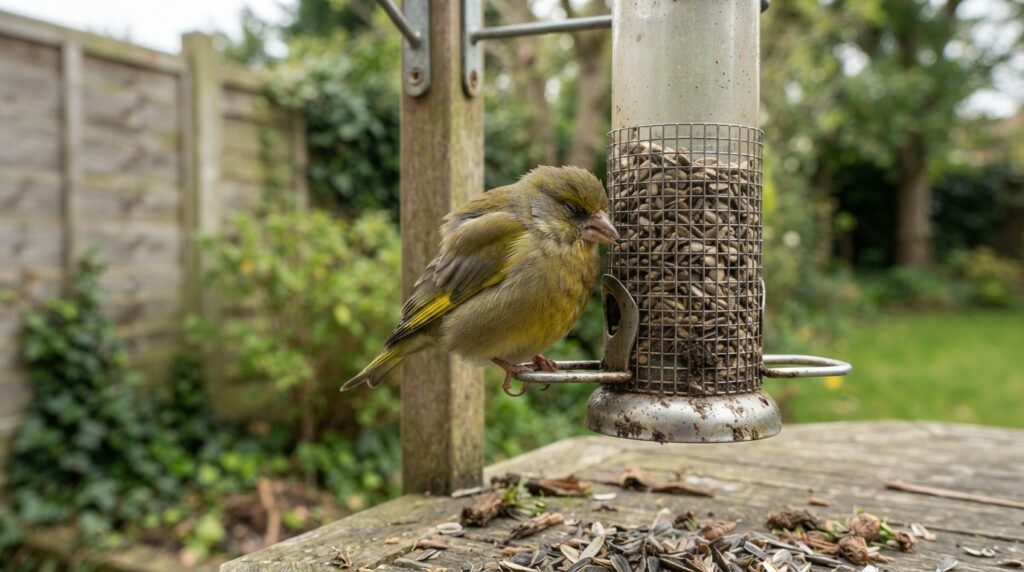
- A caged feeder — mesh admits small birds and excludes pigeons, starlings and squirrels. Physical, permanent, no habituation possible
- A weight-activated feeder — closes under the weight of anything heavier than a small bird
- Removing flat surfaces — no bird table, no seed tray. Also current guidance for disease reasons
- Changing the food — sunflower hearts and safflower are far less attractive to pigeons than cheap wheat-heavy mix
- Clearing spillage — ground food is what brings pigeons in, not the feeder
Our guides on pigeons and starlings and too many pigeons cover this properly.
A legal note: all wild birds are protected under the Wildlife and Countryside Act 1981. Deterrence must stop well short of harm, and nothing should be used that could injure or trap a bird. Fine netting, glue products and anything with sharp edges have no place in a garden.
It’s also an offence to deliberately disturb birds at an active nest, so deterrents near nesting sites during the breeding season are best avoided entirely.
Things that genuinely do put birds off
If your garden is quiet, these are far more likely than ornaments.
- No cover within about 2m of the feeder — the most common cause
- A cat that patrols regularly
- A sparrowhawk working the area — birds go quiet for days after a strike
- Stale or mouldy food
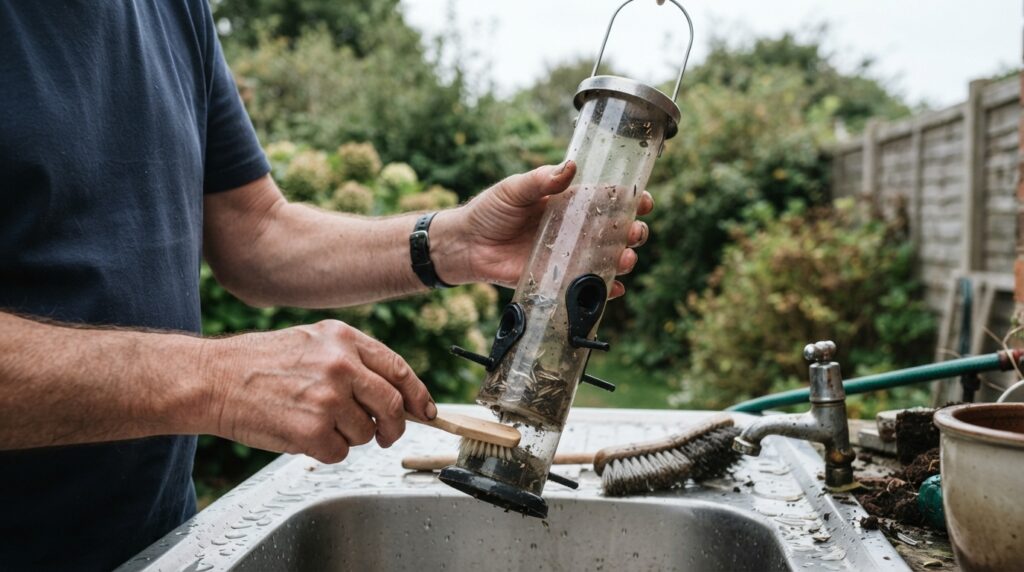
- A dirty feeder
- Constant human activity right beside the feeder
- Building work or a new fence — sustained disruption rather than a novel object
- Late summer — birds are moulting and natural food is abundant. This is seasonal and normal
Common questions
Will wind chimes stop birds visiting?
Briefly, if they’re right beside the feeder. Birds habituate within days. Keep chimes a few metres away, especially while a feeder is new.
Do plastic owls work?
No. They’re static and silent, and birds routinely perch on them.
Does shiny tape deter pigeons?
For a week or two, and it deters songbirds equally. You generally end up with fewer of the birds you wanted and the same number of pigeons.
Do ultrasonic bird deterrents work?
There’s no good evidence for them. Bird hearing doesn’t extend into the ultrasonic range the way some mammals’ does.
My garden has lots of ornaments. Is that why it’s quiet?
Very unlikely. Look at cover, cats, feeder hygiene and time of year first — those explain nearly all quiet gardens.
What about solar lights?
No meaningful effect on daytime feeding. Worth knowing that artificial light at night can cause robins to sing through the small hours — see our night singing guide.
Related guides
- Why have the birds stopped coming to my feeder?
- How to stop pigeons and starlings taking all the bird food
- Birds flying into windows: why it happens and what works
- How to keep cats away from bird feeders
Sources: RSPB guidance on deterring birds and on feeder placement; British Trust for Ornithology; Wildlife and Countryside Act 1981.
Compare current prices on bird food and feeders at Amazon UK. Prices and stock change often, so it is worth checking before you commit.
Browse bird food →