Affiliate disclosure: some links on this page go to Amazon. If you buy through one we may earn a small commission, at no extra cost to you. Full disclosure.
Pigeons are there for spilled seed on the ground, not the feeder itself. Switch to sunflower hearts (almost no waste), stop ground feeding, clear beneath the feeder, and use a caged feeder that admits small birds only. Removing the ground food removes the reason they come.
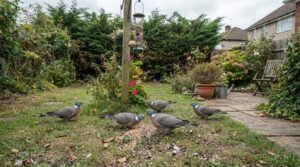
A garden that suddenly has six woodpigeons and a pair of collared doves in permanent residence is a common complaint, and it’s almost always the same underlying cause.
The good news is that the fix is the same one that reduces mess, cuts waste and deters rats.
The short version
- They want ground food — spillage, not the feeder
- Cheap mixes make it worse — birds reject the wheat, pigeons eat it
- Caged feeders exclude them while letting small birds through
- Flat surfaces are no longer recommended anyway — remove trays and tables
- All are protected — exclusion is the appropriate approach
Which pigeon do you have?
| Woodpigeon | Collared Dove | Feral Pigeon | |
|---|---|---|---|
| Size | Large, 40cm+, bulky | Slim, about 32cm | Medium, stocky |
| Colour | Grey with pinkish breast | Pale sandy-buff | Highly variable |
| Neck | Bold white patch | Thin black half-collar | Green-purple sheen |
| Call | Five-note coo | Insistent three-note “coo-COO-cuk” | Rolling coo |
| Takeoff | Loud wing clatter | Quieter | Quick |
Woodpigeon — the big one. White neck patch, white wing bars in flight, and an explosive clatter on takeoff. Britain’s most numerous pigeon and increasingly a garden fixture.
Collared dove — worth knowing the history. They only arrived in Britain in the 1950s, having spread across Europe from the Middle East in one of the most rapid natural range expansions ever recorded. Now everywhere.
Feral pigeon — descended from domestic birds, themselves descended from rock doves. Highly variable in colour, more common in towns.
Why they’ve moved in
Pigeons and doves are ground feeders. They aren’t interested in clinging to a tube feeder; they want food lying on open ground.
Your garden supplies that if:
- You use cheap mixed seed. Small birds flick out the wheat, barley and split peas — and those are exactly what pigeons want. You’re effectively running a pigeon feeder underneath the songbird one
- You scatter food on the ground for blackbirds and robins
- You have a bird table or tray — a flat surface a pigeon can stand on
- Spillage isn’t cleared, so there’s a permanent supply
Collared doves in particular breed almost year-round where food is reliable, so a consistent supply produces more of them.
The fixes, in order
1. Switch to sunflower hearts
The single most effective change. No husk, so birds eat virtually the whole thing and almost nothing reaches the ground.
Cheap mixes are the root of most pigeon problems. If your bag lists wheat, barley or split peas near the top, that’s what’s feeding them.
2. Use a caged feeder
A mesh cage around a tube feeder admits tits, finches and sparrows while excluding pigeons, doves, starlings and squirrels.
Check the mesh is wide enough for blue tits to pass through comfortably — too fine and you exclude everything.
One caveat: a cage also excludes woodpeckers. Running one uncaged suet feeder elsewhere solves that.
3. Remove flat surfaces
Bird tables, seed trays beneath feeders, and window feeders are all things a pigeon can stand on.
They’re also no longer recommended generally — the RSPB advises against flat-surfaced feeders and removed them from sale in December 2024, because regurgitated food collects on them and spreads disease. So removing them solves two problems.
Our feeder types guide covers the alternatives.
4. Stop ground feeding temporarily
If you scatter food for blackbirds and robins, pause it for two or three weeks. Pigeons move on when the reliable supply stops.
When you restart, scatter only what will be eaten by dusk, in a different spot each time, ideally tucked close to cover where a pigeon is less comfortable.
5. Clear beneath the feeder weekly
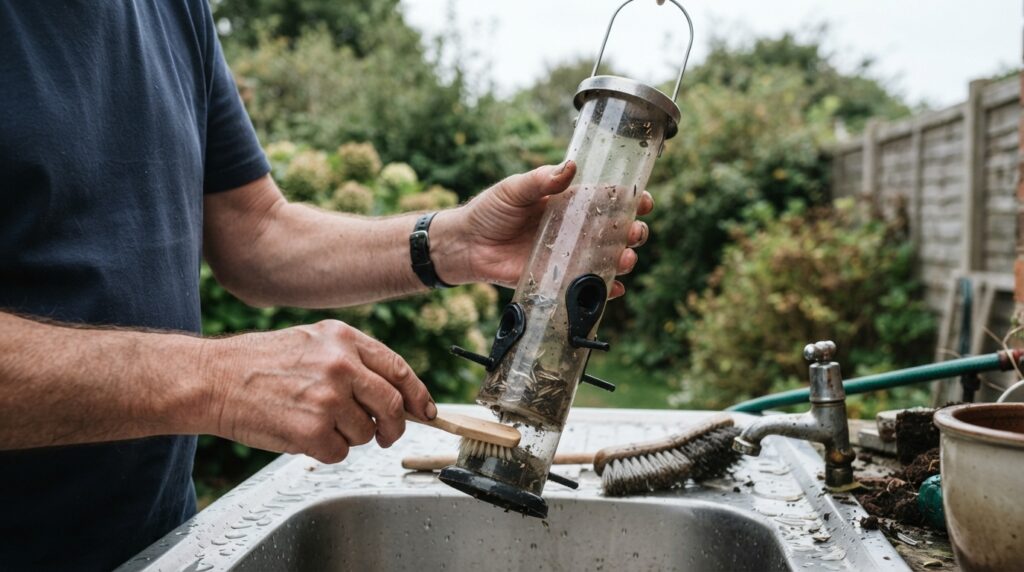
Do it alongside the weekly feeder clean that current guidance recommends. Raking up spillage removes the standing invitation.
The legal position
Woodpigeons, collared doves and feral pigeons are all wild birds protected under the Wildlife and Countryside Act 1981.
Some species may be controlled under general licences for specific purposes such as preventing serious agricultural damage or protecting public health — but those licences carry strict conditions, vary between England, Scotland, Wales and Northern Ireland, are revised periodically, and require non-lethal methods to have been tried first.
“Pigeons are eating my bird food” is not lawful grounds for control. Exclusion is the appropriate and effective approach.
What doesn’t work
- Plastic owls and hawk silhouettes — pigeons habituate within days
- Shiny tape and CDs — same problem, and they also deter the birds you want
- Ultrasonic deterrents — no good evidence they work on birds
- Chasing them off — they return within minutes
Removing the food source works. Deterrents generally don’t.
A word in their favour
Worth a moment before declaring war.
Woodpigeons and collared doves are native (or, in the collared dove’s case, naturally colonising) wild birds doing nothing wrong. They’re also prey for sparrowhawks and peregrines, and their presence is part of a functioning garden.
The reasonable goal is stopping them monopolising food meant for smaller birds — not removing them from the garden. A caged feeder achieves that neatly.
Common questions
Will pigeons stop small birds coming?
They can dominate ground feeding and clear food quickly, but they don’t generally prevent small birds using a hanging feeder. A caged feeder removes the competition entirely.
Why do I suddenly have so many?
Usually a change in what you’re feeding, or spillage building up. Collared doves also breed almost year-round where food is reliable, so numbers grow over a season.
Do pigeons carry disease?
Risk to people from garden birds is low with normal hygiene — wear gloves when cleaning feeders and wash hands. Worth knowing that pigeons and doves are natural carriers of the parasite behind trichomonosis, which is why keeping feeders clean matters.
Can I stop them nesting in my garden?
Not once a nest is active — that’s an offence. Outside the breeding season you can remove old nests and prune, but woodpigeons nest over a long season, so check carefully first.
Is a spinning or weight-activated feeder worth it?
A weight-activated feeder works well and also handles squirrels and starlings. It’s more expensive than a cage but excludes by weight rather than size, so it doesn’t shut out woodpeckers.
Related guides
- How to stop pigeons and starlings taking all the bird food
- Types of bird feeder: which one should you actually buy?
- Rats under the bird feeder: how to stop attracting them
- Best bird food for winter: what to put out and what to skip
Sources: RSPB species information and feeding guidance (April 2026); RSPB flat-surface feeder sales suspension (December 2024); British Trust for Ornithology population trends; Wildlife and Countryside Act 1981 and current general licences, which differ by country.
Compare caged feeders that exclude larger birds at Amazon UK. Prices and stock change often, so it is worth checking before you commit.
Browse caged feeders →