Affiliate disclosure: some links on this page go to Amazon. If you buy through one we may earn a small commission, at no extra cost to you. Full disclosure.
A dunnock has a slate-grey head and breast and a thin, fine bill — where a house sparrow has a buff-brown head and a thick conical bill. Dunnocks shuffle about alone under hedges; sparrows arrive in noisy groups. They eat small seeds and insects on the ground and won’t use hanging feeders.
The dunnock is probably in your garden right now, and there’s a fair chance you’ve been calling it a sparrow.
It isn’t one. It isn’t even closely related — the old name “hedge sparrow” is a piece of misleading folk taxonomy that has caused confusion for centuries. Dunnocks belong to an entirely different family, the accentors.
Dunnock quick facts
- Key feature: slate-grey head and breast, thin pointed bill
- Behaviour: shuffles alone on the ground under cover
- Eats: small seeds and insects — ground level only
- Feeder use: none. They can’t cling to hanging feeders
- Song: a thin, fast, slightly scratchy warble from inside a hedge
Dunnock or house sparrow?
This accounts for more garden misidentification than anything else in Britain.
| Dunnock | House Sparrow (female) | |
|---|---|---|
| Bill | Thin, fine, sharply pointed | Thick, short, conical |
| Head | Slate-grey | Buff-brown, pale stripe behind eye |
| Breast | Grey | Plain buff |
| Company | Alone, almost always | In a group, almost always |
| Manner | Quiet, furtive, shuffling | Bold, noisy, sociable |
| Where | Under hedges and shrubs | Feeders, roofs, open ground |
If you check one thing, check the bill. A dunnock’s is a fine insect-eater’s bill; a sparrow’s is a stout seed-cracker’s. It’s visible at surprising distance once you know to look.
If you can’t see the bill, watch the behaviour. A single small brown bird creeping along the ground under a shrub, alone and quietly, is almost certainly a dunnock. Sparrows don’t do that.
Our brown bird guide covers the whole set of confusable species.
Identifying one properly
Size: about 14cm — sparrow-sized but slimmer and more elongated.
Plumage: streaky chestnut-brown and black back and wings, distinctly slate-grey head, throat and breast, brown-streaked flanks. Reddish-brown legs.
The overall impression is of a neat, unobtrusive, greyish bird that keeps low and moves with a curious shuffling crouch — often described as creeping or mouse-like.
Juveniles lack the clean grey and are browner and more streaked, which makes late summer confusing.
What they eat, and how to feed them
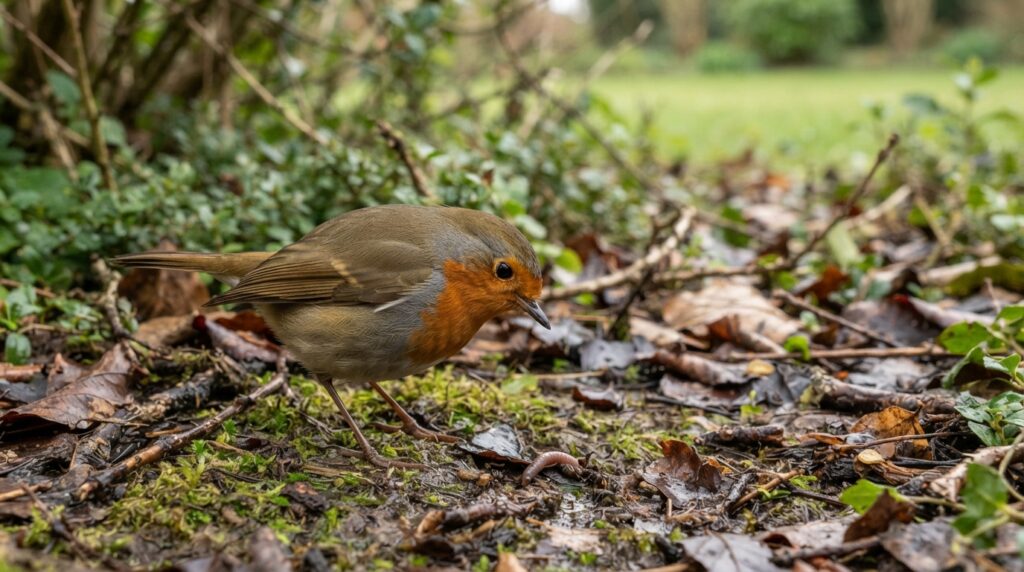
Dunnocks take small seeds and invertebrates, foraging almost entirely on the ground beneath cover.
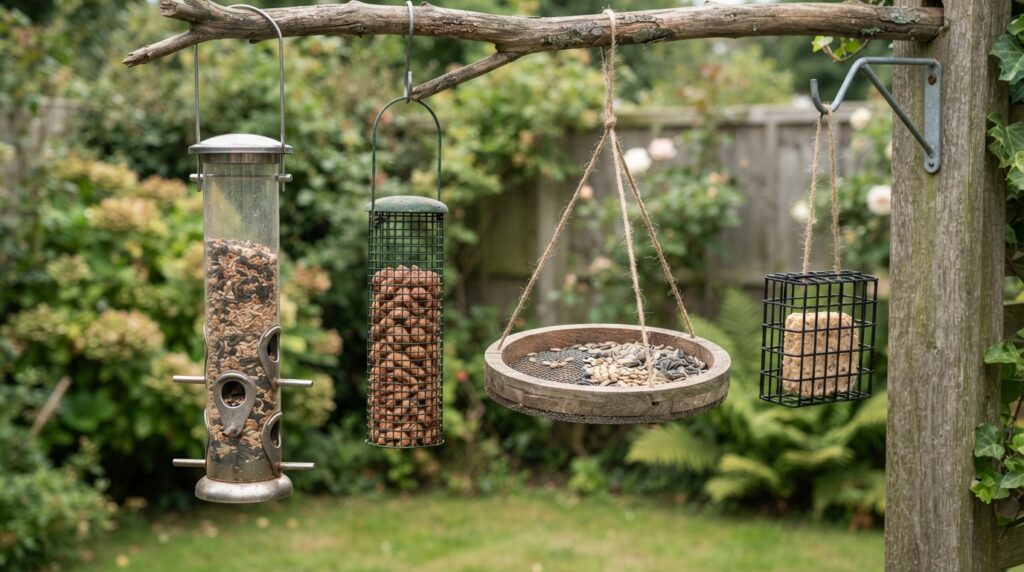
They will not use a hanging feeder. They can’t cling like a tit, and they don’t want to be that exposed. A garden full of dunnocks can have a completely ignored seed feeder.
What works:
- Small seed scattered on the ground near a hedge bottom — millet, finely kibbled seed, sunflower hearts
- Suet pellets or crumbs at ground level
- Dried mealworms, soaked first, in a small shallow dish low down
- Spillage beneath a hanging feeder — often how they benefit from feeding without ever using the feeder
Put out only small amounts, in a different spot each time, cleared by dusk — flat surfaces where food accumulates are no longer recommended, and leftovers attract rats. Our seasonal feeding guide covers the current position.
The strangest private life in the garden
Dunnocks look modest and are anything but. Their mating system is among the most unusual of any British bird, and it’s genuinely well documented.
Rather than settling into simple pairs, dunnocks form a range of arrangements depending on how territories overlap:
- Monogamy — one male, one female
- Polyandry — one female with two or more males, which is rare among birds
- Polygyny — one male with several females
- Polygynandry — several males and several females sharing overlapping territories
Where more than one male is attending a female, both may help feed the chicks — and how much each male provisions relates to how much access he had. The competition between males is intense and largely invisible unless you know what you’re watching.
If you see two or three dunnocks in an apparent scuffle in spring, with wing-flicking displays, that’s not a squabble over food. That’s the dunnock mating system in operation.
The song
Easy to overlook and worth learning, because it’s often the only sign one is present.
A thin, fast, slightly scratchy warble of a few seconds, usually delivered from inside or on top of a hedge. Less musical than a robin, less rich than a blackbird, and easy to dismiss as background noise.
They sing from late winter through spring, often from a surprisingly exposed perch given how secretive they otherwise are.
How to make a garden dunnock-friendly
- Keep a dense hedge or thick shrub border — this is the single most important thing
- Leave leaf litter under shrubs, where they forage
- Scatter small seed and suet crumbs at ground level near cover
- Don’t over-tidy — a bare, swept garden gives them nothing
- Avoid insecticides — invertebrates are a large part of the diet
- Provide water in a shallow dish, changed daily
- Grow ivy — cover, insects and nest sites in one
They won’t use a nest box. Dunnocks build a neat cup nest low in dense shrubs, so thick planting is the only way to provide for them.
Don’t cut hedges between March and August. Dunnocks nest low in dense cover, and it’s an offence under the Wildlife and Countryside Act 1981 to damage an active nest. See our nesting season guide.
Common questions
Is a hedge sparrow the same as a dunnock?
Yes — “hedge sparrow” is an old name for the same bird. It’s misleading, because dunnocks aren’t sparrows and aren’t closely related to them. The name is best avoided.
Why won’t dunnocks use my feeder?
They’re ground foragers with fine bills and can’t cling to a hanging feeder. Scatter small amounts of seed or suet crumbs beneath it instead.
Are dunnocks declining?
They declined through the late 20th century and are on the UK Amber List, though numbers have been more stable in recent decades. Loss of scrubby, hedged habitat is the usual explanation.
Why are two dunnocks fighting in spring?
Almost certainly males competing over a female. Their mating system involves several males attending one female, and the competition is genuinely intense.
Do dunnocks migrate?
British dunnocks are largely sedentary and stay put year-round. Some continental birds arrive in winter, but the one under your hedge is likely a resident.
Related guides
- Small brown birds in your garden: how to tell them apart
- How to attract house sparrows (and why they’re disappearing)
- Best plants to attract birds to a UK garden
- Common garden birds in the UK: how to identify your visitors
Sources: RSPB species information and conservation status listings; British Trust for Ornithology population trends and research on dunnock breeding systems; Woodland Trust; Wildlife and Countryside Act 1981.
Compare feeder poles and baffles at Amazon UK. Prices and stock change often, so it is worth checking before you commit.
Browse feeder poles →