Affiliate disclosure: some links on this page go to Amazon. If you buy through one we may earn a small commission, at no extra cost to you. Full disclosure.
House sparrows want three things: seed (sunflower hearts or a quality mix), dense scruffy cover to sit in, and nest holes in a building. They nest in loose colonies, so a multi-chambered sparrow terrace with 32mm holes works far better than a single box.
The house sparrow is still the most commonly recorded bird in UK gardens. It’s also on the Red List of conservation concern, having declined severely since the 1970s.
Both things are true at once, which is why it’s a species worth actively helping rather than taking for granted.
House sparrow quick facts
- Best food: sunflower hearts, quality mixed seed, millet
- Nest box: 32mm hole, ideally a terrace with several chambers
- Male: grey cap, black bib, chestnut nape
- Female: plain buff-brown, pale stripe behind the eye, no bib
- Behaviour: sociable and noisy — almost never alone
Identifying a house sparrow
Male: a pale grey crown, chestnut-brown stripe running back from behind the eye, a black bib covering the throat and upper chest, off-white cheeks, and a streaked chestnut-and-black back. Short, thick, conical bill.
Female: much plainer — buff-brown all over with a streaked back, a pale stripe behind the eye, no bib and no grey cap. This is the one people struggle with, because a female house sparrow is a textbook “little brown job”.
The commonest confusion is with a dunnock, and one feature settles it: the bill. A sparrow’s is thick and conical, built for cracking seed; a dunnock’s is thin and fine. A dunnock also has a slate-grey head and shuffles about alone under a hedge, where sparrows arrive in a noisy group.
Our brown bird guide works through the whole set.
Not to be confused with a tree sparrow
Tree sparrows are a different, much scarcer species. The tell: a tree sparrow has a chestnut-brown crown (not grey) and a distinct black spot on a white cheek. Male and female look alike.
The decline
UK house sparrow numbers have fallen substantially since the 1970s — a decline severe enough to put a bird most people still think of as ubiquitous onto the Red List.
The causes aren’t fully settled, and honest sources say so. The factors most often cited:
- Loss of nest sites. Modern buildings are sealed. Renovation, soffit replacement and cavity insulation remove the roof-space gaps sparrows have used for centuries
- Fewer insects. Sparrow chicks are fed on invertebrates for their first days. Fewer insects means lower chick survival, even where adults have plenty of seed
- Loss of scruffy habitat — hedges replaced by fences, gardens paved over, weedy corners tidied away
- Less spilled grain in towns and around farms than there once was
Urban populations have generally fared worse than rural ones, and some cities have seen particularly steep declines.
What they eat
Adults are primarily seed eaters — the conical bill gives that away. But chicks need insects, especially in their first week, and that distinction matters for anyone wanting to help.
What to put out:
- Sunflower hearts — the reliable staple, taken readily
- A quality mixed seed — sparrows are one of the few garden birds that genuinely eat millet, so a mix containing it isn’t wasted on them
- Suet pellets and fat balls — useful, and approved year-round
- Mealworms — particularly valuable in the breeding season
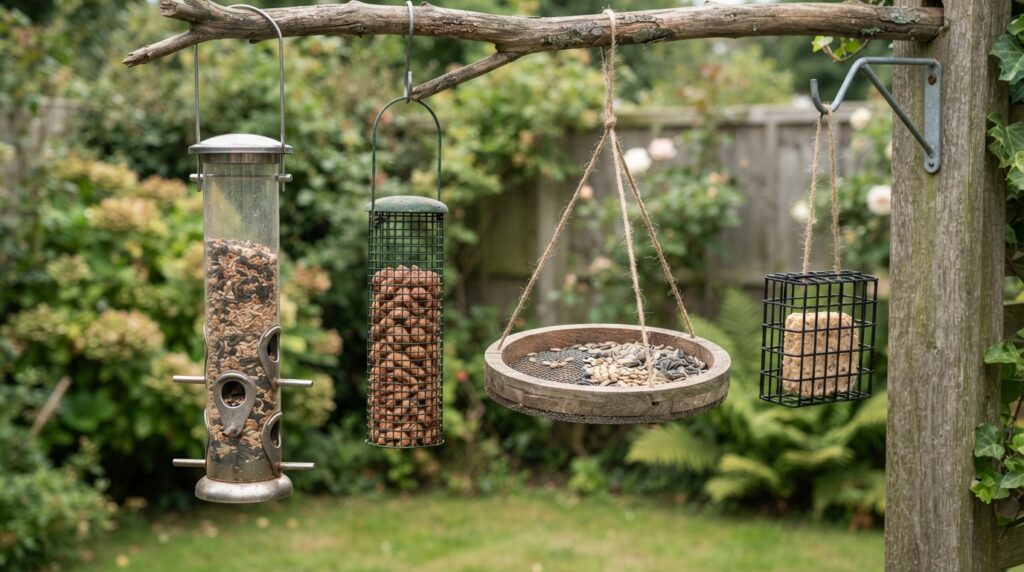
Sparrows will feed from hanging feeders and from the ground equally happily, and being sociable they often turn up in numbers, so a feeder with several ports gets used well.
Nest boxes: think terrace, not box
This is where most people go wrong, and it’s an easy fix.
House sparrows nest in loose colonies. They like neighbours. A single box on a wall may be used, but a sparrow terrace — a long box with two or three separate chambers — suits their biology far better and is much more likely to be occupied.
The specification:
- 32mm entrance hole (25mm is blue tits, 28mm great tits)
- Height 2–4m, ideally under the eaves of a house or on a wall
- Facing between north and east, avoiding the hottest sun and wettest winds
- Group boxes together if using singles — several on the same wall, a metre or so apart
Put boxes up in autumn or early winter — sparrows roost in them through the cold months and are more likely to nest in a box that’s been in place a while. Our nest box guide covers siting properly.
If sparrows already nest in your roof, that’s a genuinely valuable nest site — they’re scarce enough that losing one matters. It’s also an offence to block an active nest under the Wildlife and Countryside Act 1981. If you need the gap closed for building work, do it between September and February and put up a terrace nearby first. See our roof nesting guide.
Cover matters as much as food
Sparrows are nervous birds that spend a lot of time sitting in dense vegetation, chattering, before dropping down to feed. Without somewhere to sit, they won’t linger.
What works:
- A dense hedge — hawthorn, privet, or anything thick. Sparrows will use a scruffy hedge that a tidier gardener would have cut back
- Climbers on a wall or fence — ivy especially
- Shrubs near the feeder, about two metres away
- Not cutting everything back in autumn
The phrase worth holding onto is “slightly untidy”. Sparrows do well in gardens that aren’t immaculate.
Insects for the chicks
The single highest-impact thing, and it costs nothing: stop using insecticides.
Sparrow chicks are fed invertebrates — aphids, caterpillars, beetles. A garden with plenty of seed but no insects can support adults while failing their young, which is thought to be part of the wider decline picture.
Beyond that: let some areas grow, plant flowering natives, tolerate aphids on the roses, and leave a rough corner. Our plants guide covers what helps.
Dust bathing
A behaviour worth knowing about, because people sometimes think a sparrow flapping in dry soil is injured.
Sparrows dust bathe — settling into dry earth or sand and flicking it through their feathers, which helps control parasites and absorb excess preen oil. They often do it communally, in a shallow scrape, and it looks like a small chaotic scuffle.
If you have a dry, sunny patch of bare soil, you may well get a sparrow dust bath. It’s a good sign, not a problem.
How to attract them: the checklist
- Put up a sparrow terrace with 32mm holes, high on a wall, facing north to east
- Offer sunflower hearts and a millet-containing mix
- Plant or keep a dense hedge near the feeding area
- Stop using insecticides — chicks need invertebrates
- Leave a dry patch of bare soil for dust bathing
- Provide water, changed daily
- Don’t over-tidy — scruffy suits them
- Protect existing roof nest sites rather than sealing them
Common questions
How can sparrows be Red Listed if I see loads?
Red Listing is based on the rate of decline, not current abundance. Sparrows remain numerous in absolute terms but have lost a very large share of their population since the 1970s. Local abundance also varies enormously — some areas still have plenty, others have lost them almost entirely.
Why do sparrows arrive all at once and then vanish?
Normal behaviour. They’re sociable, feed as a group, and move on together. A feeder that looks empty five minutes later hasn’t been abandoned.
Is my “sparrow” actually a dunnock?
Check the bill and the company. Thick conical bill in a noisy group means sparrow; thin fine bill, grey head, alone under a bush means dunnock.
Will sparrows use a normal nest box?
Sometimes, if the hole is 32mm. But a terrace suits their colonial habit far better and has a much higher take-up rate.
Do sparrows migrate?
No. UK house sparrows are highly sedentary — many spend their whole lives within a very small area, sometimes just a few streets. That’s part of why local declines can be so complete: once a colony is lost, it isn’t quickly replaced.
Related guides
- Small brown birds in your garden: how to tell them apart
- When to put up a nest box (and exactly where to site it)
- Birds nesting in your roof or eaves: what you can and can’t do
- Best plants to attract birds to a UK garden
Sources: RSPB species information and conservation status listings; British Trust for Ornithology population trends and nest box guidance; RSPB Big Garden Birdwatch results; Wildlife and Countryside Act 1981.
Compare current prices on bird food and feeders at Amazon UK. Prices and stock change often, so it is worth checking before you commit.
Browse bird food →