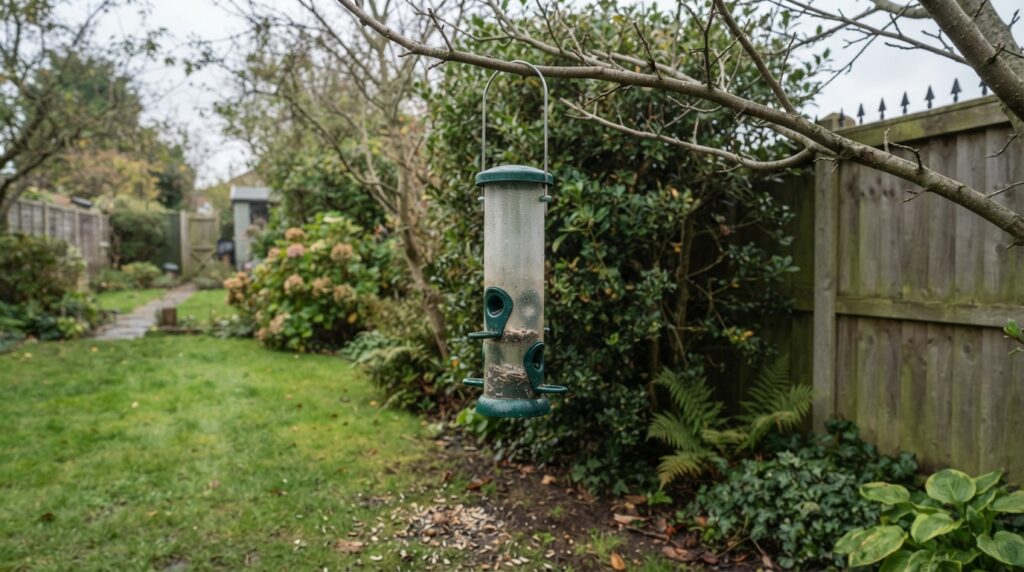
Don’t stop feeding. Sparrowhawk predation is natural, and long-term research has not found it to be a cause of songbird population declines. The useful response is to move the feeder closer to cover — about two metres from a dense shrub — so small birds have somewhere to bolt to.
Watching a sparrowhawk take a blue tit off your feeder is genuinely upsetting, and the instinct afterwards is usually to feel you’ve lured birds to their deaths.
That instinct is understandable and, on the evidence, misplaced. Here’s what’s actually going on and what’s worth doing about it.
The short version
- It’s natural — sparrowhawks are native predators of small birds
- Research has not linked sparrowhawk predation to songbird declines
- Don’t remove the feeder — you’d displace birds, not protect them
- Do move it nearer cover — about 2m from a dense shrub
- They’re protected — deterring them by any harmful means is an offence
Identifying a sparrowhawk
Often glimpsed rather than seen properly, because the hunting style is a fast low dash rather than a soar.
Look for: a long tail, short broad rounded wings, and a habit of flying fast and low along a hedge line before flicking over it. Bright yellow eyes and long yellow legs.
Male: surprisingly small — not much bigger than a blackbird. Slate-grey above, with fine orange-barred underparts.
Female: considerably larger, up to about a quarter bigger. Browner-grey above with grey-barred underparts and a pale stripe over the eye.
That size difference is unusual and worth knowing — it means males take small birds like tits and finches, while females can take birds up to woodpigeon size. So a “different hawk” in your garden may just be the other sex of the same pair.
Not to be confused with a kestrel, which hovers over open ground hunting voles. Sparrowhawks don’t hover; they ambush.
What the evidence actually says
This is the part worth reading properly, because the intuition is so strong.
Sparrowhawk numbers collapsed in the mid-20th century due to organochlorine pesticides, and recovered from the 1970s once those were withdrawn. That recovery coincided with declines in some songbird species, which made a causal link seem obvious.
It was investigated at length. Long-term analysis by the British Trust for Ornithology, using decades of national monitoring data, did not find evidence that sparrowhawk predation was driving songbird population declines. Where declines occurred, the drivers were overwhelmingly habitat loss, agricultural intensification and reduced invertebrate food.
The underlying logic: predators generally track prey abundance rather than determining it. Sparrowhawks also take a disproportionate share of young, sick and inexperienced birds — individuals with poor survival prospects anyway.
None of which makes it pleasant to watch. But it does mean the garden isn’t a trap you’ve set.
Should you take the feeder down?
No. Two reasons.
First, removing it doesn’t protect the birds — it just moves them somewhere else to feed, often somewhere with less cover, while removing a food source they may be relying on.
Second, sparrowhawks hunt hedgerows and gardens regardless of whether anyone is feeding. Your feeder isn’t what brought it into the neighbourhood.
What a feeder can do is concentrate birds in an exposed spot with no escape route. That part is worth fixing.
What actually helps: cover
The single useful change.
Small birds survive sparrowhawk attacks by diving into dense vegetation. A feeder in open lawn gives them nowhere to go; a feeder tucked hard against a hedge lets the hawk use the hedge as an ambush screen.
The workable distance is about two metres from cover — close enough to reach safety in a second or two, far enough that nothing can launch from it unseen.
Other things that help:
- Dense thorny shrubs near the feeding area — hawthorn, blackthorn, berberis, pyracantha. Thorns slow a pursuing hawk considerably
- Several feeders spread out rather than one busy one. Fewer birds in one place at one time — and spreading feeders out is recommended anyway for hygiene reasons
- A shrub or brash pile within a couple of metres of each feeder
- Avoid feeders against a fence or wall, which funnel birds into a corner
A used Christmas tree, staked upright near a feeder in January, makes genuinely effective temporary cover in a bare garden. Free, and lasts a couple of months.
The legal position
Sparrowhawks are protected under the Wildlife and Countryside Act 1981. It is an offence to kill, injure or take one, or to destroy an active nest.
There is no lawful way to remove a sparrowhawk from your garden. Providing cover for small birds is the only appropriate response — and it’s also the effective one.
What you might find
A ring of feathers on the lawn with nothing else is normal — sparrowhawks pluck prey before eating, often at a favoured spot known as a plucking post.
Feathers scattered widely with the quills intact usually means a bird of prey. Feathers chewed off with damaged quills usually means a cat or fox.
It’s grim to clear up, but it’s a sign of a functioning food chain rather than something going wrong.
How long until the birds come back?
Usually days rather than weeks. A garden can go noticeably quiet after a strike as birds stay in cover, then normal activity resumes.
If your feeder has stayed empty for longer, the cause is more likely to be something else — our guide on why birds stop coming to feeders works through the possibilities.
Sparrowhawks will also learn a productive hunting spot and return to it, so a period of repeated visits is normal. Improving cover is what changes the odds.
Common questions
Am I responsible for the bird’s death because I feed?
No. Sparrowhawks hunt gardens and hedgerows regardless. What you can control is whether small birds have escape cover — and improving that genuinely helps.
Are sparrowhawks the reason there are fewer songbirds?
The research doesn’t support it. Long-term BTO analysis found habitat loss, agricultural change and reduced insect availability to be the drivers, not sparrowhawk predation.
Can I scare it off?
Not effectively, and not by any means that would harm it. They habituate to deterrents quickly. Cover works; scaring doesn’t.
Why does it look like two different hawks?
Probably a pair. Female sparrowhawks are substantially larger than males and browner — they look like different birds until you know.
Will it take my cat or a small dog?
No. Even a large female sparrowhawk tops out at woodpigeon-sized prey.
Should I report the sighting?
Not for any welfare reason, but sightings are useful data — eBird and BTO BirdTrack both take casual records, and the Big Garden Birdwatch in January picks up garden raptors.
Related guides
- Why have the birds stopped coming to my feeder?
- How to keep cats away from bird feeders
- Best plants to attract birds to a UK garden
- Black birds in your garden: crow, rook, jackdaw or something else?
Sources: British Trust for Ornithology research on avian predators and songbird population trends; RSPB species information and guidance on sparrowhawks in gardens; Wildlife and Countryside Act 1981.
Compare hanging bird feeders at Amazon UK. Prices and stock change often, so it is worth checking before you commit.
Browse bird feeders →