Beakfeeder is reader-supported. If you buy through our Amazon links we may earn a small commission at no extra cost to you.
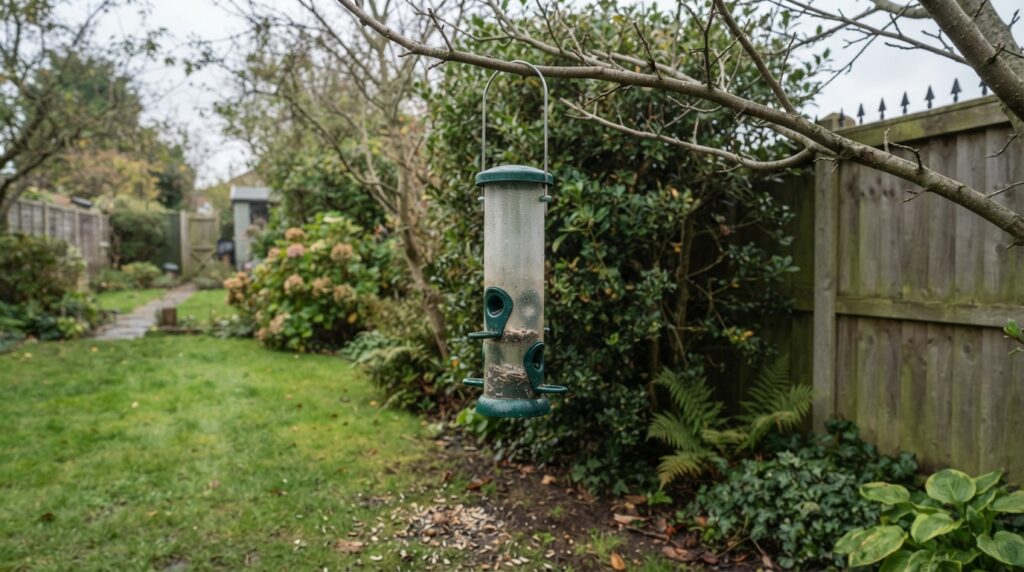
Hang hanging feeders about 1.5–2 metres off the ground, about 2 metres from dense cover, and either under 1 metre or more than 5 metres from a window. That’s high enough to stop cats leaping up, close enough to cover that small birds can dash to safety from a sparrowhawk, but not so close that a cat can hide in the hedge and ambush them.
- Hanging feeders: 1.5–2 m high.
- From a hedge or shrub: roughly 2 m.
- From a fence or wall top: at least 1.5–2 m away, so cats and squirrels can’t jump.
- From a window: under 1 m or over 5 m.
- Ground food: open space with a clear view, 2 m+ from cat-hiding cover.
Why height matters
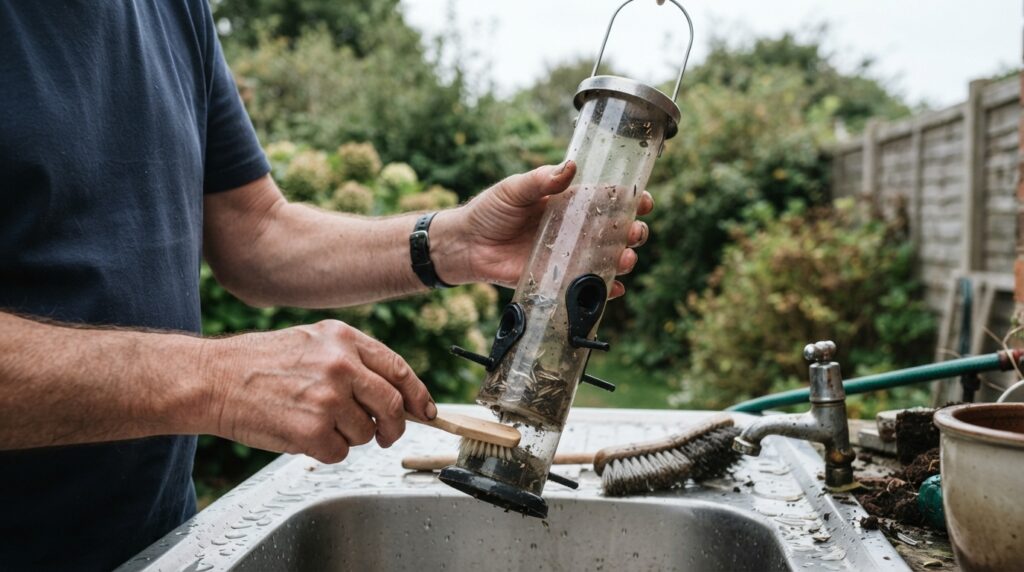
The main job of height is protection from cats. A domestic cat can jump well over a metre from standing, so a feeder at knee height is effectively a cat bowl. At around 1.5–2 metres, birds feeding are out of easy reach, and you can still reach the feeder to clean and refill it without a ladder — which matters, because the RSPB now asks garden feeders to clean weekly.
Going much higher doesn’t add much. Birds happily feed at 3 metres or more, but you’ll clean and refill less often, and a very high feeder in an open spot can swing badly in wind.
The cover distance — the one people get wrong
Small birds feel safest when they can reach cover in a second or two. That’s their defence against sparrowhawks. But dense cover right next to a feeder is also where a cat waits. The compromise that most guidance lands on is about 2 metres: close enough for a quick escape, far enough that nothing can pounce from the bushes.
- Ideal cover: a thorny or dense shrub such as hawthorn, holly, pyracantha or a mixed hedge.
- No cover at all? Birds will be warier and visit less. A large potted shrub or a trellis with climbers a couple of metres away helps a lot, especially in new-build gardens.
Distance from fences, walls and trees
Squirrels can leap around 2 metres horizontally and further downwards; cats walk fence tops. Hang feeders at least 1.5–2 metres from any launch point — fence tops, walls, sheds, overhanging branches — if you want to limit raids. If you’re using a bracket on a fence, choose a longer arm and accept squirrels may still reach it, or use a squirrel-proof feeder.
Distance from windows
This one sounds odd but is well established. Feeders closer than about 1 metre to glass mean a bird taking off can’t build up enough speed to hurt itself if it hits the window. Feeders further than about 5 metres mean birds recognise the house as a structure rather than a reflection of sky and trees. The danger zone is in between. Window decals or external screens reduce strikes wherever the feeder sits.
Best of both: a window-mounted suction feeder puts birds right up close for viewing and sits inside the safe zone.
Heights for different feeder types
| Feeder | Suggested height | Notes |
|---|---|---|
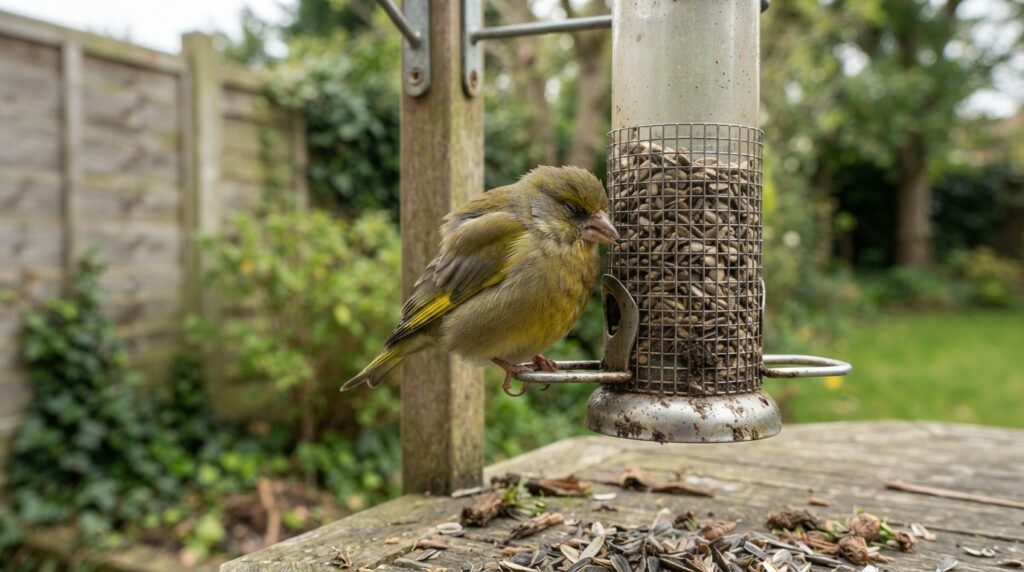
| Hanging seed or sunflower-heart feeder | 1.5–2 m | Tits, finches, sparrows |
| Nyjer feeder | 1.5–2.5 m | Goldfinches like a high, open perch |
| Fat ball or suet feeder | 1.5–2 m | Starlings, tits, woodpeckers |
| Peanut feeder (mesh) | 1.5–2 m | Tits, nuthatches, great spotted woodpeckers |
| Mealworm dish on a pole | 1–1.5 m | Robins like it lower; keep out of hedgehog reach |
| Ground tray | Just off ground | Open space, clear sightlines; clean and move often |
Other placement rules that matter
- Shelter from wind: avoid a gusty corner — it wastes seed and puts birds off.
- Somewhere you can see it: you’ll notice problems (empty, mouldy, sick birds) quickly.
- Somewhere you can move it: RSPB advice now includes moving feeders regularly so droppings and spilled food don’t build up in one spot. A pole with two or three ground sockets makes this easy.
- Away from bird baths directly below: droppings and seed foul the water fast.
- Not on a flat surface: flat-surface feeders were withdrawn from RSPB sale in December 2024 because birds stand in their food and droppings.
Common questions
Can a bird feeder be too high?
Not for the birds, but a feeder you can’t reach easily won’t get cleaned weekly. Keep it at a height you can manage.
Should a bird feeder be in sun or shade?
Dappled or part shade is best. Full sun speeds up fats melting and food spoiling.
Why won’t birds use my new feeder?
Usually it’s too exposed, too close to a cat hiding spot, or simply new. Give it two to three weeks before moving it.
How far apart should multiple feeders be?
Spread them out — a metre or more between them reduces squabbling and the build-up of droppings in one spot.
Related guides
- Birds hitting windows: why and how to stop it
- How to keep cats away from bird feeders
- Fence and wall bracket feeders
- Why are there no birds at my feeder?
Sources: RSPB garden bird feeding guidance (April 2026 update); RSPB advice on window collisions; BTO Garden BirdWatch.
Compare hanging bird feeders at Amazon UK. Prices and stock change often, so it is worth checking before you commit.
Browse bird feeders →