Affiliate disclosure: some links on this page go to Amazon. If you buy through one we may earn a small commission, at no extra cost to you. Full disclosure.
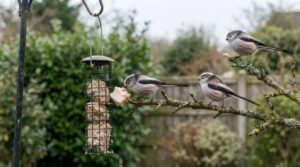
Suet is what brings them in. Long-tailed tits are primarily insect eaters and largely ignore seed, but they take fat balls and suet blocks readily. They travel as a flock, so they arrive in numbers, feed for a minute or two, and are gone — that’s normal, not a rejection.
Long-tailed tits are the small pink-and-black birds that appear all at once, swarm over a fat ball, and vanish as suddenly as they came.
They’re among the most charming things that visit a garden, and there’s one specific thing that gets them coming back.
Long-tailed tit quick facts
- Weight: around 8 grams — one of the UK’s lightest birds
- Key feature: a tail longer than its own body
- Best food: suet, fat balls, suet pellets
- Behaviour: almost always in a flock of 6–20
- Nest box: won’t use one — they build their own remarkable structure
Identifying them
Not really confusable with anything else once seen.
Look for: a tiny, round, fluffy body — often described as a flying lollipop or a ball on a stick — with a very long narrow black tail that’s longer than the rest of the bird.
The head is whitish with a broad black stripe running above each eye to the nape. The back is black with dusky pink shoulder patches, and the underparts are pinkish-white. The bill is extremely small and stubby, almost invisible.
The sound is often what alerts you first: a constant thin, high-pitched contact calling — “tsee-tsee-tsee” with dry trills mixed in — as the flock keeps in touch while moving.
Why they arrive as a gang
Long-tailed tits are unusually sociable. Outside the breeding season they move as family flocks, typically six to twenty birds, working through gardens and hedgerows in a loose stream.
They don’t settle. A flock arrives, feeds for a minute or two, and moves on — often covering a wide circuit and returning at roughly the same time each day.
So if they came once and haven’t been back within the hour, that’s completely normal. Keep the suet topped up and they’ll work you into their round.
What to feed them
Their natural diet is insects, spiders and larvae, gleaned from twigs and buds. They don’t crack seed and largely ignore seed feeders.
Suet is the answer, and it’s reliable:
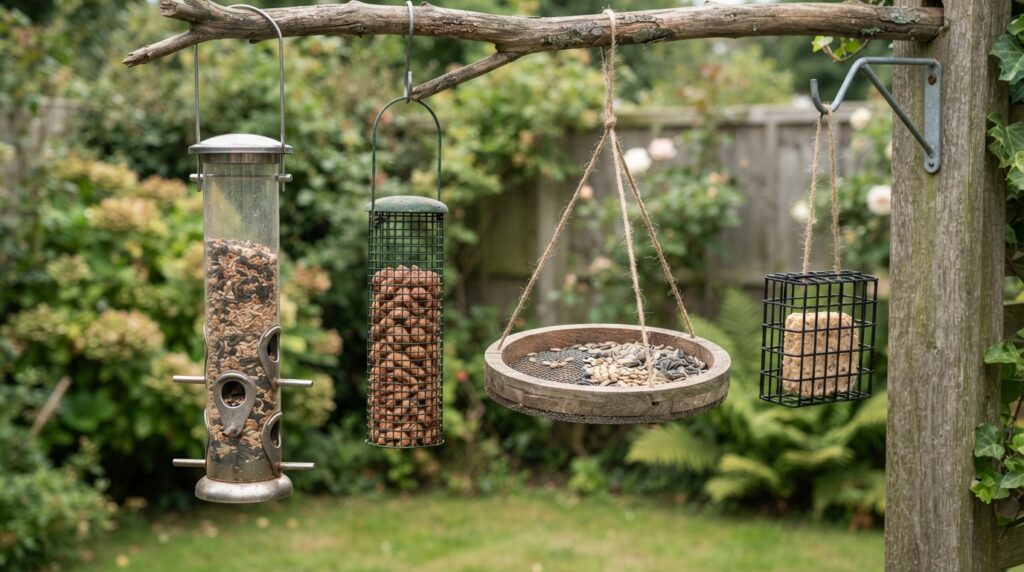
- Fat balls in a cage feeder — the classic and most effective option
- Suet blocks in a square cage
- Suet pellets, which they’ll take from a standard feeder
- Sunflower hearts — occasionally taken, but well behind suet
Never leave fat balls in plastic netting. Birds get beaks and feet caught in it, and a bird this small is particularly vulnerable. Buy them loose and use a proper cage feeder.
A useful practical point: suet stays recommended year-round under current guidance, while seeds and peanuts pause between 1 May and 31 October. So a suet feeder is the one that keeps long-tailed tits visiting through the summer as well.
The nest
Genuinely one of the most impressive structures built by any British bird.
A long-tailed tit nest is a domed, oval ball with a small side entrance, built from moss bound together with spider silk, camouflaged on the outside with lichen, and lined with a very large number of feathers — often well into the hundreds.
The spider silk matters: it makes the structure elastic, so the nest stretches as the chicks grow. A pair may spend around three weeks building it.
They’re usually placed low in a thorny bush — gorse, bramble, blackthorn or hawthorn — or higher in a fork of a tree.
They won’t use a nest box. If you want them nesting, the answer is dense thorny shrubs rather than anything you can buy.
Helpers at the nest
Another unusual behaviour. If a pair’s nest fails — and predation rates are high — the failed adults often don’t try again. Instead they join a relative’s nest as helpers, bringing food to their nieces and nephews.
So a flock in late summer may include birds that never raised young of their own but contributed to raising the flock’s.
Winter survival
At around 8 grams, a long-tailed tit has very little margin on a cold night.
Their strategy is to roost communally — the flock huddles together in a row along a branch, pressed tightly against each other, sharing body heat. Dominant birds tend to occupy the warmer middle positions.
Even so, hard winters cause substantial mortality, and populations can drop noticeably after a severe one before recovering across a few milder years.
What helps: keep suet available through winter, don’t cut back dense evergreen cover, and leave ivy alone. Our freezing weather guide covers the wider picture.
How to attract them
- Put up a suet cage feeder and keep it stocked — this is the single thing that matters most
- Be patient about the pattern — they visit on a circuit, often at similar times daily, rather than hanging around
- Plant dense thorny shrubs — hawthorn, blackthorn, bramble — for nesting and shelter
- Keep hedges and ivy rather than fences and bare walls
- Stop using insecticides — insects are their staple diet
- Provide water in a shallow dish, changed daily
- Leave nest boxes up over winter — not for nesting, but flocks may roost nearby in sheltered spots
Common questions
They came once and never returned. Why?
They almost certainly did return — you just missed them. Flocks work a circuit and stop for a minute or two. Watch at the same time of day and you’ll often catch them again.
Will they use a nest box?
No. They build their own domed nest in dense, usually thorny, vegetation. Planting is the only way to provide for them.
Do they eat seed at all?
Occasionally sunflower hearts, but they’re primarily insectivorous. Suet is far more effective.
Why are there so many together?
Family flocks. Outside the breeding season they travel as extended family groups, which is also how they survive cold nights — huddled together.
Are they related to blue tits?
Not closely, despite the name. Long-tailed tits sit in a different family from blue and great tits, which is part of why their nesting and social behaviour is so different.
Related guides
- Best bird food for winter: what to put out and what to skip
- Types of bird feeder: which one should you actually buy?
- Best plants to attract birds to a UK garden
- Where do garden birds sleep at night?
Sources: RSPB species information; British Trust for Ornithology research on long-tailed tit nesting, cooperative breeding and winter roosting; Woodland Trust.
Compare current prices on bird food and feeders at Amazon UK. Prices and stock change often, so it is worth checking before you commit.
Browse bird food →