Affiliate disclosure: some links on this page go to Amazon. If you buy through one we may earn a small commission, at no extra cost to you. Full disclosure.
Safe: unsalted roast or boiled potato, plain cooked vegetables, mild grated cheese, unsalted plain nuts, fruit, unsalted suet or fat. Not safe: anything salted, mince pies and Christmas cake (dried vine fruit and alcohol), chocolate, gravy-covered leftovers, turkey fat from the roasting tin, and cooked porridge or stuffing.
Christmas produces a great deal of leftover food, and it’s a natural instinct to put some out for the birds — particularly if it’s cold.
Quite a lot of it is fine. Some of it is genuinely harmful, and a couple of the traditional offerings are worse than most people realise.
The three rules
- No salt. This rules out most of a Christmas dinner as served
- Nothing with dried vine fruit — mince pies, Christmas pudding, cake
- Nothing from the roasting tin — fat mixed with meat juices goes rancid and smears feathers
Safe to put out
| Leftover | Conditions |
|---|---|
| Roast or boiled potato | Unsalted, no butter or goose fat. Cooled. Chopped small |
| Plain vegetables | Sprouts, carrots, parsnips, peas — unsalted, unbuttered. Chopped |
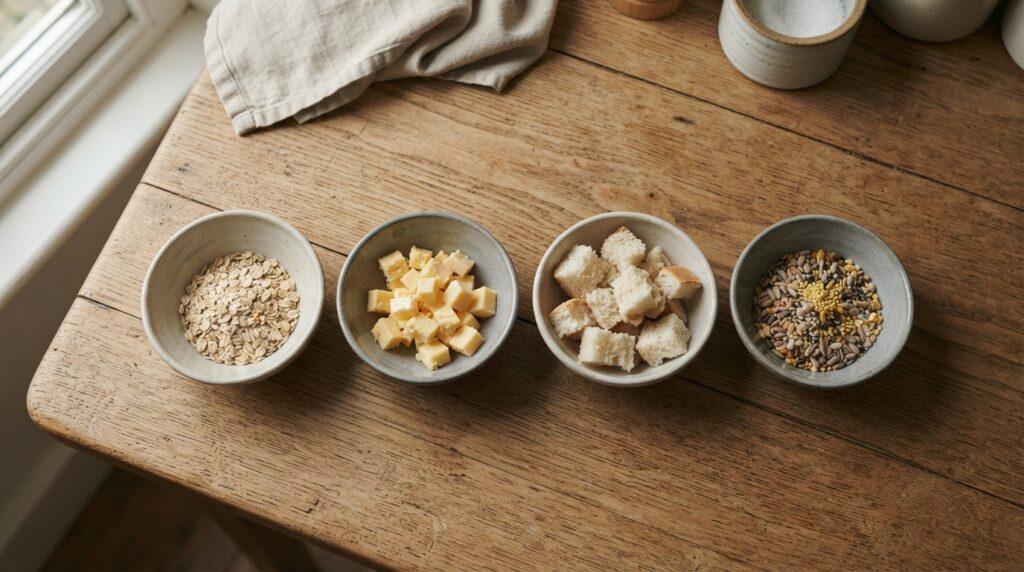
| Mild grated cheese | Mild cheddar, finely grated. Small amounts. Robins and wrens love it |
| Unsalted plain nuts | Only if genuinely unsalted and unroasted. Crushed or grated |
| Fruit | Apples, pears, grapes (halved), satsuma segments. Bruised is ideal |
| Plain cooked rice or pasta | Unsalted, no sauce |
| Unsalted suet or lard | Raw block fat is good. Not fat from cooking |
| Raw porridge oats | Uncooked only — see the warning below |
| Plain pastry | Cooked or uncooked, if made with animal fat. Small amounts |
Chop or grate anything you put out — small birds can’t manage a whole roast potato.
Not safe
Mince pies, Christmas cake and pudding
The one people most often get wrong, because it feels like a harmless treat.
All three are built on dried vine fruit — raisins, sultanas and currants. Plain soaked raisins are actually fine for birds, and blackbirds take them readily. The problem is everything else in a mince pie: high salt in the pastry, large amounts of sugar, and usually alcohol.
There’s a second reason to be careful, and it isn’t about the birds. Raisins, sultanas, currants and grapes are toxic to dogs, even in small quantities, and can cause kidney failure. Mince pies and Christmas cake put out on a lawn are a genuine risk to any dog with garden access — yours or a neighbour’s.
If you have a dog, skip dried fruit entirely rather than trying to place it out of reach.
Anything salted
Birds cannot process salt, and quantities we’d consider trivial are harmful to a small bird.
This rules out most of a Christmas dinner as it’s actually served — the potatoes, the stuffing, the pigs in blankets, the gravy, the crisps, the salted nuts, the ham. If it was seasoned, it’s out.
Turkey fat and roasting tin drippings
Another traditional offering that’s genuinely a bad idea.
Fat from a roasting tin is mixed with meat juices, which makes it go rancid quickly and provides a good medium for bacteria. Worse, it stays soft and smears onto feathers, damaging the waterproofing and insulation a bird depends on in December.
Raw suet or lard is different — hard block fat is fine and genuinely useful. It’s the cooked, meat-contaminated stuff to avoid.
Chocolate
Toxic to birds, as it is to dogs. No exceptions, including the leftover selection box.
Cooked porridge and stuffing
Cooked oats become sticky and set hard around a bird’s beak as they dry, which can make feeding impossible. Raw oats are fine; cooked are not. Stuffing has the same texture problem plus salt.
Bread and mince pies’ pastry in quantity
Not poisonous, but close to nutritionally worthless. In December, when a bird needs every calorie, filling up on bread is actively counterproductive.
Milk and cream
Birds can’t digest lactose. Cheese is fine because the lactose content is much lower; milk and cream are not.
What’s actually most useful in late December
If you want to help birds over Christmas, these do far more than leftovers:
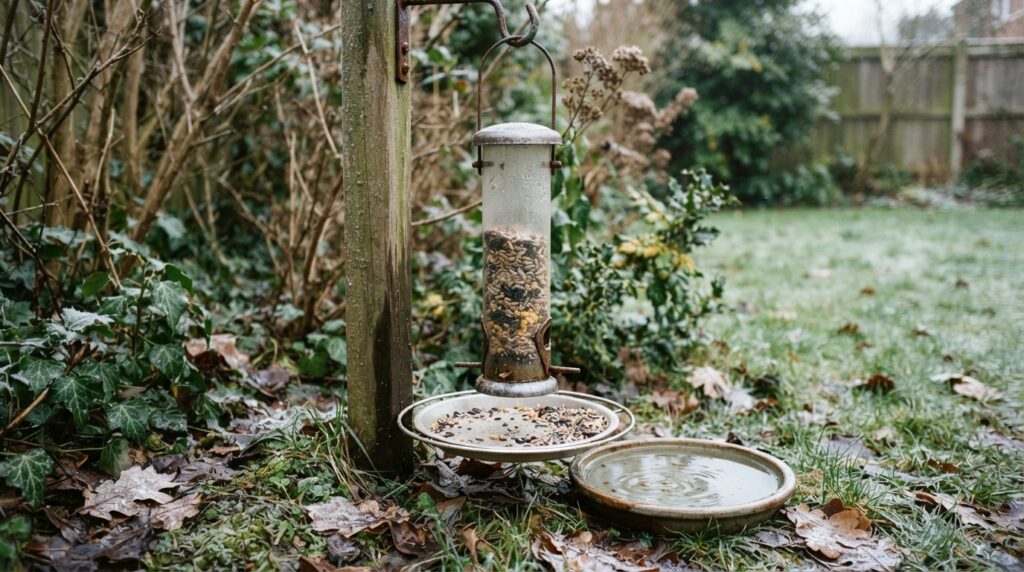
- Unfrozen water. Often scarcer than food in a frost, and free. A shallow dish topped up with warm water twice a day
- Suet and fat balls. Highest calorie density available, and December is peak demand
- Sunflower hearts. The reliable staple
- Windfall or bruised apples on the ground — blackbirds, and any redwings or fieldfares that have moved in during cold weather
December falls inside the 1 November to 30 April window when the full range including seeds and peanuts is recommended, so nothing is off-limits seasonally.
How to put leftovers out
- Small amounts only — what will be gone by dusk
- Chopped or grated so small birds can handle it
- Scattered on the ground, in a different spot each time, rather than on a fixed tray or table. Flat surfaces where food accumulates are no longer recommended
- Cleared before dark — leftovers attract rats, and Christmas food attracts them faster than seed does
- Not every day — leftovers are a supplement to proper bird food, not a replacement for it
A note on Christmas trees
Worth knowing if you have a real tree.
Once it’s done indoors, a real Christmas tree staked upright outside near a feeder makes genuinely good winter cover — dense, evergreen, and exactly what small birds want within a couple of metres of a feeding position. It’ll last a couple of months before it drops.
Costs nothing, and in a bare garden it’s one of the more useful things you can do in January.
Common questions
Can birds eat mince pies?
Best not. The dried vine fruit is fine for birds in isolation, but mince pies also carry salt, a lot of sugar and usually alcohol. And if you have a dog, dried vine fruit in the garden is a real hazard to them.
What about leftover turkey meat?
Small amounts of unsalted, plain cooked meat aren’t harmful and some birds will take it. But it spoils quickly, attracts rats and cats, and most Christmas turkey has been seasoned. Suet is a better source of the same thing.
Are Brussels sprouts safe?
Yes, if plain and unsalted. Chop them small. Whether anything eats them is another matter.
Can I put out leftover cheese board?
Mild hard cheeses grated finely, yes. Not blue cheese, not strong mature cheeses, not anything processed — too salty.
What about the fat from the turkey?
No. Roasting tin fat is mixed with meat juices, goes rancid fast and smears feathers, damaging their waterproofing. Use raw suet or shop-bought fat balls instead.
Is it safe to make my own fat balls with leftovers?
Only with hard raw fat — suet or lard — mixed with sunflower hearts, raw oats or dried mealworms. Never use cooking fat, margarine, soft spreads or oils. And never put any fat product out in netting.
Related guides
- Can birds eat bread, porridge oats or cheese?
- How to help garden birds in freezing weather
- Best bird food for winter: what to put out and what to skip
- Rats under the bird feeder: how to stop attracting them
Sources: RSPB guidance on kitchen scraps and foods to avoid; RSPB feeding guidance (April 2026); RSPCA advice on feeding wild birds; Kennel Club and veterinary guidance on dried vine fruit toxicity in dogs.
Compare current prices on bird food and feeders at Amazon UK. Prices and stock change often, so it is worth checking before you commit.
Browse bird food →