Affiliate disclosure: some links on this page go to Amazon. If you buy through one we may earn a small commission, at no extra cost to you. Full disclosure.
The two changes that make the most difference are feeder placement and timing. Put feeders about two metres from cover — close enough for birds to escape into, far enough that a cat can’t ambush from it — and keep cats indoors at dawn and dusk, when birds feed most and are most vulnerable.
Everything else helps, but those two do the heavy lifting.
What works
- Feeders about 2m from cover — not against it, not in the open
- Raise feeders to 1.5m+ on a smooth pole
- Prickly planting at the base of feeders and beneath nest boxes
- Keep cats in at dawn and dusk, and during the fledging season
- Quick-release collar with a bell — reduces catches, doesn’t eliminate them
- Clear ground beneath feeders so there’s nowhere to lie in wait
A note on the bigger picture
Worth being accurate rather than emotive, because this topic generates a lot of heat.
Cats undoubtedly kill large numbers of garden birds in the UK each year. However, the RSPB’s position is that there’s no clear scientific evidence that cat predation is causing population declines in the species affected — the birds taken are disproportionately weak, sick or young individuals with low survival prospects anyway, and the declines in species like house sparrows and starlings are driven mainly by habitat loss, agricultural change and reduced insect availability.
That’s not a reason to do nothing. Reducing predation in your own garden is worthwhile, and for individual birds it obviously matters enormously. But the framing matters: this is about good garden management, not about cats being the cause of Britain’s bird declines.
1. Feeder placement — the 2 metre rule
Both extremes cause problems, and most people get this wrong in one direction or the other.
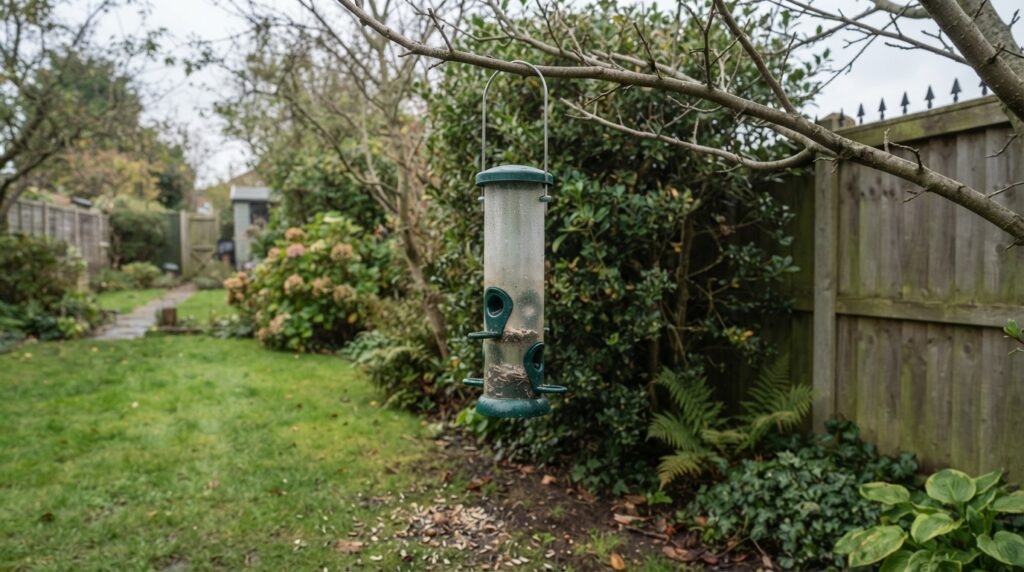
Too close to cover — a feeder tucked against a dense hedge or shrub is an ambush point. A cat lies in the cover and waits.
Too exposed — a feeder in the middle of a lawn with no cover within reach means birds have nowhere to bolt to when a sparrowhawk or cat appears. They’ll often avoid it entirely.
About two metres from cover is the workable middle: birds can reach safety in a second or two, but a cat has to cross open ground to get near.
2. Height and poles
- 1.5m or higher puts feeders above easy pouncing height
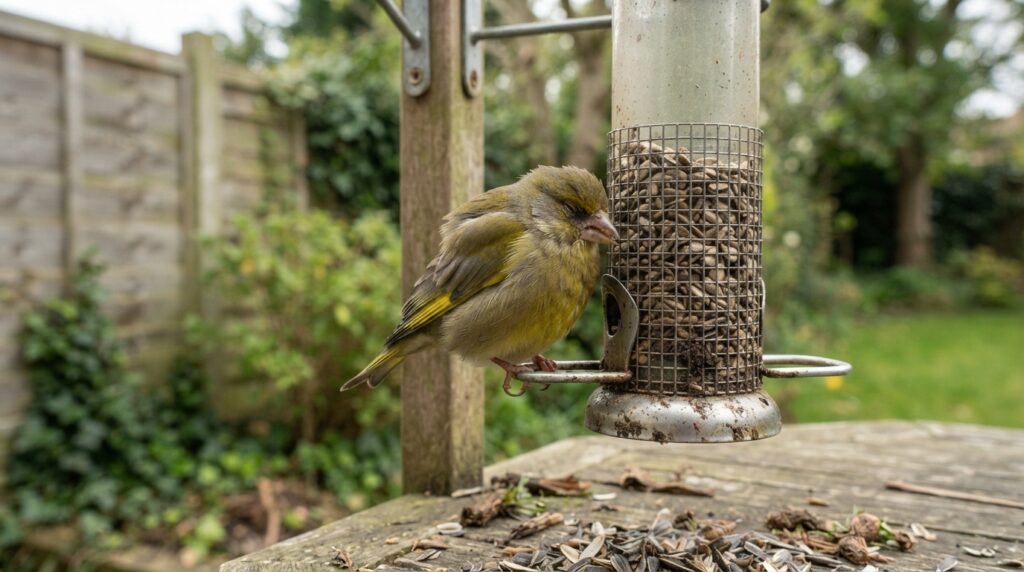
- Smooth metal poles are hard for cats to climb — wooden posts and rough surfaces are not
- A baffle fitted for squirrels also blocks cats climbing the pole
- Nothing to launch from within a couple of metres — no bench, wall, water butt, low branch or shed roof
3. Plant defensively
One of the most effective long-term measures, and it costs nothing to maintain.
- Prickly shrubs at the base of feeders — berberis, holly, pyracantha, hawthorn. Cats won’t sit in them
- Prickly plants beneath nest boxes and under nesting hedges
- Dense thorny hedging for nesting — blackthorn and hawthorn protect nests far better than open shrubs
- Keep the ground clear beneath feeders — long grass and clutter give cover to lie in
See our plants guide for species that do double duty as bird food and protection.
4. Timing — if the cat is yours
The single most effective thing an owner can do.
- Keep cats indoors an hour before and after sunrise and sunset. These are peak bird feeding times and peak cat hunting times
- Keep them in during the fledging season — roughly May to July. Fledglings spend days on the ground unable to fly properly, and this is when cats catch most birds
- Keep them in after bad weather, when birds are weakened and feeding urgently
- Feed your cat before letting it out — a well-fed cat still hunts, but somewhat less
5. Collars and bells
Research indicates that cats wearing bells catch meaningfully fewer birds than those without — not zero, but a real reduction.
Important safety point: only use a quick-release (breakaway) collar. Cats climb and squeeze through gaps, and a fixed collar that snags can strangle or trap a limb. This is not a minor caveat — it’s the difference between a safe collar and a dangerous one.
Some owners use brightly coloured or patterned collar covers instead, on the basis that birds see colour well and spot an approaching cat sooner.
6. If the cat isn’t yours
The awkward situation, and the one people write in about most.
Legally: cats are permitted to roam in the UK, and owners are generally not liable for trespass. You can’t demand a neighbour keep their cat in. It’s also an offence to harm a cat.
What you can do:
- Make your garden less usable. Everything above — placement, height, prickly planting, clear ground — works regardless of whose cat it is
- Water. A motion-activated sprinkler is generally considered the most effective humane deterrent. Cats dislike being startled with water and learn to avoid the area
- Textured surfaces. Cats dislike walking on certain textures. Scatter mats and prickly ground cover discourage them from patrolling
- Scent deterrents — cats avoid citrus peel, coffee grounds and some plants such as Coleus canina. Effects are modest and need refreshing
- Block access routes — angled fence toppers along a favoured route make climbing in harder
- Have a friendly conversation. Many owners genuinely don’t realise, and some will happily keep the cat in at dawn and dusk if asked reasonably
Never use anything that could harm a cat. Under the Animal Welfare Act 2006 it is an offence to cause unnecessary suffering to an animal. Ultrasonic deterrents are legal but evidence for their effectiveness is mixed. Anything involving physical harm, traps or harmful substances is both illegal and unacceptable.
Protecting nest boxes
- Height: 2-4m for tit boxes
- No perch below the hole — boxes sold with a little perch are worse, giving predators something to grip
- No branch immediately below that a cat could use as a platform
- Prickly planting beneath
- Open-fronted robin boxes must be hidden deep in vegetation — an exposed one is a liability
More in our nest box guide.
If a cat has caught a bird
Any bird caught by a cat needs veterinary attention urgently, even if it looks unhurt. Bacteria in cats’ mouths cause rapidly fatal infection in birds — a bird that seems fine can die within a day or two without antibiotics.
Contact a vet or wildlife rescue: RSPCA in England and Wales, Scottish SPCA in Scotland, USPCA in Northern Ireland. Local independent rescues are often quicker. In the meantime, keep the bird quiet, dark and warm in a ventilated box, and don’t offer food or water.
Common questions
Do bells on collars actually work?
Research suggests a meaningful reduction rather than elimination. Use a quick-release collar only — fixed collars can trap or strangle a climbing cat.
Should I stop feeding birds if cats visit?
No. A well-placed feeder is safer than birds foraging in random spots. Fix the placement rather than stopping.
Can I make my neighbour keep their cat in?
Not legally — cats are allowed to roam and owners generally aren’t liable. A polite conversation is more likely to work than anything else.
Are cats causing bird declines in the UK?
The RSPB’s position is that there’s no clear evidence cat predation drives population declines — habitat loss and reduced insect availability are the main causes. Reducing predation in your garden is still worthwhile.
Do ultrasonic cat deterrents work?
Evidence is mixed and cats often habituate. Motion-activated water is generally considered more reliable.
What about a cat-proof fence?
Angled toppers and roller bars do work but are expensive and only practical for enclosed gardens. Usually worth it only for owners containing their own cat.
Related guides
- Why have the birds stopped coming to my feeder?
- When to put up a nest box (and exactly where to site it)
- I’ve found a baby bird — what should I do?
- Best plants to attract birds to a UK garden
Sources: RSPB guidance on cats and garden birds and its position on cat predation and population trends; RSPCA advice on collars and cat welfare; Animal Welfare Act 2006.
Compare feeder poles and baffles at Amazon UK. Prices and stock change often, so it is worth checking before you commit.
Browse feeder poles →