Affiliate disclosure: some links on this page go to Amazon. If you buy through one we may earn a small commission, at no extra cost to you. Full disclosure.
You don’t need a garden. A hanging feeder on a bracket, a shallow water dish and a pot of the right plants will bring birds to a first-floor balcony — often within a few weeks.
Two things to know before you start, because they’ll shape everything: window feeders are no longer recommended under current UK guidance, and mess falling on the neighbour below is the fastest way to end the project.
What works on a balcony
- Hanging tube feeder on a bracket or clamp-on hook
- Suet cage — works year-round, minimal mess
- Sunflower hearts — no husk, so no debris below
- Shallow water dish, changed daily
- A pot or two of ivy, lavender or a small berry shrub
The window feeder problem
Suction-cup window feeders are the obvious suggestion for flats, and until recently they were widely recommended. That changed.
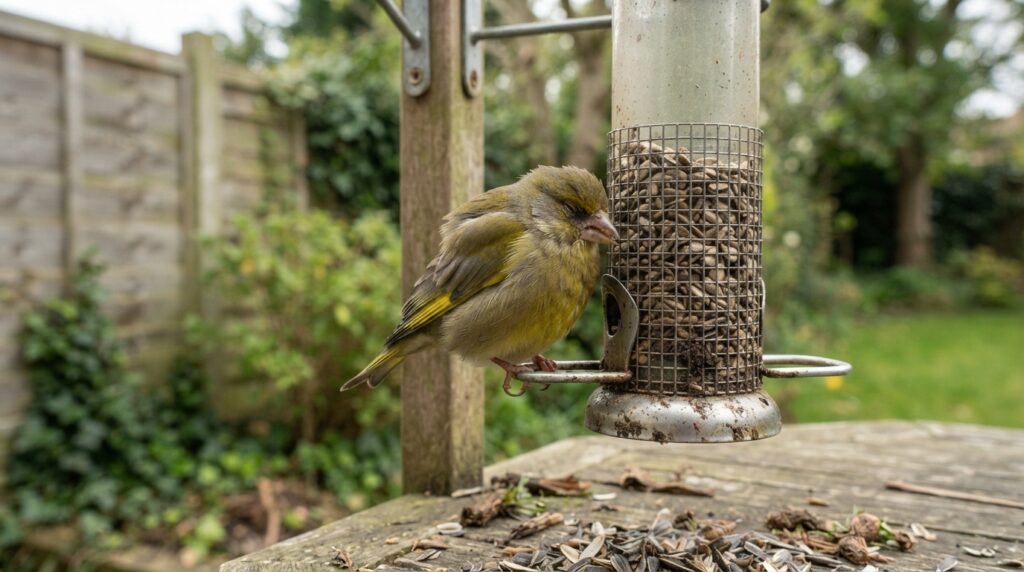
The RSPB now advises against feeders with flat surfaces — bird tables, ground stations, trays beneath hanging feeders, and window feeders. The reasoning is specific: birds with trichomonosis regurgitate contaminated food, which sits on a flat surface and is then picked up by healthy birds. The disease has driven greenfinch numbers down around 67% since 1979.
The RSPB removed flat-surface feeders from sale in December 2024.
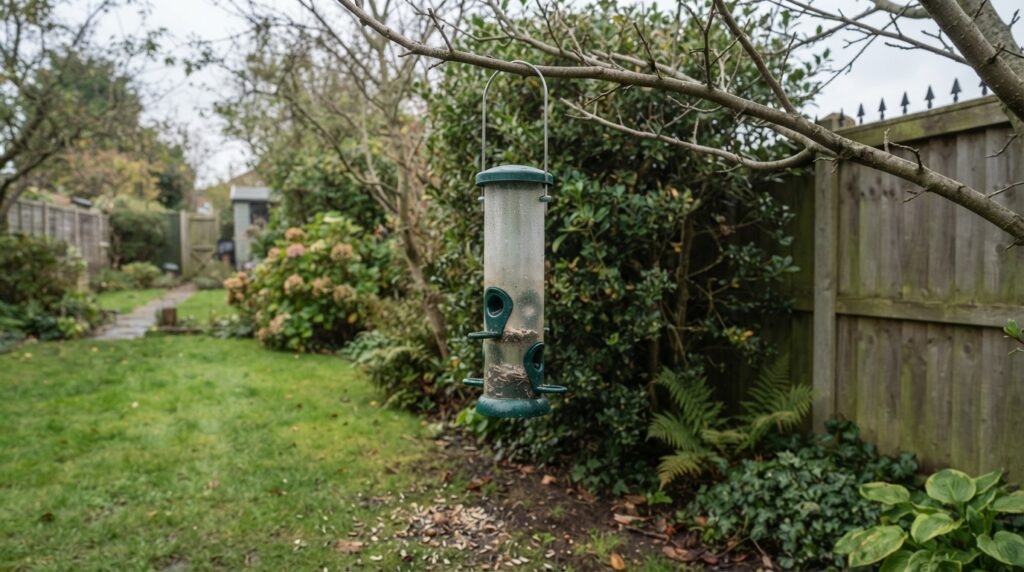
What to use instead: a hanging tube or mesh feeder. These have no surface for food to accumulate on. More detail in our feeder types guide.
Getting a feeder up without drilling
Most balconies rule out permanent fixings — rented, leasehold, or simply not something you want to drill into.
- Clamp-on railing brackets — attach to a balcony rail with a screw clamp, no drilling. The most useful option for most flats
- Deck hooks that hang over the rail
- A shepherd’s hook in a heavy pot — freestanding, no fixings at all, and easy to move
- Ceiling hooks if you have a covered balcony and permission
Check your tenancy agreement or lease first. Some prohibit attaching anything to railings or balcony structures, and some explicitly prohibit feeding birds — usually because of pest concerns in shared buildings. Worth five minutes now rather than a letter later.
Feeder and food choice matters more up high
Everything you put out on a balcony has somewhere to fall. That makes food choice a practical issue, not just a nutritional one.
Sunflower hearts are the balcony food. The husk has already been removed, so there’s essentially no debris — unlike black sunflower seeds or mixed seed, which generate a constant rain of husk. Cheap mixes padded with wheat and split peas are the worst: birds flick the filler out and it all goes over the edge.
Suet cages are the other good option. Very little falls, and suet stays approved year-round while seeds and peanuts pause between 1 May and 31 October.
Nyjer is fine if you want goldfinches, though the fine seed does scatter.
Water
Genuinely valuable and often the thing that makes a balcony work — water is scarce in built-up areas, and a reliable source gets noticed.
A shallow dish, plant saucer or similar. No deeper than about 10cm, with a couple of pebbles for grip and shallow standing.
Only offer water if you can change it daily, using fresh tap water, and clean the dish weekly. Standing water spreads disease. On a small balcony this is genuinely easy to keep up with — it’s thirty seconds a day.
Plants in pots
Containers do more than you’d expect, and they carry none of the hygiene concerns feeders do.
- Ivy in a pot, trained up a trellis or railing — shelter, cover, and late berries
- Lavender — insects in summer, seed heads left standing into autumn
- Sunflowers in a deep pot, heads left on the plant rather than cut
- Pyracantha or cotoneaster in a large container — berries in a small footprint
- Teasel in a deep pot, if you want goldfinches
- Herbs — let some flower and seed rather than harvesting everything
This matters more than it used to, because plants fill the May-to-October gap when seed feeding pauses. See our plants guide.
Keeping the neighbours onside
The most common reason balcony feeding stops. Worth handling deliberately.
- Use sunflower hearts — the single biggest reduction in fallen debris
- Position the feeder over your own floor space, not overhanging the edge
- Sweep regularly, and be honest that you’ll need to
- Feed small amounts that get eaten rather than sitting and spilling
- Watch for droppings on rails and furniture below — clean promptly
- Don’t feed pigeons, deliberately or otherwise. Nothing sours a building faster. Avoid wheat-based mixes and remove any flat surface they can stand on
Which birds you’ll realistically get
Be a little realistic about this — a third-floor balcony won’t attract the range a garden does.
Likely: blue tits, great tits, house sparrows, starlings, woodpigeons, collared doves. Goldfinches if you offer nyjer or sunflower hearts.
Possible with cover and patience: robins, blackbirds, coal tits, long-tailed tits.
Unlikely: ground-feeding species and woodland birds — nuthatches, woodpeckers, wrens.
Height affects it. Ground-floor and first-floor balconies do noticeably better than high ones, and a balcony with a tree nearby does far better than one overlooking a car park.
How long it takes
Longer than in a garden. Birds find feeders by exploring familiar routes, and a balcony three floors up isn’t on many of those routes.
Give it four to six weeks before concluding it isn’t working. Keep the feeder in one place, keep it topped up with small amounts, and be patient. Once one bird finds it, others follow quickly.
Cleaning still applies
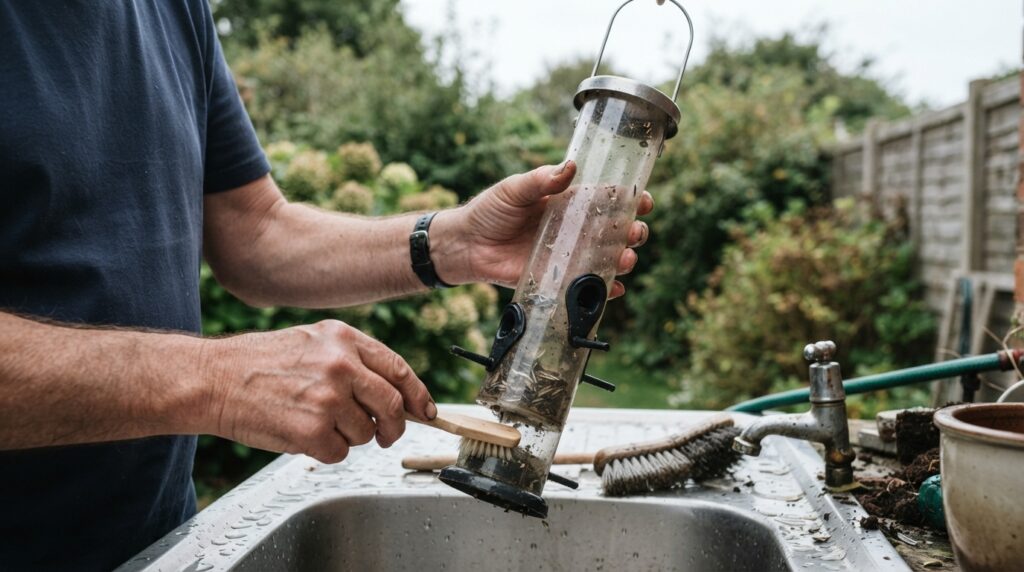
Weekly, same as anywhere: empty, hot soapy water, non-toxic disinfectant, rinse, dry fully. Move the feeder to a slightly different spot each time if you can.
On a balcony this is easier than in a garden — everything is within reach and there’s a tap nearby. Clean it outdoors or in a utility sink, not where food is prepared. Our cleaning guide has the method.
Common questions
Can I use a window feeder?
They’re no longer recommended — the flat surface allows contaminated food to accumulate. A small hanging feeder on a bracket does the same job without that problem.
Am I allowed to feed birds from a flat?
Usually, but check your tenancy or lease. Some buildings prohibit it, generally over pest concerns. Feeding responsibly — no spillage, no pigeons — is what keeps it acceptable.
Will it attract rats?
Far less likely at height than at ground level, but spilled food landing below can. Sunflower hearts and small quantities keep this under control.
My balcony is north-facing and shaded. Does that matter?
Not for feeding. It limits which plants thrive — ivy tolerates shade well, lavender doesn’t.
What about a nest box?
Worth trying if you have a sheltered spot, though balconies are usually too exposed and too busy. A 25mm-hole box facing north to east is the best bet. See our nest box guide.
Nothing has come for a month. What now?
Check the feeder is visible from nearby trees or rooftops, try sunflower hearts if you haven’t, and make sure the food is fresh. Then keep going — balconies genuinely take longer.
Related guides
- Types of bird feeder: which one should you actually buy?
- Best plants to attract birds to a UK garden
- Bird baths: choosing one, siting it, and stopping it freezing
- Why have the birds stopped coming to my feeder?
Sources: RSPB feeding and feeder guidance (April 2026); RSPB flat-surface feeder sales suspension (December 2024); RSPB advice on feeding birds in small spaces.
Compare railing brackets and hanging feeders at Amazon UK. Prices and stock change often, so it is worth checking before you commit.
Browse feeder brackets →