Affiliate disclosure: some links on this page go to Amazon. If you buy through one we may earn a small commission, at no extra cost to you. Full disclosure.
A goldcrest is tiny — around 5 to 6 grams, lighter than a 20p coin — olive-green with a bright yellow or orange crown stripe bordered in black. They’re insect eaters that rarely use feeders, favour conifers, and often travel with winter tit flocks. Suet crumbs are the only feeder food they reliably take.
The goldcrest is Britain’s smallest bird, and one most people have had in the garden without ever noticing.
There’s a specific reason for that, and it isn’t just the size.
Goldcrest quick facts
- Size: 8.5–9cm, around 5–6 grams
- Key feature: yellow or orange crown stripe with black borders
- Habitat: conifers especially — yew, pine, spruce, leylandii
- Feeder use: minimal. Suet crumbs occasionally
- Best time to see one: winter, in a mixed tit flock
Identifying a goldcrest
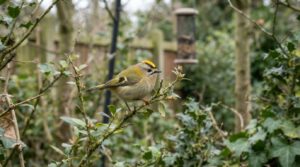
Look for: a tiny, rounded, olive-green bird with pale buff underparts, two white wing bars, and a bright stripe running down the centre of the crown — yellow on females, orange-centred on males — with a black line either side.
The face is the other giveaway: plain and pale, with a large dark eye that gives a permanently startled expression. No eye stripe, no bold markings.
The bill is extremely fine and needle-like — an insect-eater’s bill.
Behaviour: restless. Goldcrests never sit still, flitting through foliage, hovering briefly to pick insects from the underside of leaves, and working the outer twigs of conifers.
Goldcrest or firecrest?
Firecrests are scarcer but worth knowing. The tell is the face: a firecrest has a bold white stripe over the eye and a black stripe through it, plus a bronze patch on the shoulder. A goldcrest’s face is plain.
If the face has strong markings, look again — you may have something more unusual than you thought.
Why you probably can’t hear it
This is the part worth knowing, and it explains why goldcrests go unrecorded in so many gardens.
The goldcrest’s call and song sit at a very high frequency — around 8kHz and above, at the top end of what the human ear handles.
Human hearing loses sensitivity at high frequencies with age, and this happens to everyone. It’s why many birdwatchers find that goldcrests, and sometimes treecreepers, simply stop registering at some point in their forties or fifties, while younger companions hear them clearly.
If you’ve never heard a goldcrest, that may not be because there are none about. Worth knowing rather than worrying about — it’s ordinary, universal and not a sign of anything wrong.
The workaround: the Merlin Bird ID app picks them up readily from sound, even where you can’t. Genuinely useful for this species specifically.
Why they’re in your garden
Goldcrests are conifer specialists. Their natural habitat is spruce, pine and fir, and the fine bill is adapted to extracting small insects and spiders from between needles.
Which means a garden with a yew, pine, cypress or even a leylandii hedge is far more likely to get them than one without. That much-maligned leylandii is genuinely good for goldcrests.
They’re also more likely in winter, when they join roving mixed flocks with blue tits, great tits, coal tits and long-tailed tits. If a tit flock passes through your garden, it’s worth looking carefully at the smallest thing in it.
Feeding them
Honestly, there isn’t much you can do directly. Goldcrests are almost entirely insectivorous and don’t handle seed.
What occasionally works:
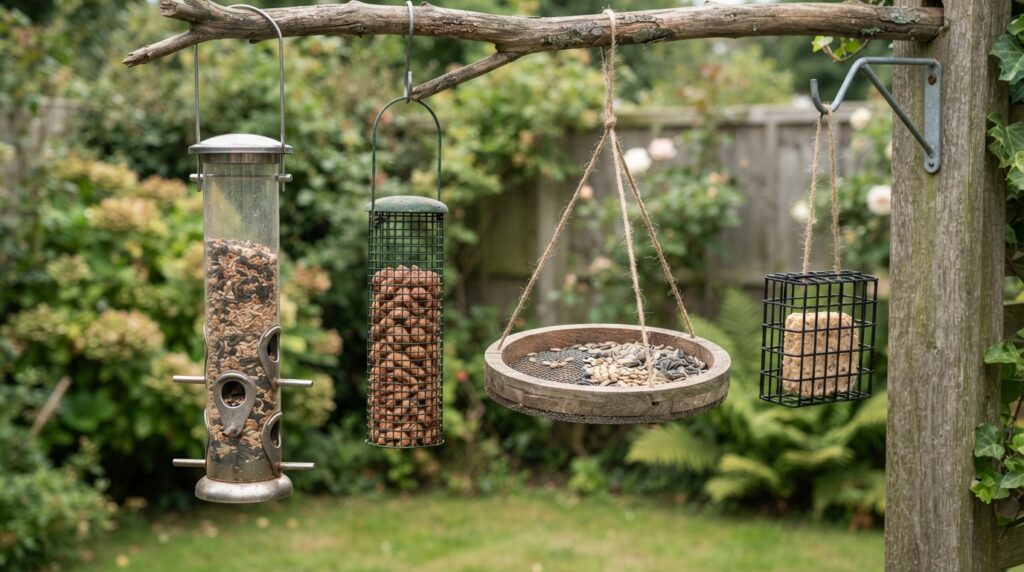
- Suet crumbs or finely grated fat — the one feeder food they’ll sometimes take, usually in hard weather
- Fragments falling below a suet feeder
- Fat smeared into bark crevices on a tree trunk
What actually helps more is habitat:
- Keep conifers — even one yew or pine makes a difference
- Don’t use insecticides, since the entire diet is invertebrates
- Leave ivy, which supports overwintering insects
- Keep some dense evergreen cover for roosting
How they survive winter
A bird weighing 5 to 6 grams has almost no margin on a cold night, and goldcrests must eat close to their own body weight in insects daily to keep going.
Their strategy is the same as several other tiny birds: huddling. Goldcrests roost pressed together in dense conifer foliage, sharing warmth.
Even so, hard winters cause heavy mortality, and populations can drop sharply after a severe one. They recover across a few milder years by breeding prolifically — a pair may raise two broods of up to a dozen young.
There’s also a genuinely remarkable fact here: some goldcrests migrate across the North Sea from Scandinavia in autumn. A bird this small crossing open water was once thought impossible, and old folklore held that they hitched rides on the backs of woodcock — which is why they were sometimes called the “woodcock pilot”.
Common questions
Is the goldcrest the UK’s smallest bird?
Yes, alongside the firecrest. Both are around 8.5–9cm and 5–6 grams — lighter than a 20p coin.
Why can’t I hear goldcrests?
Their calls sit at a very high frequency, and sensitivity to high frequencies declines with age in everyone. It’s ordinary, and the Merlin app will pick them up for you.
Will goldcrests use my feeder?
Rarely. They’re insectivores. Suet crumbs are the only thing they take with any regularity, usually in cold weather.
Do I need conifers to get them?
It helps a great deal. Yew, pine, spruce or even leylandii all work. Without any conifer nearby they’re much less likely, though winter tit flocks can still bring them through.
Are goldcrests rare?
No — they’re widespread and numerous, just very easy to miss. Numbers fluctuate sharply with winter severity.
Related guides
- Coal tit: the smallest tit and the fastest feeder
- Wrens in your garden: Britain’s most numerous bird
- Where do garden birds sleep at night?
- Best plants to attract birds to a UK garden
Sources: RSPB species information; British Trust for Ornithology population trends and migration data; Woodland Trust.
Compare current prices on bird food and feeders at Amazon UK. Prices and stock change often, so it is worth checking before you commit.
Browse bird food →