Don’t handle it with bare hands. Use gloves or an inverted plastic bag, double-bag it, and put it in household waste or bury it deep away from water. One dead small bird is usually natural. Several dead birds near a feeder means stop feeding, deep-clean everything, and report it.
Finding a dead bird in the garden is unsettling, and the two questions are usually the same: what do I do with it, and should I be worried?
Most of the time the answer is straightforward. There are a few specific situations where it matters more, and those are worth knowing.
The short version
- Never bare hands — gloves or an inverted bag
- Double-bag, then household waste or deep burial
- One small bird — usually natural, no action needed
- Several near a feeder — stop feeding, deep-clean, report
- Waterfowl, gulls or birds of prey — report to Defra, don’t touch
How to remove it safely
Risk to people from a dead garden bird is low, but basic precautions are sensible.
- Wear disposable gloves, or turn a plastic bag inside out over your hand
- Pick the bird up and turn the bag the right way out around it, so you never touch it directly
- Double-bag it — seal the first bag inside a second
- Dispose of it in your household waste bin, or bury it
- Wash your hands thoroughly with soap and water afterwards
If burying: go deep enough that a fox or dog won’t dig it up — at least 50cm — and well away from any pond, stream or water source, and away from vegetable beds.
Don’t put it on a compost heap, and don’t let pets near it.
When to report it
Most single dead garden birds don’t need reporting. Some do.
Report to Defra (or DAERA in Northern Ireland)
Report — and do not touch — if you find:
- Any dead waterfowl — swan, goose or duck
- Any dead gull or bird of prey
- Several dead wild birds of any species in the same place
These are the species and patterns associated with avian influenza, which is a notifiable disease. Use the GOV.UK dead wild bird reporting service, or contact the Defra helpline. Northern Ireland has its own reporting route through DAERA.
Requirements are updated with the disease situation, so check GOV.UK for the current position.
Report to Garden Wildlife Health
For garden birds — finches, tits, sparrows, blackbirds — the useful place to report is Garden Wildlife Health, a collaboration involving the Zoological Society of London, the BTO, the RSPB and Froglife.
Their data tracks disease outbreaks and directly informs national feeding guidance. The 2026 changes to UK feeding advice were built partly on exactly this kind of accumulated reporting.
Reports can be submitted online, and in some cases they may ask you to submit a specimen for examination.
Report a ringed bird
If the bird has a small metal ring on its leg with a number, that’s a BTO ring. Reporting the number contributes to the national dataset on lifespan and movement — this is where almost everything known about how long garden birds live comes from.
What probably happened
Some clues from what you find.
| What you see | Likely cause |
|---|---|
| Ring of plucked feathers, quills intact | Sparrowhawk. They pluck prey at a favoured spot |
| Feathers chewed off, quills damaged | Cat or fox |
| Bird below a window, no injuries | Window strike |
| Bird near the feeder, thin, fluffed | Possibly disease — see below |
| Young bird in late spring | Fledgling mortality, which is very high and entirely natural |
| Bird in cold snap, no marks | Cold and starvation, common in hard winters |
Worth keeping in proportion: most garden birds live only two or three years, and mortality among birds in their first year is very high indeed. Finding an occasional dead bird in a garden with regular visitors is normal rather than a sign something is wrong.
The situation that does need action
Several dead or visibly sick birds around your feeder is different, and needs a response.
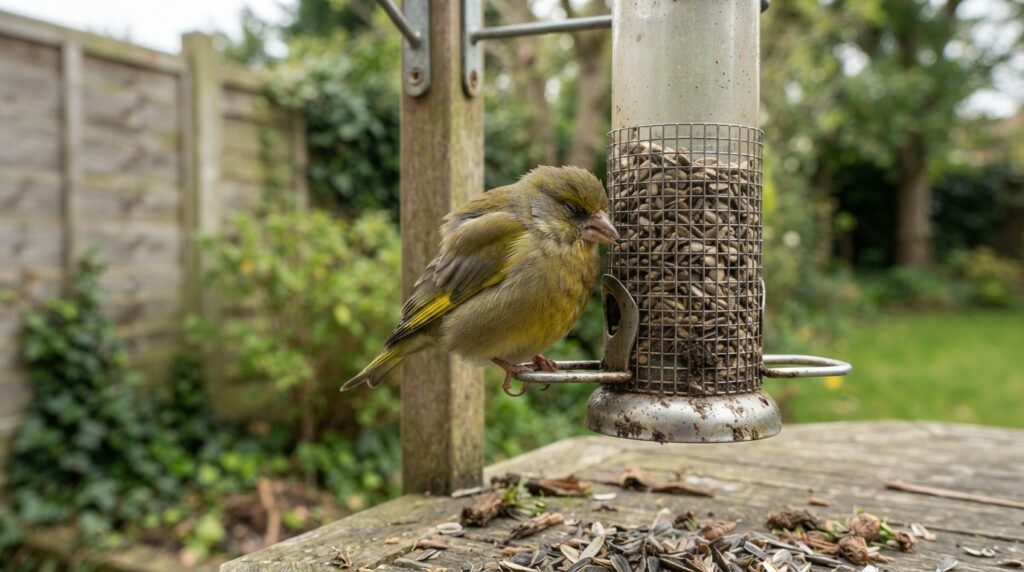
Particularly if they’re finches — greenfinches, chaffinches, bullfinches — and particularly if you’ve also seen birds looking fluffed up, lethargic, drooling or struggling to swallow. That pattern suggests trichomonosis.
What to do:
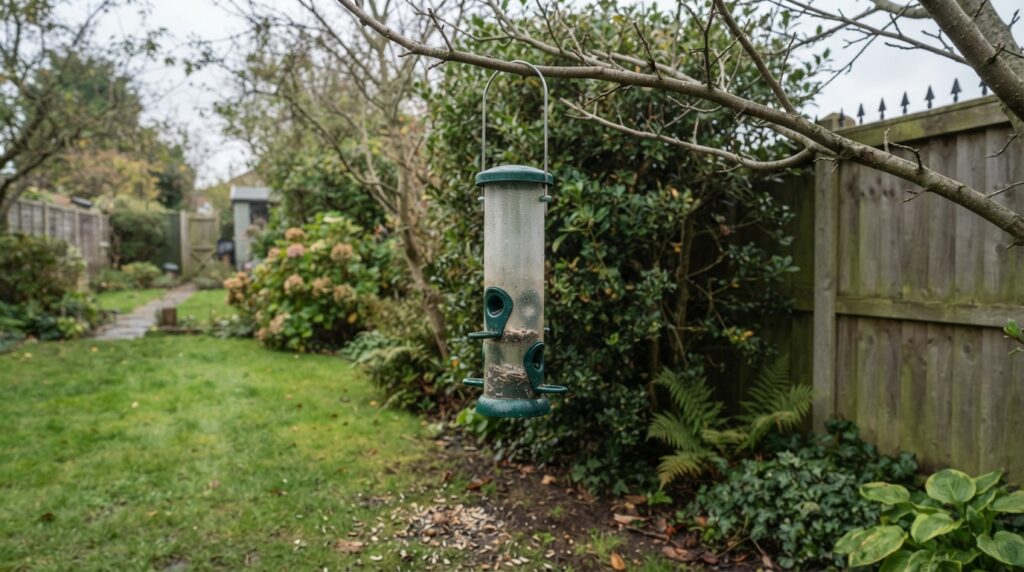
- Stop feeding immediately — take everything down, including water
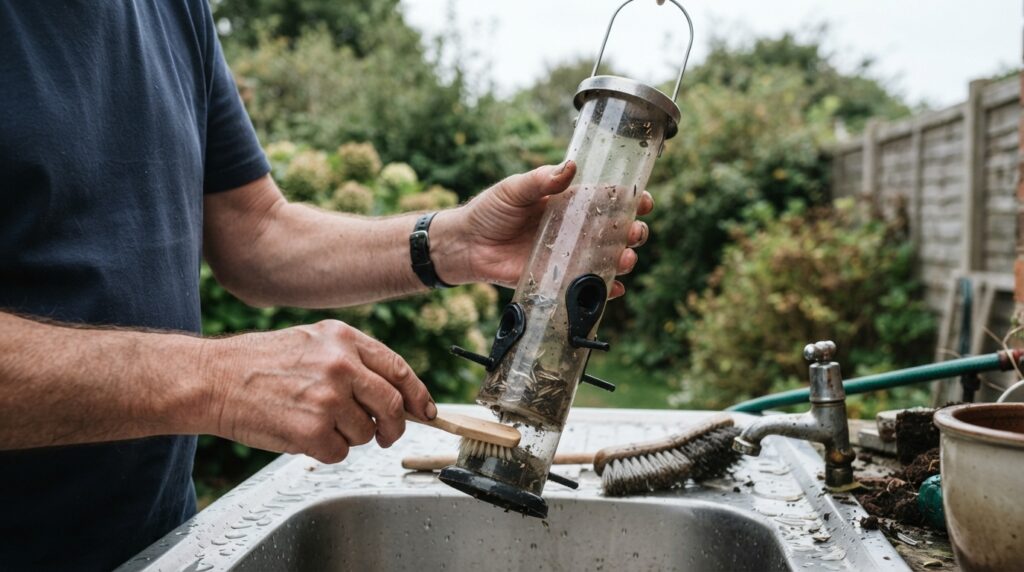
- Deep-clean all feeders and baths — hot soapy water, then a non-toxic disinfectant, rinsed and fully dried
- Clear the ground beneath thoroughly
- Leave it two to three weeks so birds disperse and stop congregating
- Report it to Garden Wildlife Health
- Restart gradually, in a different position, with smaller quantities
Our full guide: sick birds at your feeder.
Are dead birds a risk to people or pets?
Risk from a single dead garden bird is low with sensible handling.
- Trichomonosis, the main garden bird disease in the UK, does not infect mammals — no risk to you, children, cats or dogs
- Salmonella can be carried by birds, which is the main reason for gloves and handwashing
- Avian influenza risk to the general public is assessed as very low, but it’s precisely why you shouldn’t handle dead waterfowl, gulls or birds of prey, and why those should be reported rather than removed
Keep pets away from any dead bird, and don’t let a cat or dog carry one about.
Preventing the preventable causes
Two of the common causes are things you can reduce.
Window strikes. Position feeders either within 1m of the glass or beyond 10m — the middle distance is where birds build up enough speed to injure themselves. Our window strike guide covers what actually works, and why a single hawk sticker doesn’t.
Cats. Feeder placement, timing and collar bells all help. Our cats guide covers it.
If you find a bird that’s still alive after a cat has caught it, that’s urgent. Bacteria in a cat’s mouth cause rapidly fatal infection without antibiotics, even where there’s no visible wound. Contact the RSPCA (England and Wales), Scottish SPCA, USPCA (Northern Ireland), or a local wildlife rescue. Many vets accept wildlife without charge.
Common questions
Can I just leave it?
In a quiet corner it will be dealt with by scavengers and decomposers. But near a feeder, path or where pets go, it’s better removed — both for hygiene and to avoid drawing rats.
Should I stop feeding after finding one dead bird?
Not for a single bird with no signs of illness. If you find several, or any looking fluffed and lethargic, stop and deep-clean.
Is it safe to bury it in the garden?
Yes, if buried deep enough that animals won’t dig it up, away from water sources and away from vegetable beds. Wear gloves.
What if it has a leg ring?
Report the number to the BTO. Ringing recoveries are how lifespan and movement data are built, and a reported dead bird is genuinely useful.
Why do I keep finding dead birds under my window?
Window strikes. Reflection of sky or vegetation in the glass is the usual cause. Moving the feeder and treating the glass both help — see our window strike guide.
Is finding dead birds normal?
An occasional one, yes. Most small birds live only a couple of years and first-year mortality is very high. A cluster near a feeder is the pattern that warrants action.
Related guides
- Sick birds at your feeder: spotting trichomonosis and what to do
- Birds flying into windows: why it happens and what works
- A sparrowhawk killed a bird at my feeder: what to do
- How to clean a bird feeder — and why it now matters more
Sources: GOV.UK dead wild bird reporting guidance; Garden Wildlife Health (ZSL, BTO, RSPB, Froglife); RSPB guidance on dead and sick garden birds; British Trust for Ornithology ringing scheme; RSPCA guidance on injured wildlife. Avian influenza reporting requirements change with the disease situation — check current guidance.
Compare current prices on bird food and feeders at Amazon UK. Prices and stock change often, so it is worth checking before you commit.
Browse bird food →