Affiliate disclosure: some links on this page go to Amazon. If you buy through one we may earn a small commission, at no extra cost to you. Full disclosure.
Jays are pinkish-brown with a bright blue barred wing patch and a white rump that flashes in flight. They’re shy woodland crows that visit gardens most often in autumn, when they’re collecting acorns. Peanuts and acorns on the ground are what bring them in.
A jay arriving in a garden is a genuine event — most people’s first reaction is that something exotic has escaped.
They’re crows, despite the colours, and they’re responsible for planting a substantial share of Britain’s oak trees.
Jay quick facts
- Size: about 34cm — noticeably bigger than a blackbird
- Key features: blue barred wing patch, white rump, black moustache stripe
- Best time to see one: autumn, during acorn collecting
- Best food: whole peanuts and acorns on the ground
- Manner: shy and wary, unlike other crows
Identifying a jay
Look for: a warm pinkish-brown body, black tail, and a striking patch of bright blue feathers finely barred with black on the wing. White throat with a bold black moustache stripe running down from the bill. Pale streaked crown that can be raised into a small crest.
In flight the impression is completely different: a broad white rump contrasting with the black tail, and rounded wings with white patches. Flight is heavy and slightly hesitant.
The call is unmistakable and usually the first sign — a harsh, tearing screech, like fabric ripping. Jays are also good mimics and will imitate buzzards convincingly.
Despite the colours, jays are corvids, related to magpies, crows and jackdaws. Our black birds guide covers the rest of the family.
Why they matter: the acorns
The genuinely remarkable thing about jays.
Each autumn a single jay may collect and bury thousands of acorns, carrying several at a time in its throat and bill and caching them individually across a wide area — often several kilometres from the parent tree.
They relocate a great many of them months later, using spatial memory and landmarks, even under snow. But they don’t find them all.
The ones left behind germinate. Because jays deliberately choose open ground and woodland edges for caching — exactly where an oak seedling has the best chance — they’re one of the most effective dispersers of oak in Europe. Acorns are heavy and don’t travel by wind; without jays, oak woodland would spread far more slowly.
It’s a rare case of a bird materially shaping the landscape.
When you’ll see them
Jays are woodland birds and naturally wary — considerably shyer than magpies or crows. They’ll often watch from cover for some time before dropping down.
Autumn is the peak, roughly late September to November, when acorn collecting pushes them out of woodland and across gardens. This is when most people get their first garden jay.
They’re also more visible in gardens during hard winters, when natural food runs short, and in years when the acorn crop fails — which occasionally produces influxes of continental jays.
What to feed them
Jays are omnivores: acorns and nuts in autumn and winter, invertebrates in summer, plus fruit, seeds and — like all corvids — eggs and nestlings in the breeding season.
To attract them:
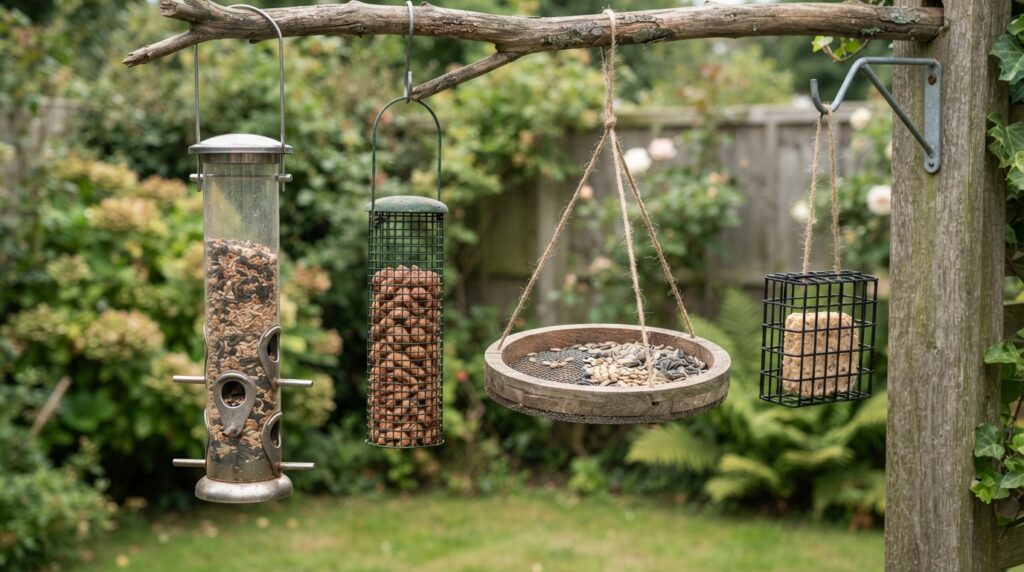
- Whole peanuts on the ground or on a low platform — jays take them readily and will cache them. Bird-grade, aflatoxin-free only
- Acorns, if you can collect some. Genuinely effective in autumn
- Suet and fat products
- Sunflower hearts scattered on the ground
Timing matters with whole peanuts. They’re a choking hazard if carried to nestlings, so whole nuts should only go out between autumn and early spring — never during the breeding season. Current guidance pauses peanuts entirely between 1 May and 31 October, which conveniently covers it. See our peanut safety guide.
Practical tip: jays are wary. Put food out and stay indoors. A jay will not come down while you’re standing in the garden watching for it.
The nest predation question
Jays do take eggs and nestlings in spring, and people who’ve seen it tend not to forgive them.
The evidence position is the same as for magpies: long-term national monitoring analysed by the BTO has not found corvid predation to be a driver of songbird population declines. Predators generally take a share of a surplus rather than determining population size.
Our article on magpies and songbirds covers the research properly, and the same reasoning applies here.
The effective response is dense thorny planting, which makes nests harder to find and work — not removal, which is also unlawful without specific licence justification.
How to attract them
- Put whole peanuts on the ground in autumn and winter, near cover
- Collect a few acorns in October and put them out
- Stay out of sight — jays won’t come down while you’re visible
- Keep mature trees if you have them, especially oak
- Provide water in a larger shallow dish, changed daily
- Be patient — they may watch for days before committing
Common questions
What’s the pinkish bird with a blue wing patch?
A jay. The blue barred wing panel and white rump in flight are unmistakable once seen.
Is a jay a crow?
Yes — a corvid, related to magpies, jackdaws and crows, despite looking nothing like them.
Why do I only see them in autumn?
Acorn collecting. From late September they range widely gathering and caching acorns, which brings them out of woodland and into gardens.
Do jays really plant oak trees?
Effectively, yes. They bury thousands of acorns each autumn and don’t retrieve them all, and they favour open ground where seedlings do well. They’re a major disperser of oak.
What’s the screeching noise?
The jay’s alarm call — a harsh tearing screech, often given when a cat or person is spotted. They also mimic buzzards.
Should I stop them coming because they take chicks?
They’re protected, and the evidence doesn’t support corvid predation driving songbird declines. Dense thorny cover protects nests far more effectively than trying to exclude jays.
Related guides
- Black birds in your garden: crow, rook, jackdaw or something else?
- Do magpies really kill songbirds? What the evidence says
- Are peanuts safe for birds? What to buy and what to avoid
- Best plants to attract birds to a UK garden
Sources: RSPB species information; British Trust for Ornithology population trends and research on corvid predation and acorn dispersal; Woodland Trust; Wildlife and Countryside Act 1981.
Compare current prices on bird food and feeders at Amazon UK. Prices and stock change often, so it is worth checking before you commit.
Browse bird food →