Magpies do take eggs and nestlings in spring — that part isn’t in dispute. But long-term national monitoring analysed by the British Trust for Ornithology found no evidence that magpie predation causes songbird population declines. Songbird numbers were similar in areas with many magpies and areas with few. The effective response is dense thorny cover, not removal.
Few garden birds generate as much dislike as the magpie, and the reason is usually a specific memory: watching one take chicks out of a nest.
That’s a genuinely distressing thing to see, and nothing below is meant to dismiss it. But the leap from “magpies eat chicks” to “magpies are why we have fewer songbirds” is one the evidence doesn’t support, and it’s worth understanding why.
The short version
- Yes, magpies take eggs and nestlings in the breeding season
- No, research has not found this to drive songbird declines nationally
- Songbird numbers were similar whether magpies were abundant or scarce
- The real drivers are habitat loss, agricultural change and reduced insect food
- They’re protected — killing or trapping them requires legal justification
- What works: dense thorny planting, not removal
What the research found
This question has been examined more thoroughly than most, precisely because it’s so contentious.
The British Trust for Ornithology has analysed decades of national monitoring data covering both magpie numbers and songbird numbers across many sites. If magpies were suppressing songbird populations, you would expect songbirds to do worse where magpies increased most.
That pattern was not found. Songbird population trends were broadly similar in areas where magpies were abundant and areas where they were scarce. Magpie numbers rose substantially through the late 20th century while some songbirds declined and others increased — the correlation simply isn’t there.
The explanation is one that applies to predators generally: they take a share of a surplus rather than determining the size of the population. Most songbirds produce far more young than can possibly survive to breed. Nest predation is one of several things that removes that surplus, alongside starvation, weather and disease. Remove one and others tend to take up the slack.
Where songbirds have genuinely declined, the drivers identified are habitat loss, agricultural intensification, reduced invertebrate abundance and — for finches specifically — disease.
Two things can be true at once. A magpie taking chicks from a nest in your garden is a real loss of those particular birds. And magpies as a species are not the reason Britain has fewer songbirds than it did. Both statements hold.
What magpies actually eat
Magpies are omnivores and generalists. Across the year their diet is mostly invertebrates, carrion, seeds, grain and fruit.
Eggs and nestlings are a seasonal component, concentrated into roughly April to June, and they’re opportunistic rather than a staple. The reason it’s so visible is that it happens in daylight, in gardens, at exactly the time of year people are watching nests they’ve become attached to.
By contrast, most nest predation in Britain is done by animals you never see doing it — including cats, rats, grey squirrels, jays, crows and, in some settings, great spotted woodpeckers.
Identifying a magpie
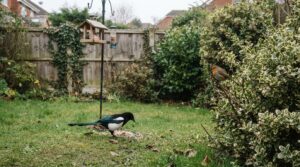
Look for: glossy black head, breast and back, clean white belly and white shoulder patches, and a very long graduated black tail showing blue-green iridescence in good light. White wing flashes are obvious in flight. Stout black bill.
Sexes look alike, though males are slightly larger. Juveniles have shorter tails and duller plumage.
The call is a harsh, rattling chatter, often given repeatedly from a rooftop or tree.
Our black birds guide covers how they compare to crows, rooks and jackdaws.
What actually protects nests
If you want fewer nests raided in your garden, this is where effort pays.
Dense thorny planting
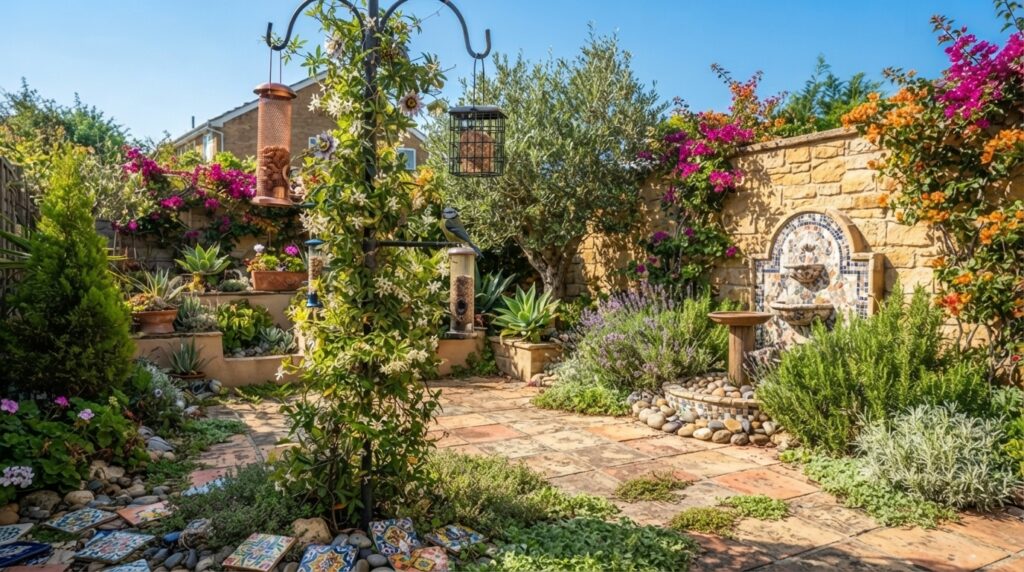
The single most effective thing. A magpie needs room to manoeuvre; dense, thorny growth denies it.
Hawthorn, blackthorn, berberis, pyracantha, holly and bramble all work. A thick native hedge is worth more to nesting songbirds than any amount of magpie management.
Cover, not open lawn
Nests in isolated shrubs surrounded by open ground are easy to find and easy to work. Connected, layered planting is much harder.
Nest boxes with hole protectors
A box with a properly sized hole excludes magpies entirely. Fitting a metal hole plate also protects against woodpeckers and squirrels enlarging the entrance.
Our nest box guide covers hole sizes and siting.
Don’t feed near nests in spring
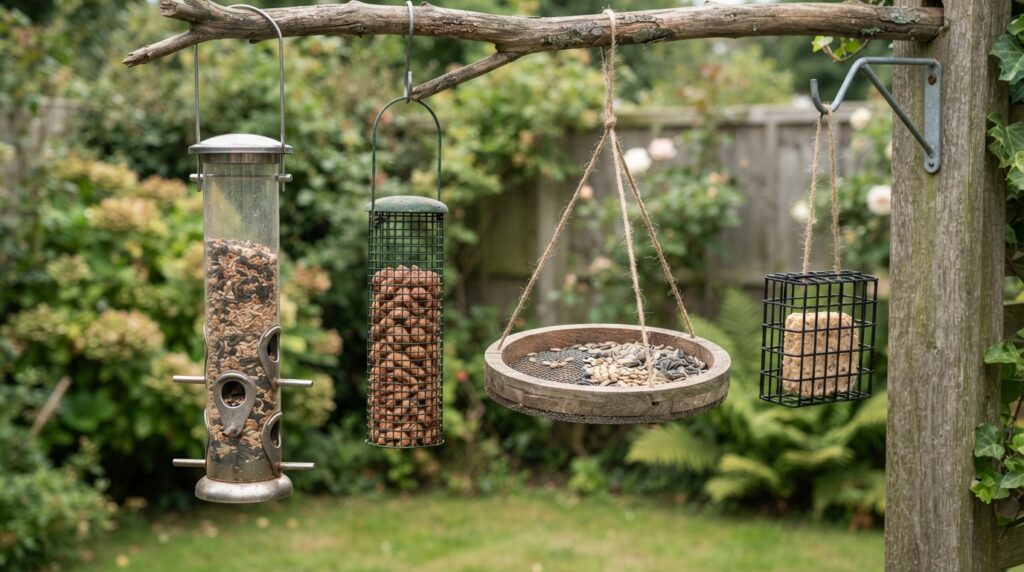
Ground-scattered food attracts magpies into the area. During the breeding season, keep feeding to hanging feeders and clear spillage.
Address cats
If nest predation genuinely concerns you, cats are worth more attention than magpies — see our guide to keeping cats away.
The legal position
Magpies are protected under the Wildlife and Countryside Act 1981, in common with all wild birds.
Control is only lawful under specific general licences, which vary between England, Scotland, Wales and Northern Ireland, are revised periodically, and permit action only for defined purposes such as protecting livestock, public health or conserving certain wild birds. Those licences carry conditions, including that non-lethal alternatives must have been tried first.
“There are magpies in my garden taking chicks” is not in itself lawful grounds for control. Anyone considering acting under a general licence should read the current licence for their country in full, since the terms change.
Trapping a magpie and releasing it elsewhere is also not the neutral solution it appears — it displaces a territorial bird into occupied territory, and welfare implications aside, the vacated territory is generally filled quickly by another.
Why removal doesn’t work anyway
Even setting the law aside, the practical case is weak.
Magpies hold territories, and a vacant territory in decent habitat is typically occupied within weeks by birds from a floating non-breeding population. Removing the pair in your garden creates a vacancy rather than an absence.
Meanwhile the other nest predators — cats, squirrels, rats, jays — carry on unaffected, and in some cases benefit from reduced competition.
Habitat is the lever that actually moves. Thorny cover works every year, needs no licence, and helps in a dozen other ways.
Common questions
I watched a magpie take chicks from a nest. Isn’t that proof?
It’s proof that magpies take chicks, which nobody disputes. Whether that reduces the songbird population is a different question, and one that requires population-level data rather than individual observations. That data doesn’t show the effect.
Why did magpie numbers increase so much?
Reduced persecution through the second half of the 20th century, plus adaptation to suburban environments with abundant food and few predators. Numbers have been broadly stable in recent decades.
Do magpies really steal shiny things?
Largely a myth. Research has found magpies are generally wary of unfamiliar shiny objects rather than attracted to them. The reputation appears to owe more to folklore and opera than to behaviour.
Can I stop magpies using my feeder?
A caged feeder excludes them while letting small birds through. Avoiding ground-scattered food and clearing spillage helps too. See our guide to larger birds at feeders.
Are magpies intelligent?
Notably so. They’re corvids, and research indicates magpies can recognise individual human faces and remember people who have threatened them — sometimes for years.
What else takes nests in gardens?
Cats, grey squirrels, rats, jays, crows and great spotted woodpeckers. Most operate less visibly than magpies, which is part of why magpies get the blame.
Related guides
- Black birds in your garden: crow, rook, jackdaw or something else?
- A sparrowhawk killed a bird at my feeder: what to do
- How to keep cats away from bird feeders
- When to put up a nest box (and exactly where to site it)
Sources: British Trust for Ornithology research on avian predators and songbird population trends; RSPB species information and position on corvid predation; Wildlife and Countryside Act 1981 and current general licences (which differ by country and are revised periodically).
Compare current prices on bird food and feeders at Amazon UK. Prices and stock change often, so it is worth checking before you commit.
Browse bird food →