Affiliate disclosure: some links on this page go to Amazon. If you buy through one we may earn a small commission, at no extra cost to you. Full disclosure.
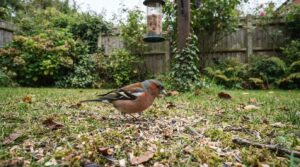
Two bold white wing bars identify a chaffinch — present on both sexes, unlike the male’s pink breast. They feed mainly on the ground beneath feeders rather than on them, so scattering a little seed below is more effective than filling the feeder.
The chaffinch is one of Britain’s most numerous birds and one of the most frequently misidentified females in the garden.
It’s also a bird with a genuinely remarkable quirk: chaffinches sing in regional dialects, and a bird in Cornwall sounds measurably different from one in Aberdeenshire.
Chaffinch quick facts
- Size: about 14cm — sparrow-sized, slimmer
- Key feature: two bold white wing bars, on both sexes
- Feeds: mainly on the ground beneath feeders
- Best food: sunflower hearts, scattered small seed
- Note: significantly affected by trichomonosis
Identifying a chaffinch
Male: blue-grey crown and nape, warm rusty-pink face and breast, chestnut-brown back, greenish rump. Striking in spring, duller in winter.
Female: plain buff-grey-brown all over, with an olive-brown back. Much less obvious, and routinely reported as an unidentified small brown bird.
Both sexes: two clean white wing bars on dark wings, and white outer tail feathers visible in flight. This is the identification to rely on — the wing bars are present year-round, on both sexes, at any age.
Our brown bird guide covers how the female compares to sparrows and dunnocks.
Chaffinch or brambling?
The winter confusion. A brambling is a close relative that arrives from Scandinavia between October and April.
- Chaffinch — greenish rump, pink breast on the male, white wing bars
- Brambling — clean white rump obvious in flight, orange breast and shoulder, mottled back
They often feed together in the same flock beneath a feeder. Our winter visitors guide covers bramblings properly.
Why they feed on the ground
Chaffinches are somewhat clumsy on hanging feeders. They can use them, but they’d rather not.
Their natural feeding style is hopping about on open ground, picking up fallen seed — which in a garden usually means working beneath the feeder for spillage rather than perching on it.
So if you want chaffinches specifically:
- Scatter a small amount of seed on the ground near cover, in a different spot each time
- Sunflower hearts work well — small, no husk, and eaten readily
- Only put out what will be gone by dusk, to avoid attracting rats
- Don’t use a fixed ground tray — flat surfaces where food accumulates are no longer recommended
The regional accents
Genuinely one of the more interesting facts about a common garden bird.
Young chaffinches learn their song from adults around them during a limited early period. Because they’re largely sedentary, small variations get passed down locally and accumulate — producing recognisable regional song dialects across Britain.
The basic structure is consistent: an accelerating, descending phrase ending in a flourish, often likened to a fast bowler’s run-up. But the details of the ending vary from place to place, and researchers have mapped these dialect boundaries.
Chaffinches raised in isolation produce only a crude, simplified version — the full song has to be learned, which is why the local variation exists at all.
Trichomonosis — worth knowing
Chaffinches have been significantly affected by trichomonosis, the parasitic disease that caused the greenfinch collapse. Numbers have fallen notably, and the same feeder hygiene applies.
Watch for: a fluffed-up, lethargic bird that struggles to swallow, drools, or has food falling from its beak. If you see this, stop feeding, deep-clean everything, and report it to Garden Wildlife Health.
See our guides on sick birds at the feeder and the greenfinch decline.
Because chaffinches feed on the ground beneath feeders, clearing spillage matters especially for them — that’s where they’re picking up food, and where contaminated material accumulates.
Current guidance to move feeders to a fresh spot after each weekly clean is aimed at exactly this.
Winter numbers
UK chaffinch numbers rise substantially in winter as birds arrive from Scandinavia and continental Europe.
Worth knowing: the scientific name Fringilla coelebs means “bachelor finch”, from an old observation that winter flocks in some regions appeared to be single-sex — males and females sometimes wintering separately.
How to attract them
- Scatter small amounts of sunflower hearts on the ground near cover
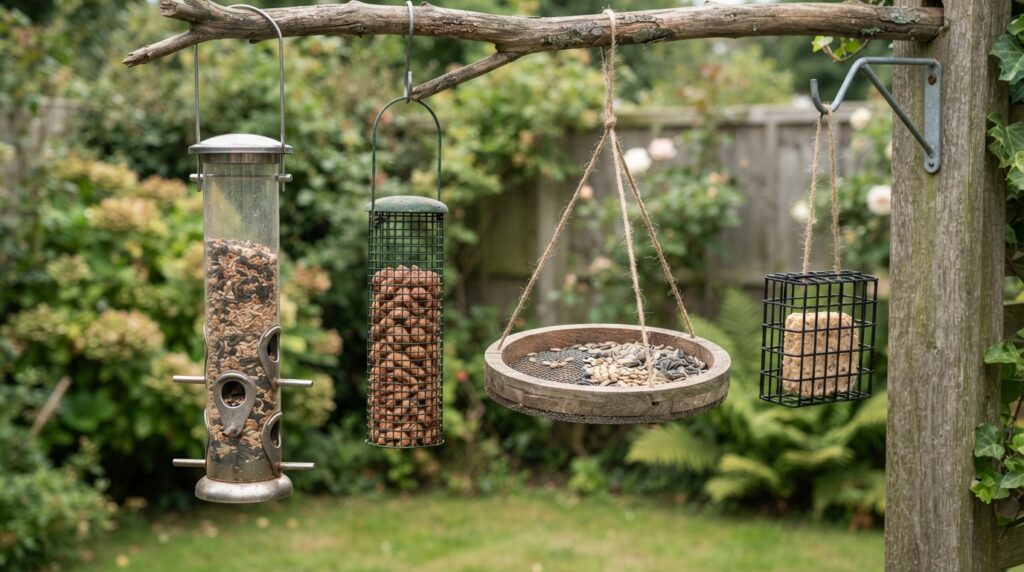
- Keep a hanging feeder stocked too — spillage feeds them anyway
- Clear beneath the feeder weekly — important for this species specifically
- Move the feeder position after each clean
- Keep hedges and shrubs for cover and nesting
- Avoid insecticides — chicks are fed on invertebrates
- Provide water, changed daily
They won’t use a nest box — chaffinches build a neat, lichen-camouflaged cup nest in a tree fork or dense shrub, so planting is the way to provide for them.
Common questions
What’s the brown bird under my feeder with white wing bars?
A female chaffinch. The two white wing bars are the reliable identifier and are present on both sexes.
Why won’t chaffinches use my hanging feeder?
They prefer feeding on the ground. Scatter a small amount of seed beneath it and they’ll take that instead.
Are chaffinches declining?
They’ve declined notably in recent years, with trichomonosis considered a significant factor. They remain one of the UK’s most numerous birds, but the trend is downwards.
Do chaffinches really have accents?
Yes. Song is learned rather than innate, and because chaffinches are largely sedentary, local variations accumulate into recognisable regional dialects.
Chaffinch or brambling?
Check the rump in flight. A clean white rump with an orange breast means brambling — a winter visitor. Greenish rump means chaffinch.
Related guides
- Small brown birds in your garden: how to tell them apart
- Greenfinch: the garden bird that disappeared
- Winter visitors: birds that only appear in UK gardens in winter
- Sick birds at your feeder: spotting trichomonosis and what to do
Sources: RSPB species information and conservation status listings; British Trust for Ornithology population trends and research on finch trichomonosis; Garden Wildlife Health; Woodland Trust.
Compare hanging bird feeders at Amazon UK. Prices and stock change often, so it is worth checking before you commit.
Browse bird feeders →