Affiliate disclosure: some links on this page go to Amazon. If you buy through one we may earn a small commission, at no extra cost to you. Full disclosure.
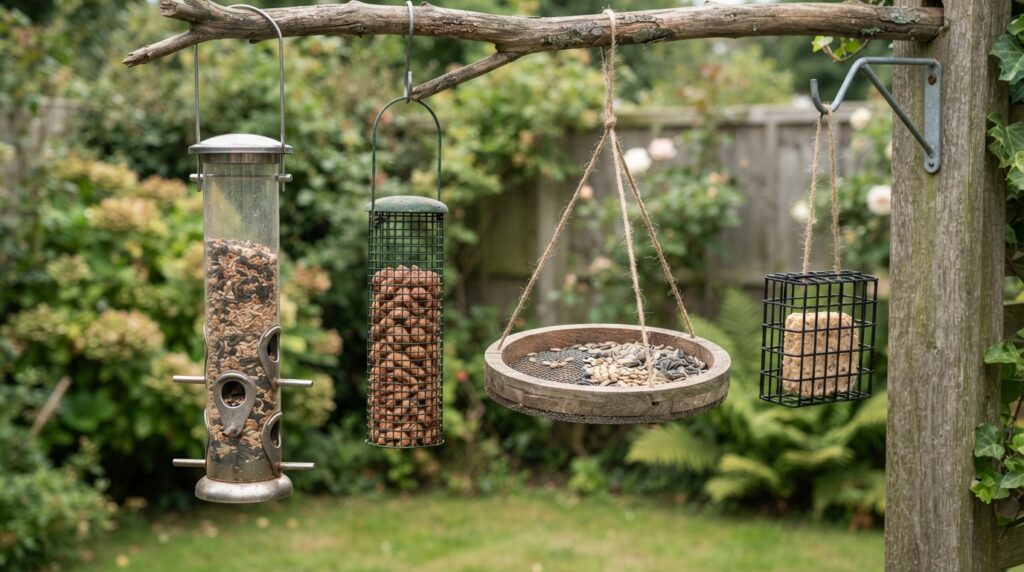
Wrens eat insects and spiders, not seed, so they’ll ignore your feeder almost entirely. What helps them is dense low cover, leaf litter left alone, and small amounts of suet crumbs or mealworms scattered at ground level near a hedge bottom.
The wren is generally reckoned to be Britain’s most numerous breeding bird — and most people have no idea it’s there.
It’s tiny, secretive, moves like a mouse through undergrowth, and rarely comes near a feeder. What usually gives it away is the noise: a song astonishingly loud for a bird weighing about the same as a pound coin.
Wren quick facts
- Size: 9–10cm, around 9 grams
- Key feature: short tail held cocked upright, almost vertical
- Eats: insects and spiders. Very little seed
- Feeder use: minimal — helps at ground level, not hanging feeders
- Nest box: open-fronted, low, hidden deep in vegetation
Identifying a wren
Size: genuinely tiny. Noticeably smaller than a blue tit, and much smaller than a sparrow.
Plumage: rich rufous-brown above, finely barred with darker brown across the wings and tail, buff-brown below with faint barring on the flanks, and a pale stripe over the eye.
The giveaway: the tail. A wren holds its short tail cocked upright, almost vertical. Nothing else in a British garden does this, and it’s visible even in a brief glimpse.
The bill is thin, fine and slightly downcurved — an insect-eater’s bill, not a seed-cracker’s.
Movement: low, fast, and mouse-like. Wrens work along the base of hedges and through log piles, disappearing into cover rather than flying across open ground.
Our brown bird guide covers how it compares to the other small brown birds.
The song
The thing most likely to alert you to a wren.
It’s a rapid, explosive trill — loud, urgent and seemingly impossible from a bird that small. Often delivered from inside a hedge, so you hear it long before you see the bird.
Wrens also have a distinctive scolding call: a hard, ticking “tek-tek-tek”, often given when a cat is about.
Why they ignore your feeder
This is the part that frustrates people.
Wrens are insectivores. They eat spiders, beetles, small flies, larvae and other invertebrates, foraging in leaf litter, log piles, ivy and the base of hedges. They’re not built to crack seed, and they can’t cling to a hanging feeder the way a tit can.
So a garden with an excellent seed feeder can be full of wrens that never touch it.
What does help
- Suet crumbs or grated suet scattered at ground level, near cover
- Dried mealworms, soaked first, in a small dish low down under a hedge
- Mild grated cheese — a traditional wren and robin food, and it works
- Fragments falling below a suet feeder, which wrens will pick up from the ground
Put out only small amounts, cleared by dusk, scattered in a different spot each time rather than on a fixed tray — flat surfaces where food accumulates are no longer recommended.
What actually helps most: habitat
For wrens, the garden matters far more than the feeder.
- Leave leaf litter under shrubs and hedges. This is where wrens forage, and raking it all up removes their food supply
- Build a log pile in a shady corner. Invertebrates colonise it, and wrens work through it
- Grow ivy on walls and fences — dense cover, insects, and nest sites in one
- Keep a dense hedge rather than a fence panel
- Don’t use insecticides — you’re removing the entire diet
- Leave a rough corner of long grass and brash
A tidy garden is a poor wren garden. Our plants guide covers what to grow.
The nests
Wren nesting behaviour is genuinely unusual and worth knowing about.
The male builds several domed nests — sometimes half a dozen or more — in different spots around his territory. These are often called “cock nests”. The female then inspects them and chooses one, which she lines with feathers before laying.
The nests are neat balls of moss, leaves and grass with a small side entrance, tucked into ivy, hedges, log piles, sheds, hanging baskets and gaps in walls.
Nest boxes: wrens will use an open-fronted box, but only if it’s low — usually under 2m — and genuinely well hidden in dense vegetation. An open-fronted box on a bare wall will be ignored, and would be a liability if used.
If you find a wren nest in a shed, hanging basket or outbuilding, leave it alone. It’s an offence under the Wildlife and Countryside Act 1981 to damage or destroy an active nest. They’re occupied for a matter of weeks.
Communal roosting
One of the more remarkable things a garden bird does.
Wrens are fiercely territorial for most of the year — but in cold weather they set that aside and roost communally, packing into a single cavity, nest box or crevice to share body heat.
Records exist of extraordinary numbers in a single box on the coldest nights. It’s an emergency strategy, and it works: a bird that small loses heat very fast alone.
The practical point: leave nest boxes up over winter. A box you might think of as a spring provision is a winter survival shelter for wrens.
Our guide on where garden birds sleep covers this in more detail.
Hard winters hit them hard
Being tiny and insectivorous is a bad combination in a freeze. Wrens can’t switch to seed the way a finch can, and their surface-area-to-weight ratio means they lose heat rapidly.
Severe winters cause substantial wren mortality, and populations can drop noticeably after a hard one. The compensation is that they breed prolifically and recover over a few mild years — which is why the species remains so numerous overall despite periodic crashes.
What helps in a freeze: keep the log pile and leaf litter, leave nest boxes up, scatter suet crumbs low down near cover, and don’t tidy the garden in November. Our freezing weather guide covers the wider picture.
Common questions
Why won’t wrens use my bird feeder?
They eat insects, not seed, and can’t cling to a hanging feeder. Suet crumbs and mealworms at ground level near cover are the way to feed them.
Is the wren really Britain’s most common bird?
By breeding territories, yes — it’s generally reckoned the most numerous. It doesn’t top garden survey rankings because it’s secretive and rarely visits feeders, so it’s under-recorded relative to how many there actually are.
What’s the tiny brown bird with its tail sticking up?
A wren. The vertical cocked tail is unique among British garden birds.
Why is there an empty nest in my shed?
Probably one of the male’s unused “cock nests”. He builds several and the female picks one, so most end up empty.
How long do wrens live?
Typically only a year or two, with very high first-winter mortality. They compensate with high breeding output rather than longevity.
Related guides
- Small brown birds in your garden: how to tell them apart
- Where do garden birds sleep at night?
- Best plants to attract birds to a UK garden
- How to help garden birds in freezing weather
Sources: RSPB species information; British Trust for Ornithology population estimates and research on wren roosting and winter mortality; Woodland Trust; Wildlife and Countryside Act 1981.
Compare feeder poles and baffles at Amazon UK. Prices and stock change often, so it is worth checking before you commit.
Browse feeder poles →