Affiliate disclosure: some links on this page go to Amazon. If you buy through one we may earn a small commission, at no extra cost to you. Full disclosure.
A great tit is bigger than a blue tit, has a black cap instead of blue, and — the feature that settles it — a bold black stripe running down the centre of its yellow breast. Sunflower hearts, peanuts and suet all work, and the nest box needs a 28mm hole.
The great tit is the largest of the UK’s tits and one of the most confident birds at a feeder. It’s also the one people most often mistake for a blue tit, which is fair enough — they’re similar shapes in similar colours.
One marking separates them permanently, and once you’ve noticed it you’ll never mix them up again.
Great tit quick facts
- Size: about 14cm — noticeably chunkier than a blue tit
- Key feature: broad black stripe down the yellow breast
- Best food: sunflower hearts, peanuts, suet
- Nest box: 28mm hole, 2–4m up, facing north to east
- Song: a ringing two-note “tea-cher, tea-cher”
Great tit or blue tit?
| Great Tit | Blue Tit | |
|---|---|---|
| Cap | Glossy black | Bright blue |
| Breast stripe | Broad, bold, unmistakable | Faint thin line, or none |
| Cheeks | Solid white patches | White with a dark line through the eye |
| Size | About 14cm, chunky | About 12cm, small and round |
| Back | Olive-green | Yellow-green |
| At the feeder | Dominant, displaces others | Gives way to great tits |
If you can only check one thing, check the breast stripe. A broad black band running from the throat down through the belly is a great tit. A faint line, or none at all, is a blue tit.
Male or female?
Both sexes have the stripe, but it’s a genuinely useful sex indicator: males have a broad stripe that widens between the legs, while females have a narrower, patchier one that often fades out towards the belly.
Unlike most garden birds, this is a difference you can actually judge at a feeder.
The song
Great tits have an unusually large vocabulary — enough that birdwatchers have a running joke that any unfamiliar sound in a British wood is probably a great tit.
The classic song is a ringing, repetitive two-note phrase, usually written as “tea-cher, tea-cher, tea-cher”. It’s one of the earliest songs of the year, often starting in January, and one of the easiest to learn.
They also produce a wide range of scolding, churring and buzzing calls, which is why the same bird can sound like several different species over the course of a morning.
What they eat
Insects and caterpillars through the breeding season, seeds and nuts in autumn and winter — the standard tit pattern.
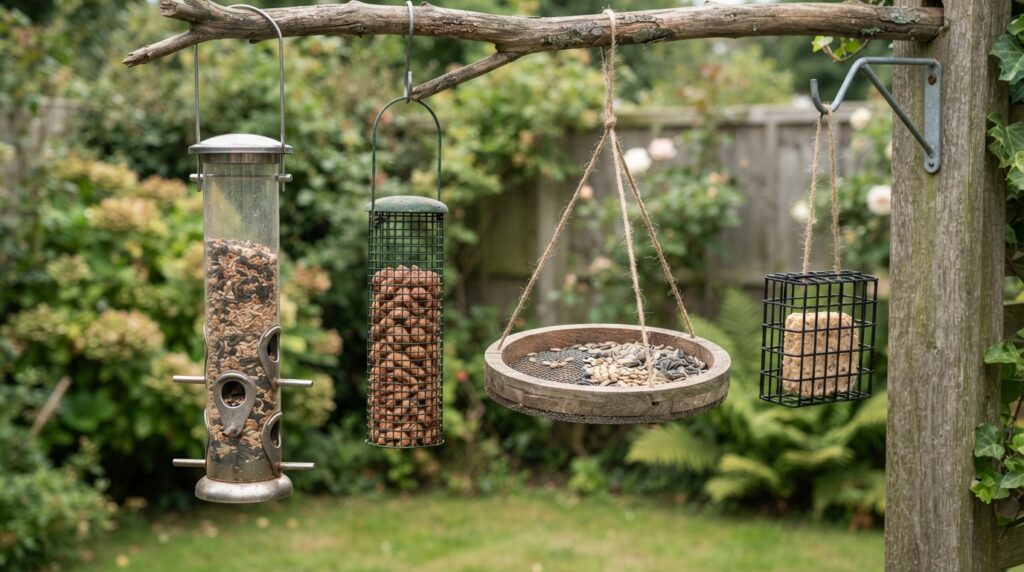
At the feeder:
- Sunflower hearts — the reliable choice, high in oil and easy for them to handle
- Peanuts in a mesh feeder — great tits are strong enough to work at them properly
- Suet and fat balls — high energy, and approved year-round when seeds and peanuts pause
Great tits have a heavier bill than blue tits and can crack tougher seeds. They’ll also take a seed away to a branch, hold it under one foot, and hammer it open — worth watching for.
Nest boxes: 28mm
The hole size determines who moves in, and 28mm is the great tit specification.
| Hole size | Suits |
|---|---|
| 25mm | Blue tit, coal tit, marsh tit |
| 28mm | Great tit, tree sparrow, pied flycatcher |
| 32mm | House sparrow, nuthatch |
A 25mm box excludes great tits, which is exactly why people who specifically want blue tits buy them. A 28mm box lets both in — and the great tit will usually win.
Siting: 2–4m up, facing between north and east, tilted very slightly forward, with a clear flight path and no branch immediately below that a cat could use. Put boxes up in autumn rather than spring. Our nest box guide covers it fully.
The caterpillar timing problem
Great tits, like blue tits, raise one large brood a year and time it to coincide with the peak abundance of caterpillars — a window lasting only a couple of weeks.
Everything depends on hitting it. Get it right and most chicks fledge; miss it because a warm spring shifted the caterpillars earlier than the birds anticipated, and a whole brood can fail. This mismatch is one of the more closely studied effects of changing climate on UK birds.
The practical consequence for a garden is simple: avoid insecticides. Caterpillars matter more to a nesting great tit than anything in your feeder.
Behaviour worth watching for
Dominance. Great tits sit near the top of the garden pecking order and will displace blue tits, coal tits and often anything else their size. If your feeder has a queue, they’re usually at the front of it.
Caching. They’ll take food and hide it, returning later. Coal tits do this far more, but great tits do it too.
Problem solving. Great tits are genuinely inventive birds and have been the subject of a lot of research into learning and social transmission — the classic example being tits learning to open milk bottle tops in the mid-20th century, a behaviour that spread across the country.
Roosting in boxes. They use nest boxes as winter roost sites, which is another argument for putting boxes up in autumn.
How to attract them
- Hang a tube feeder with sunflower hearts, about 2m from cover
- Add a mesh peanut feeder and a suet cage
- Put up a 28mm nest box by mid-February, ideally in autumn
- Provide water in a shallow dish, changed daily
- Stop using insecticides — caterpillars feed the chicks
- Plant native trees and shrubs if you have room — hawthorn, birch and oak all support caterpillars
- Clean feeders weekly and move them to a fresh spot
Common questions
Why do great tits chase other birds off the feeder?
They’re dominant among the tits and will displace smaller species. Running two or three feeders spaced apart gives everyone access — and spreading feeders out is now recommended anyway for hygiene reasons.
What’s the bird singing “tea-cher tea-cher” in January?
Almost certainly a great tit. It’s one of the earliest and most persistent singers of the year.
Can I tell males from females?
Usually yes, which is unusual for garden birds. Males have a broad black breast stripe that widens towards the belly; females have a narrower, patchier one.
Will great tits use a 25mm box?
No — they physically can’t get through. That’s the point of the smaller hole if you specifically want blue tits.
How long do great tits live?
Typically two to three years, with high mortality in the first winter. Birds that survive their first year can live considerably longer, though that’s the exception rather than the rule.
Related guides
- How to attract blue tits to your garden
- Common garden birds in the UK: how to identify your visitors
- When to put up a nest box (and exactly where to site it)
- Best bird food for winter: what to put out and what to skip
Sources: RSPB species information and nest box guidance; British Trust for Ornithology Nest Box Challenge and research on breeding timing; Woodland Trust.
Compare sunflower hearts and suet at Amazon UK. Prices and stock change often, so it is worth checking before you commit.
Browse bird food →