Affiliate disclosure: some links on this page go to Amazon. If you buy through one we may earn a small commission, at no extra cost to you. Full disclosure.
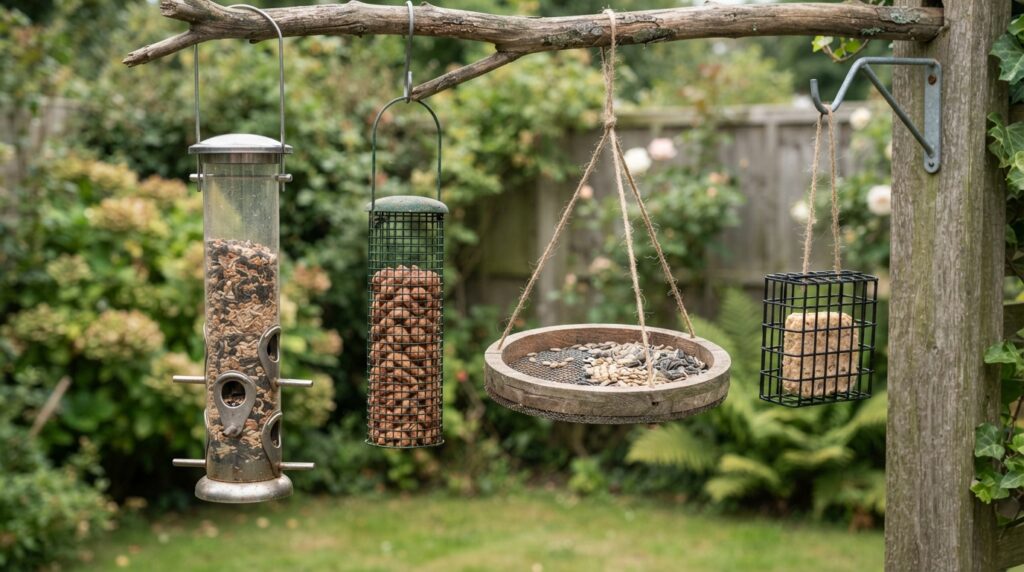
Blackbirds eat earthworms, insects, berries and windfall fruit. They’re ground feeders — which is why the feeder you hung up is being ignored by them, and why the answer to attracting blackbirds is almost never “buy a better feeder”.
If you want one thing to put out: mealworms, or a windfall apple cut in half and left on the lawn.
Blackbird quick facts
- Best foods: mealworms, windfall apples, suet pellets, raisins (soaked)
- Feeds: on the ground — poor at hanging feeders
- Male: glossy black, bright orange bill
- Female: brown, not black. Very commonly mistaken for another species
- Present: all year, with numbers boosted in winter by continental arrivals
Male, female and juvenile
This trips people up constantly, so it’s worth being clear.
Male: glossy jet black, with a bright orange-yellow bill and a matching ring around the eye. Unmistakable.
Female: brown — dark brown above, slightly paler and faintly mottled on the throat and breast. Bill is duller, often brownish with a hint of yellow. Many people assume a brown “blackbird” must be a thrush or a different species entirely.
Juvenile: warmer, more rufous brown than the female, with obvious pale speckling. Often mistaken for a song thrush — the difference is that a song thrush has bold, sparse, arrowhead-shaped spots on a clean cream breast, while a young blackbird is more uniformly mottled.
Young males moult into black plumage in their first autumn but often keep a dark bill until the following spring.
What blackbirds eat naturally
Spring and summer: earthworms above all, plus beetles, caterpillars, snails and other invertebrates. That characteristic run-stop-listen-run behaviour on a lawn is a blackbird locating worms.
Autumn and winter: a big shift to fruit and berries — hawthorn, holly, rowan, elder, ivy, cotoneaster and pyracantha, plus fallen apples and pears.
They’re less interested in seeds than most garden birds, which is why a seed feeder does very little for them.
What to put out
Mealworms
The most effective single food. High protein, close to their natural diet, and taken enthusiastically — particularly during the breeding season when adults are feeding chicks.
Dried mealworms soaked in water for twenty minutes before use are considerably more valuable than dry ones, especially in dry weather.
Windfall fruit
Genuinely one of the best things you can offer, and free if you have an apple tree. Halved apples and pears left on the lawn are taken readily, particularly in hard weather. Bruised and slightly past-it fruit is fine — better, in fact.
Soaked raisins and sultanas also work well. Soak them first; dry ones can be difficult to swallow.
If you have a dog, be careful with raisins and sultanas — they’re toxic to dogs even in small quantities. Either skip them or put them somewhere your dog can’t reach.
Suet pellets
High energy and taken well from the ground. Also useful because suet stays recommended year-round, while seeds and peanuts pause between 1 May and 31 October.
What not to give them
- Bread — bulk with almost no nutrition
- Whole peanuts — a choking risk, and not a natural food for them
- Anything salted or mouldy
- Milk or desiccated coconut
The ground-feeding problem
Blackbirds feed at ground level, which sits awkwardly against current guidance advising against flat-surfaced feeders and permanent ground feeding stations. Worth being straightforward about how to square that.
The concern is accumulation — a fixed tray or table where damp food and droppings build up in one place, which is how trichomonosis spreads. It isn’t a concern about ground-feeding birds eating at ground level, which is simply what blackbirds do.
The practical approach:
- Scatter small amounts directly on the ground, in a different spot each time
- Put out only what will be gone the same day
- Use a small shallow dish for mealworms, cleared and cleaned daily — not a permanent station
- Hang a suet feeder above a clear patch of ground; fallen fragments feed blackbirds below
- Rake up debris regularly
More on this in our seasonal feeding guide.
Blackbird song
Widely considered one of the finest songs of any British bird — rich, fluty, unhurried, delivered from a rooftop or high branch. Males sing from late winter through to July, most intensely at dawn and dusk.
They also have a very recognisable alarm call: a loud, agitated chattering rattle, usually meaning a cat or a bird of prey is about. Learn it and you’ll know when something’s happening in the garden before you see it.
Nesting
Blackbirds nest low — in hedges, dense shrubs, ivy, climbers, and frequently in awkward places like open sheds, garages and hanging baskets.
They’re early nesters, often starting in March, and typically raise two or three broods a season. The female builds a cup nest of grass and mud.
Hedge cutting: under the Wildlife and Countryside Act 1981 it’s an offence to intentionally damage or destroy an active nest. In practice this means not cutting hedges or dense shrubs between March and August without checking thoroughly first.
How to attract blackbirds
- Leave part of the lawn unfertilised and unsprayed — worms are the main draw
- Put out mealworms in a small dish at ground level
- Leave windfall apples on the ground in autumn and winter
- Plant berry shrubs — hawthorn, holly, rowan, elder, pyracantha, cotoneaster
- Leave some leaf litter under shrubs — blackbirds forage in it noisily
- Provide dense low cover for nesting
- Water in a shallow dish, changed daily — blackbirds bathe enthusiastically
- Avoid slug pellets — blackbirds eat snails and slugs, and can be poisoned indirectly
Common questions
Why is my blackbird brown?
It’s a female, or a juvenile. Only adult males are black with an orange bill.
Why won’t blackbirds use my hanging feeder?
They physically can’t cling to one well. Blackbirds are built for ground foraging. Put food on the ground instead.
Why is a blackbird throwing leaves around under my hedge?
Foraging. Flicking leaf litter aside to find invertebrates underneath is normal blackbird behaviour, and surprisingly loud.
Are there more blackbirds in winter?
Often, yes. UK blackbirds are joined in winter by birds arriving from Scandinavia and continental Europe, so garden numbers can rise noticeably.
I’ve seen a blackbird with white feathers. Is it ill?
Almost certainly not. Partial leucism — patches of white feathering — is relatively common in blackbirds and harmless. Such birds are often recognisable individuals in a garden for years.
Can I feed blackbirds in summer?
Yes. Mealworms, suet and fruit remain fine year-round; it’s seeds and peanuts that pause from 1 May to 31 October.
Related guides
- Common garden birds in the UK: how to identify your visitors
- Small brown birds in your garden: how to tell them apart
- Best plants to attract birds to a UK garden
- When to feed garden birds: the new UK guidance explained
Sources: RSPB species information and feeding guidance; British Trust for Ornithology; Woodland Trust; Wildlife and Countryside Act 1981.
Compare dried mealworms at Amazon UK. Prices and stock change often, so it is worth checking before you commit.
Browse mealworms →