Affiliate disclosure: some links on this page go to Amazon. If you buy through one we may earn a small commission, at no extra cost to you. Full disclosure.
Blue tits are the second most commonly recorded bird in UK gardens, and among the easiest to attract. Put out sunflower hearts in a hanging tube feeder and you’ll usually have them within a few weeks.
If you want them to nest as well as feed, there’s one number that matters more than anything else: a 25mm entrance hole. Get that wrong and you’ll get great tits or house sparrows instead.
Blue tit quick facts
- Best foods: sunflower hearts, peanuts, suet
- Feeder: hanging tube or mesh — they’re excellent clingers
- Nest box hole: 25mm, facing between north and east
- Size: about 12cm — smaller than a house sparrow
- Present: all year round
Identifying a blue tit
Look for: a blue cap, white cheeks with a dark line through the eye, a yellow-green back and a yellow breast. Blue wings and tail.
Most often confused with: the great tit, which is noticeably larger, has a black cap rather than blue, and a bold black stripe running down the centre of its yellow breast. If there’s a thick black line down the middle, it’s a great tit.
Coal tits are smaller and duller, with a white patch on the back of the neck and no blue or yellow to speak of.
Males and females look very similar. Males tend to have a slightly brighter blue cap, but it’s not something you can reliably judge in the garden.
What blue tits eat
Insects and caterpillars for most of the year — a pair feeding chicks can bring back hundreds of caterpillars a day. In autumn and winter they switch to seeds and nuts, which is when garden feeders genuinely matter.
The three that work best:
- Sunflower hearts — the single most reliable blue tit food. High in oil, easy to handle, no husk waste
- Peanuts — high fat and protein. Mesh feeder only, and aflatoxin-free from a proper bird food supplier
- Suet and fat balls — highest calorie option, and the one that stays recommended year-round when seeds and peanuts pause between 1 May and 31 October
The feeder they prefer
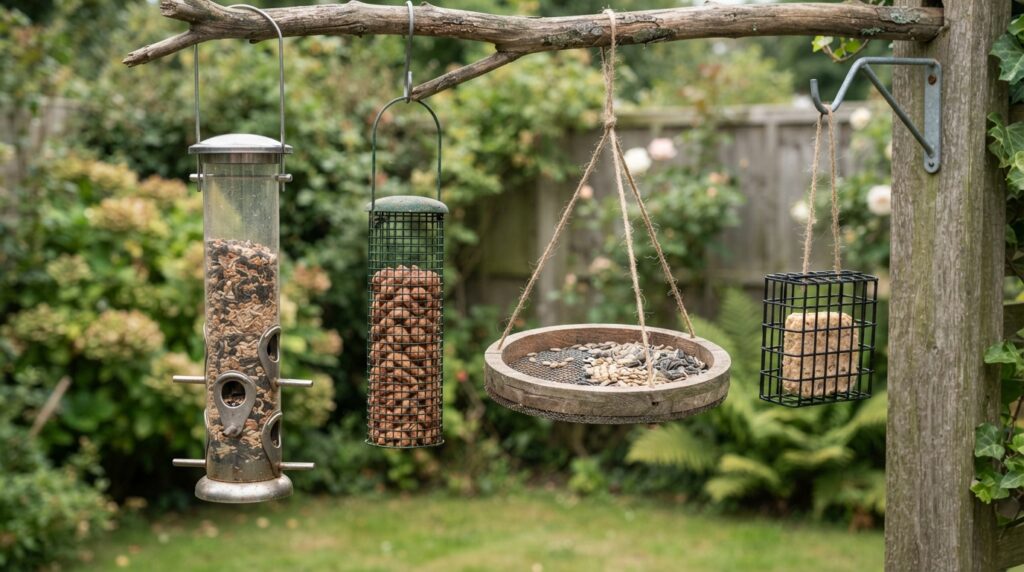
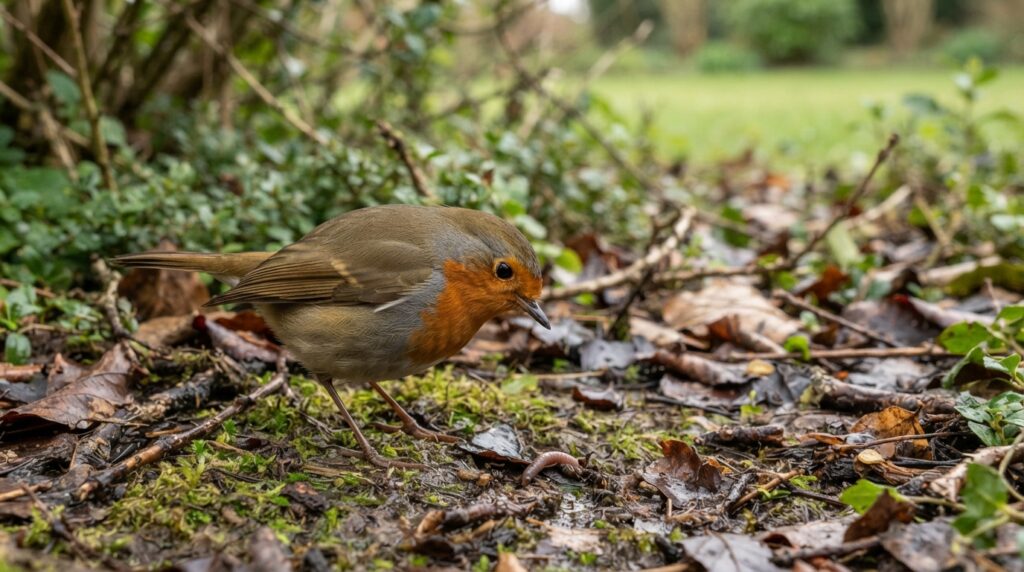
Blue tits are acrobatic. They cling upside down without apparent effort, which means hanging feeders suit them perfectly — unlike robins and blackbirds, which can’t manage them at all.
A hanging tube feeder filled with sunflower hearts is the standard setup. A mesh peanut feeder and a suet cage alongside it will cover everything they want.
Note their feeding style: a blue tit rarely sits and eats. It darts in, takes one seed, and flies off to a branch to deal with it before returning. So a feeder that looks quiet may actually be busy — they’re just quick.
Getting blue tits to nest: the 25mm rule
This is where most people go wrong, and it’s a genuinely easy fix.
Nest box entrance hole sizes determine which species can use the box:
| Hole size | Suits |
|---|---|
| 25mm | Blue tit, coal tit, marsh tit |
| 28mm | Great tit, tree sparrow, pied flycatcher |
| 32mm | House sparrow, nuthatch |
| Open front | Robin, wren, spotted flycatcher |
A 28mm or 32mm hole doesn’t exclude blue tits — but it does let in larger, more dominant species that will take the box first. If blue tits specifically are what you want, buy 25mm.
Where to put the box
- Height: 2 to 4 metres up
- Direction: facing somewhere between north and east. This avoids both the strongest midday sun and the wettest prevailing winds
- Tilt: angled very slightly forward so rain runs off the front rather than in
- Approach: a clear flight path in, with no branch immediately below that a cat could use
- Away from feeders — nesting birds don’t want a crowd outside the front door
When to put it up
Autumn or winter is ideal. Birds prospect for sites well before spring, and a box that’s been in place for a few months looks established rather than new. Aim to have boxes up by mid-February at the latest — National Nest Box Week runs from 14 February each year for exactly this reason.
Legal note: under the Wildlife and Countryside Act 1981 it is an offence to intentionally disturb nesting birds or damage an active nest. Don’t inspect, move or clean a box during the breeding season. Cleaning is done between September and January, and only old nesting material may be removed.
The caterpillar timing problem
Worth knowing, because it explains a lot about blue tit behaviour.
Blue tits time their breeding to coincide with the peak abundance of caterpillars on oak and other trees — a window that lasts only a couple of weeks. A pair will lay a large clutch, sometimes eight to twelve eggs, and gamble everything on hitting that window.
Get it right and most chicks fledge. Miss it — because a warm early spring shifted the caterpillars earlier than the birds anticipated — and a whole brood can fail. This mismatch is one of the more closely studied effects of changing climate on UK birds.
Practical consequence: avoid insecticides. If you want blue tits to breed successfully in your garden, the caterpillars matter more than the feeder.
How to attract them: the checklist
- Hang a tube feeder with sunflower hearts, about 2m from cover
- Add a suet cage — covers the summer months when seed pauses
- Put up a 25mm nest box, 2-4m up, facing north to east, by February
- Provide water in a shallow dish, changed daily
- Stop using insecticides — caterpillars are what feed the chicks
- Plant native trees and shrubs if you have room — hawthorn, birch and oak all support caterpillars
- Clean feeders weekly and move them to a new spot each time
- Be patient — a new feeder can take several weeks to be found
Common questions
Why do blue tits take one seed and fly away?
Normal behaviour. They carry each seed to a perch to open it, which is safer than sitting exposed on a feeder. It also means a busy feeder can look deceptively quiet.
Blue tits looked at my box but didn’t nest. Why?
Prospecting without committing is common, especially in the first year. Boxes are often investigated one season and used the next. Check the hole size, the direction it faces, and whether it’s too close to a busy feeder.
Can I look inside the nest box?
Not during the breeding season — it’s an offence to disturb nesting birds. Clean it out between September and January instead.
How long do blue tits live?
Typically only two to three years, with high mortality in the first winter. Individuals surviving that can live considerably longer.
Do blue tits use the nest box in winter?
Sometimes, as a roost site on cold nights. Another good reason to put boxes up in autumn rather than spring.
Related guides
- Common garden birds in the UK: how to identify your visitors
- Nest boxes: when to put one up and where
- Best bird food for winter: what to put out and what to skip
- Types of bird feeder: which one should you actually buy?
Sources: RSPB species information and nest box guidance; British Trust for Ornithology Nest Box Challenge; Wildlife and Countryside Act 1981.
Compare nest boxes at Amazon UK. Prices and stock change often, so it is worth checking before you commit.
Browse nest boxes →