Beakfeeder is reader-supported. If you buy through our Amazon links we may earn a small commission at no extra cost to you.
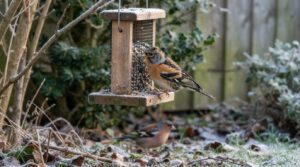
A brambling looks like a chaffinch but with warm orange on the breast and shoulders and a bright white rump that flashes in flight. They’re winter visitors from Scandinavia and northern Russia, arriving in the UK from October and often feeding on the ground under beech trees or on garden feeders in cold weather. Numbers vary hugely from winter to winter with the beechmast crop.
- Size: about 14 cm — chaffinch-sized.
- Male in winter: mottled dark and pale head, orange shoulders and breast.
- Female: paler, greyer, still with orange shoulders and white rump.
- In flight: bright white rump — the giveaway.
- Favourite food: beech mast in the wild; sunflower hearts in gardens.
How to identify a brambling
Bramblings and chaffinches are close cousins, and in a mixed winter flock they can be surprisingly easy to miss. Look for:
- An orange chest and shoulders — warmer and darker than a chaffinch’s pinkish flush.
- A white belly below the orange.
- A bright white rump visible when the bird flies away — chaffinches show green here.
- A scaly, mottled head on winter males (they gain a full black head in summer, mostly abroad).
- A pale yellow bill in winter (turning black in the breeding season).
Brambling vs chaffinch
| Brambling | Chaffinch (male) | |
|---|---|---|
| Chest colour | Warm orange | Pink-red |
| Head | Mottled dark/pale (winter) | Blue-grey cap and nape |
| Belly | White | Pink-red |
| Rump in flight | Bright white | Green |
| When | October–April | All year |
| Call | Nasal “eeep” | “Pink pink” |
Quickest field mark: the rump. If a chaffinch-like bird flies away and its lower back is a flash of white, it’s a brambling.
Where and when to see them
Bramblings breed in the birch and conifer forests of Scandinavia and Siberia. They arrive in the UK from October and are usually gone again by April. Numbers depend on the beechmast crop — the small triangular seeds inside beech nuts. In a good beech year on the continent, most bramblings stay; in a bad year, huge numbers come to Britain, and a single wintering flock can occasionally number in the tens of thousands.
In gardens they usually turn up when natural food is short — a cold snap, snow, or a poor beechmast year — and often as one or two birds mixed in with chaffinches on the ground under the feeder.
Feeding bramblings in the garden
Bramblings feed mostly on the ground. They’ll take:
- Sunflower hearts — the most reliable garden draw.
- Kibbled peanuts and small pieces of suet.
- Millet and small mixed seed scattered on the ground under cover.
A ground tray tucked near a hedge, with sunflower hearts and a little chopped peanut, is a brambling magnet in winter.
Feeding season: under the RSPB’s 2026 guidance, seed and peanuts are paused from 1 May to 31 October, which fits bramblings — they’re rarely here outside November to March. Keep feeders and any ground tray very clean; finches as a group are prone to trichomonosis.
Behaviour
Bramblings are sociable, often travelling with chaffinches and, at woodland roosts, in mixed flocks of many hundreds. They’re generally quieter and shyer than chaffinches at a feeder, so if a chaffinch-looking bird waits its turn nervously at the back, take a closer look — it might be your first brambling.
Common questions
Are bramblings rare in the UK?
They’re common winter visitors, but garden sightings are usually of one or two birds at a time. Big flocks are more often seen at woodland roosts than at feeders.
Do bramblings breed in the UK?
Only a handful of pairs, in Scottish birch woods, in most years. Nearly every bird you see is a winter visitor.
Why does my brambling look different in April?
Males moult towards their summer plumage before leaving — the mottled winter head starts to darken into a solid black. Most have gone by May.
Can bramblings catch trichomonosis?
Yes — like all finches. Clean feeders weekly and move them around; stop feeding for a couple of weeks if you see sick, fluffed-up birds.
Related guides
- Chaffinch identification and behaviour
- Winter visitors to UK gardens
- Sick birds at the feeder
- UK bird migration in winter
Sources: BTO BirdFacts; RSPB species profile for brambling; BTO Garden BirdWatch.
Compare current prices on bird food and feeders at Amazon UK. Prices and stock change often, so it is worth checking before you commit.
Browse bird food →