Beakfeeder is reader-supported. If you buy through our Amazon links we may earn a small commission at no extra cost to you.
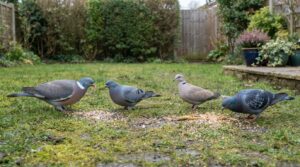
Check the neck. A woodpigeon is big and plump with a white patch on the side of the neck and white wing bars in flight. A stock dove is smaller and bluer, with no white at all and a shiny green neck patch. A collared dove is slim, pale sandy-grey, with a thin black half-collar. A feral pigeon varies wildly in colour but usually has two black bars across each wing and often a white rump.
- Woodpigeon: ~41 cm, white neck patch, white wing bands.
- Stock dove: ~33 cm, no white, green neck sheen, dark eye.
- Collared dove: ~32 cm, pale buff-grey, black half-collar.
- Feral pigeon: ~33 cm, variable, two black wing bars.
- Pigeon vs dove: no scientific difference — just size by habit.
The comparison table
| Woodpigeon | Stock dove | Collared dove | Feral pigeon | |
|---|---|---|---|---|
| Size | Largest, bulky | Medium, compact | Slim, long-tailed | Medium |
| Colour | Blue-grey, pinkish breast | Darker blue-grey | Pale sandy-grey | Anything from white to black |
| Neck | White patch plus green-purple sheen | Green sheen, no white | Thin black half-collar | Green-purple sheen |
| Wings in flight | Broad white band | Black edges, pale grey panel, two short black bars | Dark tips, pale inner wing | Two long black bars |
| Eye | Pale yellow | Dark | Red-dark | Orange-red |
| Call | “Coo-COO-coo, coo-coo” | Deep, grunting “oo-woo” | “Coo-COOO-coo”, repetitive | Burbling coo |
Woodpigeon
The UK’s commonest and biggest pigeon, and the one most likely to be clearing seed off your ground tray. Look for the white neck patch (absent on young birds) and the broad white band across the wing when it flies. Its take-off is loud, with a clattering of wings, and in spring males display by climbing steeply, clapping their wings, and gliding down.
Stock dove
Easily overlooked as “just a pigeon”. Stock doves are smaller and neater than woodpigeons, with no white anywhere, a dark eye, and an iridescent green patch on the neck. They nest in holes — old trees, barn owl boxes, even large nest boxes — and often feed in pairs. Britain holds a large share of the European population, which makes it a species worth noticing in your garden.
Collared dove
A relative newcomer. Collared doves spread across Europe from the Balkans in the twentieth century and first bred in Britain in the 1950s. They’re now in almost every town and village. Pale, slim and gentle-looking, with that thin black collar. They nest in trees and on buildings and can breed in almost any month.
Feral pigeon
Descended from domesticated rock doves, feral pigeons are the town and city pigeon. Colours range from classic blue-grey with two black wing bars, to chequered, brown, white or patchy. Racing pigeons, with a ring on the leg, sometimes turn up exhausted in gardens — the Royal Pigeon Racing Association can help trace the owner.
Pigeon or dove? There’s no real difference. “Dove” tends to be used for smaller species and “pigeon” for bigger ones, but they’re all in the same family.
Too many pigeons at the feeder?
All four can eat a lot of seed. To give smaller birds a chance:
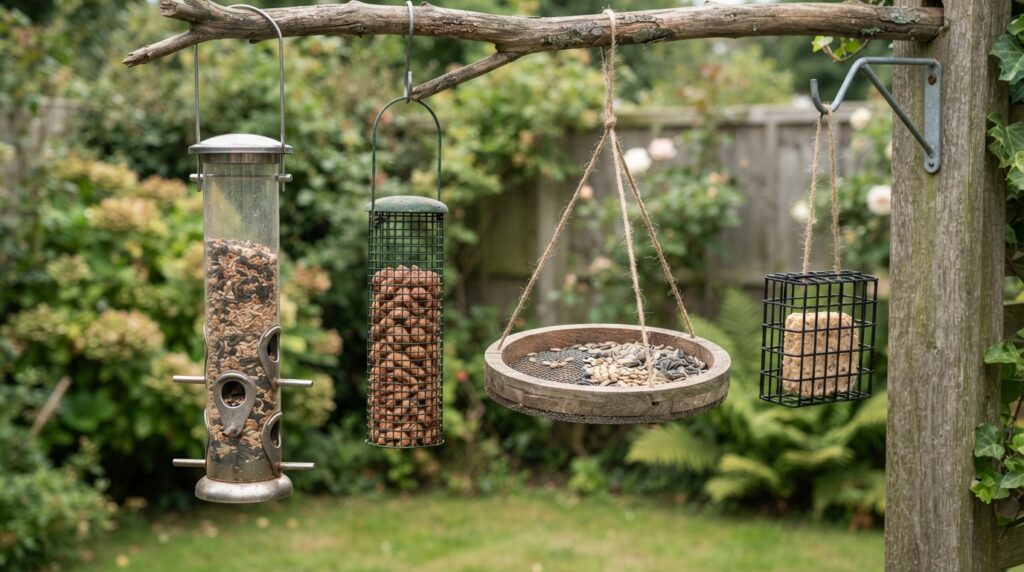
- Use hanging feeders rather than ground trays.
- Put a guardian cage (with gaps too small for pigeons) around a ground tray or feeder.
- Avoid cheap mixes full of wheat and maize, which pigeons love.
- Clear spilled seed regularly.
Pigeons and doves can carry trichomonosis, which also affects finches. Clean feeders weekly, move them regularly and don’t use flat-surface feeders — current RSPB advice.
Common questions
Why don’t I ever see baby pigeons?
Young pigeons stay in the nest until almost adult-sized, so by the time you see them they look like adults. Young woodpigeons lack the white neck patch.
Are pigeons protected?
All wild birds, their nests and eggs are protected under the Wildlife and Countryside Act 1981. Some control is allowed only under specific licences.
What pigeon has a white ring round its neck?
A woodpigeon — though it’s a patch on each side rather than a full ring. A thin black collar means a collared dove.
What’s the grey pigeon with no white on it?
Most likely a stock dove, or a young woodpigeon that hasn’t developed its neck patch yet.
Related guides
- Too many pigeons in the garden?
- How to stop pigeons and starlings taking over the feeder
- Common UK garden birds
- Sick birds at the feeder
Sources: BTO BirdFacts; RSPB species profiles for woodpigeon, stock dove, collared dove and feral pigeon; RSPB garden bird feeding guidance (April 2026 update); Wildlife and Countryside Act 1981.
Compare caged feeders that exclude larger birds at Amazon UK. Prices and stock change often, so it is worth checking before you commit.
Browse caged feeders →