Affiliate disclosure: some links on this page go to Amazon. If you buy through one we may earn a small commission, at no extra cost to you. Full disclosure.
A song thrush has a cream breast covered in bold dark arrowhead spots arranged in rows. They feed on the ground, eat snails, and are Red Listed after a severe decline. The single most useful thing you can do for them is stop using slug pellets and leave windfall fruit out in winter.
The song thrush was once as familiar as the blackbird. It’s now on the Red List of conservation concern, having declined sharply since the 1970s.
It’s also the only British garden bird that uses a tool — sort of — and the evidence is usually lying in plain sight if you know what to look for.
Song thrush quick facts
- Size: about 23cm — slimmer than a blackbird
- Key feature: bold arrowhead spots in rows on a cream breast
- Status: UK Red List
- Eats: worms, snails, insects, windfall fruit
- Biggest help: no slug pellets, and leave leaf litter
Identifying a song thrush
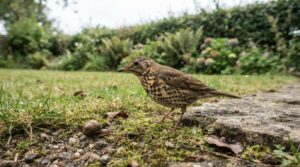
Look for: warm golden-brown upperparts, and a cream or buff breast marked with bold dark brown spots shaped like arrowheads, pointing upwards and arranged in neat rows. A warm buff wash across the upper breast and flanks. Pale pink legs, dark-tipped yellowish bill.
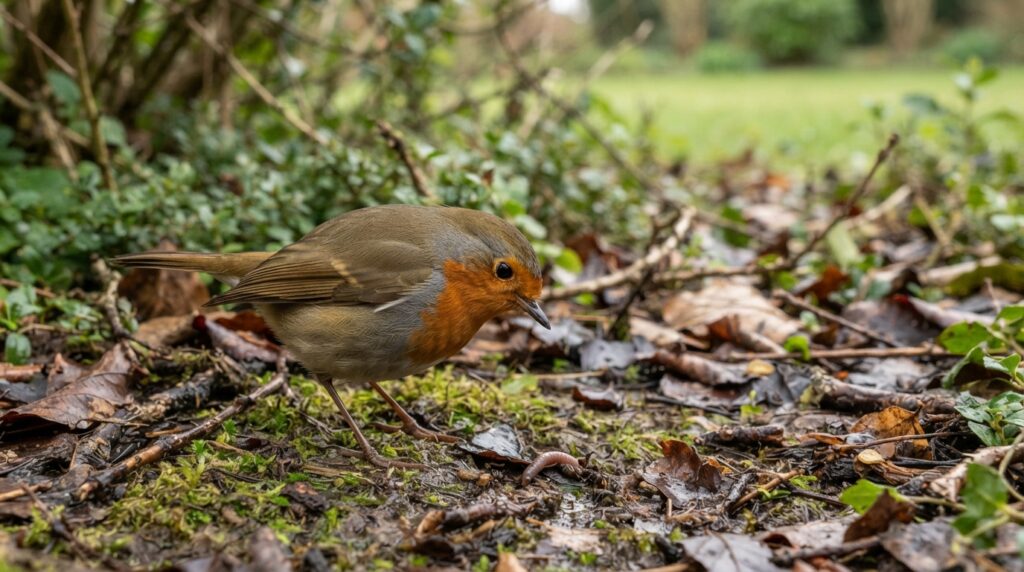
Posture: upright and alert, often with the head tilted as though listening — which it is, for worms.
Song thrush or mistle thrush?
| Song Thrush | Mistle Thrush | |
|---|---|---|
| Size | 23cm, neat | 27cm, noticeably bigger and bulkier |
| Spots | Neat arrowheads in rows | Larger, rounder, scattered untidily |
| Upperparts | Warm golden-brown | Colder grey-brown |
| Underwing | Warm buff | White, obvious in flight |
| Manner | Neat, unobtrusive | Bold, upright, aggressive |
Song thrush or female blackbird?
A common confusion. A female blackbird is uniformly dark brown with only faint, indistinct mottling on the throat. A song thrush has a clean cream breast with bold, clearly defined spots. Once you’ve seen both, they’re not similar.
Our brown bird guide covers this properly.
The snail anvils
The behaviour song thrushes are famous for, and it’s genuinely uncommon among British birds.
A song thrush that finds a snail will carry it to a favoured stone, paving slab or exposed tree root — an anvil — grip it by the lip of the shell, and smash it repeatedly against the surface until the shell breaks.
Individual birds use the same anvil repeatedly, and you’ll often find a ring of broken shell fragments around a particular stone. If you have one in your garden, you have a resident song thrush.
This matters ecologically: song thrushes are one of the few birds that eat snails in quantity, which makes them a genuine ally in a garden.
Why they declined — and the one thing to stop doing
UK song thrush numbers fell severely from the 1970s, and the species moved onto the Red List. Causes are thought to include agricultural intensification, loss of hedgerows, drier summers making soil harder to probe for worms, and reduced invertebrate abundance.
Slug pellets are the garden factor most directly within your control.
A bird that specialises in eating snails and slugs is exactly the animal harmed by a product designed to kill them. Metaldehyde slug pellets were banned from sale and use in Great Britain in 2022, but older stock still turns up in sheds — if you have any, dispose of it through your council’s hazardous waste service rather than using it.
Ferric phosphate pellets are the permitted alternative and are considered lower risk to wildlife, but the better approach for thrushes is simply not to remove their food supply.
Alternatives that don’t harm thrushes: beer traps, copper tape on pots, encouraging hedgehogs and frogs, and accepting some damage. A garden with snails is a garden that can support song thrushes.
What to feed them
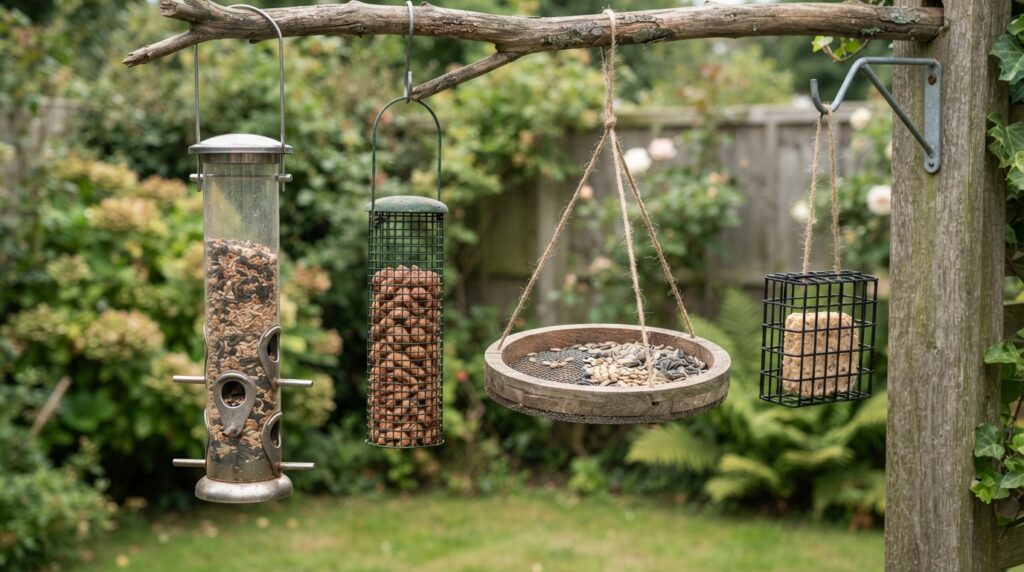
Song thrushes are ground feeders and won’t use hanging feeders.
- Windfall apples and pears, halved and left on the ground — the most effective thing, especially in autumn and winter
- Dried mealworms, soaked, in a shallow dish at ground level
- Sultanas and raisins, soaked — though skip these entirely if you have a dog, as dried vine fruit is toxic to dogs
- Suet pellets scattered on the ground
Scatter small amounts in a different spot each time, cleared by dusk. Flat feeding trays are no longer recommended, and leftovers attract rats.
The song
One of the finest and most recognisable songs in Britain, and unusually easy to identify by structure rather than sound.
A song thrush repeats each phrase two or three times before moving to the next one. Nothing else does this so consistently. Once you’ve noticed the repetition you’ll pick them out immediately.
Clear, loud, bell-like, and delivered from a prominent perch. They sing from late winter through to summer, and often at dusk.
How to help them
- Stop using slug pellets — the single most important step
- Leave leaf litter under shrubs, where they forage for invertebrates
- Put out windfall fruit in autumn and winter
- Keep a dense hedge — they nest in thick shrubs and hedgerows
- Leave a damp, shaded area — worms are easier to find in moist soil
- Provide water in a shallow dish, changed daily
- Don’t over-tidy — bare, swept gardens offer nothing
- Leave a few stones or paving slabs exposed for anvils
They won’t use a nest box. Song thrushes build a mud-lined cup nest in dense shrubs, so planting is the way to provide for them. Our plants guide covers what works.
Don’t cut hedges between March and August. Song thrushes nest low in dense cover and often raise two or three broods, so the season runs long. Damaging an active nest is an offence under the Wildlife and Countryside Act 1981.
Common questions
What are the broken snail shells around a stone?
A song thrush anvil. Individual birds return to the same stone repeatedly to smash snails, leaving a ring of fragments.
Song thrush or mistle thrush?
Mistle thrushes are noticeably bigger, greyer, with larger scattered spots and white underwings in flight. Song thrushes are warmer brown with neat arrowhead spots in rows.
Why don’t song thrushes use my feeder?
They’re ground feeders and can’t cling to hanging feeders. Windfall fruit and soaked mealworms at ground level are what work.
Are slug pellets really the problem?
They’re the factor most directly under your control. Metaldehyde was banned in Great Britain in 2022, but the wider point stands — a bird that eats snails needs snails to be present.
How do I recognise the song?
By the repetition. Each phrase is repeated two or three times before the bird moves on — a structure no other British garden bird uses so consistently.
Related guides
- What do blackbirds eat? How to feed and attract them
- Small brown birds in your garden: how to tell them apart
- Winter visitors: birds that only appear in UK gardens in winter
- Best plants to attract birds to a UK garden
Sources: RSPB species information and conservation status listings; British Trust for Ornithology population trends; Health and Safety Executive guidance on metaldehyde withdrawal in Great Britain (2022); Royal Horticultural Society; Wildlife and Countryside Act 1981.
Compare current prices on bird food and feeders at Amazon UK. Prices and stock change often, so it is worth checking before you commit.
Browse bird food →