Affiliate disclosure: some links on this page go to Amazon. If you buy through one we may earn a small commission, at no extra cost to you. Full disclosure.
A coal tit has a white patch on the back of its neck — the single feature that separates it from marsh and willow tits. It’s the smallest UK tit, and it grabs a seed and flies off within a second because it’s caching food, not eating it there. Sunflower hearts and a 25mm nest box.
If something tiny keeps darting onto your feeder, taking one seed and vanishing before you’ve focused on it, that’s a coal tit.
They’re easy to overlook because they never linger — but the behaviour that makes them hard to watch is also the most interesting thing about them.
Coal tit quick facts
- Size: about 11.5cm — the smallest UK tit
- Key feature: white patch on the nape
- Behaviour: takes one seed and leaves immediately
- Best food: sunflower hearts, peanut granules, suet
- Nest box: 25mm hole, sited low and well hidden
Identifying a coal tit
Look for: a black cap and black bib, bold white cheeks, buff-grey underparts, olive-grey back, and two thin white wing bars.
The giveaway is the white nape patch — a clear white oval on the back of the neck, between the black cap and the back. Nothing else in a British garden has it.
Smaller and slimmer than a blue tit, with a proportionally larger head and a finer bill.
Coal tit, marsh tit or willow tit?
The three black-capped tits, and the source of a lot of confusion.
| Coal Tit | Marsh Tit | Willow Tit | |
|---|---|---|---|
| Nape | White patch | No white patch | No white patch |
| Cap | Glossy black | Glossy black | Duller, sooty black |
| Wings | Two thin white bars | Plain | Pale wing panel |
| Bib | Small, neat | Small, neat | Larger, more diffuse |
| Gardens | Common | Occasional | Rare — Red Listed |
If you can see a white nape patch, it’s a coal tit. Marsh and willow tits are genuinely difficult to separate even for experienced birdwatchers — call is often the only reliable way — but neither has that patch.
Willow tits have declined severely and are now one of the UK’s most threatened resident birds, so a confirmed garden record is worth reporting.
Why it takes one seed and leaves
The behaviour people find frustrating, and it’s not shyness.
Coal tits are enthusiastic cachers. They take a seed, fly off, and hide it — in bark crevices, moss, under leaves, in conifer needles — then return for another. A single bird may make dozens of trips in an hour, storing food to retrieve over the following days and weeks.
They have genuinely impressive spatial memory to relocate those caches later.
The practical upshot: a busy coal tit is emptying your feeder much faster than it’s eating. They’re also lower in the pecking order than blue and great tits, so caching lets them grab food quickly and deal with it somewhere safer.
What to feed them
- Sunflower hearts — the reliable choice, and small enough to carry easily
- Peanut granules — easier for them than whole nuts in mesh
- Suet pellets — high energy, approved year-round
- Nyjer — occasionally taken
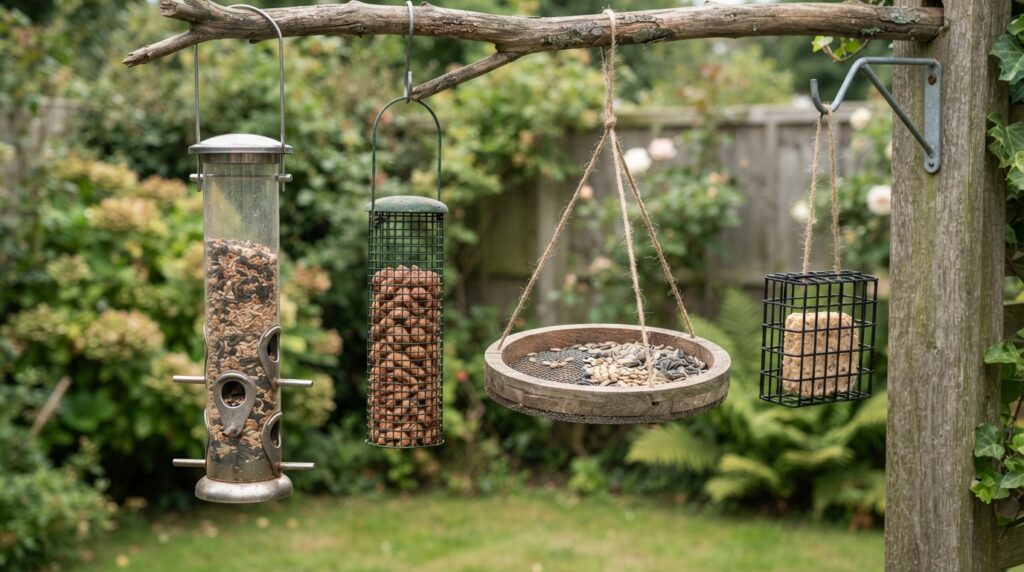
Running more than one feeder helps them considerably. Coal tits get displaced by larger tits, so a second feeder a few metres away gives them a chance — and spreading feeders out is recommended anyway for hygiene reasons.
Habitat and nest boxes
Coal tits are associated with conifers — their fine bill is well suited to extracting seeds from between needles. Gardens with pines, spruce, yew or leylandii nearby do noticeably better.
They’ll happily use gardens without conifers too, particularly in winter.
Nest box: a 25mm hole, the same as for blue tits. But coal tits naturally nest low — often in tree stumps, wall crevices, or even holes in the ground — so a box sited low down, around 1–2m, and well hidden in dense vegetation suits them better than one high on a trunk.
Put boxes up in autumn. Our nest box guide covers siting properly.
The song
A clear, rhythmic, repeated two-note phrase — often described as a higher, faster, sweeter version of the great tit’s “tea-cher, tea-cher”.
If you hear something that sounds like a great tit but noticeably quicker and thinner, it’s usually a coal tit. They start singing early in the year, from January onwards.
How to attract them
- Offer sunflower hearts in a tube feeder
- Run a second feeder a few metres from the first, so they aren’t always displaced
- Add suet pellets, useful year-round
- Keep conifers if you have them — even a single yew or pine helps
- Put up a 25mm box low and well hidden
- Leave leaf litter and mossy areas, which they use for caching
- Provide water, changed daily
Common questions
Why does it never stay on the feeder?
It’s caching, not feeding. Coal tits take one seed at a time and hide it elsewhere, returning repeatedly. Perfectly normal.
Is my coal tit emptying the feeder?
Quite possibly. A caching bird moves far more seed than it eats, and a pair working steadily gets through a surprising amount.
Coal tit or marsh tit?
Check the back of the neck. A white nape patch means coal tit. Marsh and willow tits have none.
Do I need conifers to get them?
No, but they help. Coal tits are strongly associated with conifers and are more likely where some are nearby — though they visit gardens without them, especially in winter.
Are coal tits declining?
No. Coal tits are widespread and their numbers have been relatively stable. It’s the willow tit, superficially similar, that has declined severely and is Red Listed.
Related guides
- How to attract blue tits to your garden
- Great tit: how to identify and attract them
- When to put up a nest box (and exactly where to site it)
- Common garden birds in the UK: how to identify your visitors
Sources: RSPB species information and conservation status listings; British Trust for Ornithology population trends and nest box guidance; Woodland Trust.
Compare hanging bird feeders at Amazon UK. Prices and stock change often, so it is worth checking before you commit.
Browse bird feeders →